Chronicle Editor
Vincent Gono, Features Editor
THE recognition of indigenous knowledge systems (IKS) has been consolidated through recent steps to recognise, regularise and document traditional medicine with both the Government and other private players exhibiting at this year’s Zimbabwe International Trade Fair (ZITF).
Prior to this development, traditional medicine was pushed to the periphery by conventional drugs despite the fact that large numbers of African families (both rural and urban) use traditional medicine for their health care, much so because it is accessible, affordable, culturally appropriate and acceptable.
Despite its increasing acceptance in Zimbabwe’s rural and urban communities where a number of families have managed to successfully manage and different ailments, this rich indigenous knowledge has not been adequately documented but the Government is committed to making the recognition of traditional medicine a policy issue.
The Government has walked its talk and demonstrated sincerity by opening a traditional medicine clinic at Parirenyatwa Group of Hospitals in Harare.
Higher and Tertiary Education, Science and Technology Development Minister Professor Amon Murwira said there was need to deliberately direct science towards the improvement of IKS in Zimbabwe.
“When a country focuses on its unique resources and develops them to meet the needs of the modern world, it can solve most of its problems,” he said.
“Our education and science will now be pursuant of ideas that have always been part of us. We all know there are herbs that can cure stomach aches, headaches and other diseases. Why can we not improve them then make them part of the mainstream health system?” he queried.
Dr Faith Sibanda, an African Indigenous Knowledge Systems (AIKS) lecturer at Great Zimbabwe University said it was encouraging that the Government has turned a corner and lifted the blanket of suspicion and secrecy that had been shrouding important indigenous knowledge systems.
He said the recognition of traditional medicine bared some aspects of knowledge that were suffering onslaught from imperialism.
An official of the Traditional Medicine Practitioners’ Council said at ZITF that the Government had made bold steps to revitalise traditional medicine which was facing demise due to lack of recognition.
The official said they were working on creating a platform for integration without segregation where Government would craft a policy that allows a patient to take traditional medicine while in hospital. Currently the policy disallows that.
“The biggest challenge is to get those in the practice to say what they know. There is a lot of secrecy and suspicion around the subject. We have managers and chief executive officers who are traditional healers but they do not want to be known, they do not want to come out in the open with what they know despite the encouragement for them to do so.
“The claim is that some have elders who come through them and they claim to have no permission from them to disclose what they know. So, in as much as we want to document the knowledge that desire may as well remain a pipedream,” said the official.
“There are diseases that traditional medicine can cure but there has been no holistic guidance from the Government to make traditional medicine an alternative to conventional medicine. I believe more needs to be done in that area and the potential is there,” said the official adding that Government should provide financial support to promote the potential role of traditional medicine in primary health care.
Documentation of plants used as traditional medicines is therefore needed so that the knowledge can be preserved and the utilised plants conserved and used sustainably.
The feeling in Government is that although the use of traditional herbs and medicine remains a personal option, there is a need for heightened effort in conscientising the communities that traditional medicine is not demonic as otherwise portrayed by some churches.
Herbalist and director of Musimboti Traditional Science and Technology Institute Mr Morgan Zimunya who was also exhibiting at the ZITF said it was a display of ignorance for anyone to claim that herbs and traditional medicine do not work when populations in countries like India and China that were relied upon in medicine were using traditional medicine.
He says in Zimbabwe research has shown that more than 80 percent of pregnant mothers have their primary health care techniques rooted in the use of traditional medicine and urged harmonisation of the practice for the good of the country’s health sector.
He said traditional medicine was holistic and culturally accepted adding that the bulk of African families rely on it for primary health care, especially in pre and post-natal health care.
“Traditional medicine as part of African indigenous knowledge systems has been in use since time immemorial.
To this day 80 percent of pregnant mothers in Zimbabwe rely on it one way or the other. In any community traditional medicine forms the first line of health care as it is used at the first stages of illness.
“So, to me as to any African, the question as to the effectiveness of traditional medicine is not only unAfrican but absurd because that is what exactly has been relied on before the advent of conventional medicine,” said Mr Zimunya.
He added that some of his herbs were sought after even by Western countries that were initially in the forefront of discrediting traditional medicine.
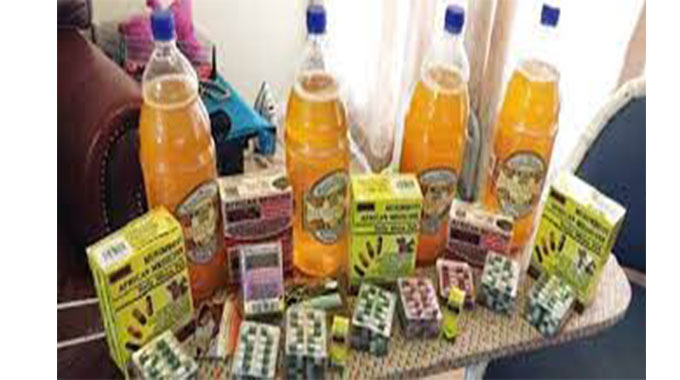
“Traditional medicine practitioners and herbalists are readily available and explain illness in terms that are familiar because they are part of the local belief systems. The practitioner and the patient are culturally bound, and the practitioner has a personal interest and stake in the patient, who may be a relative, a relative of a friend or a neighbour who they may want to come back or to refer other people as well.
Health problems are based on the notion that each cultural group handles its medical problems in a particular way, with its own world-view, traditions, values and institutions. Traditional medicine is an important part of culture,” he said.
Mr Zimunya applauded the Government for its efforts in ensuring the practice was registered and regulated.
He said traditional medicine could treat sexually transmitted infections (STIs), genital warts, snake bites and many other diseases.
The challenge in documentation, he said, was that African traditional medical practitioners acquire their skills through observation and a long and tedious apprenticeship involving intervention of ethno-socio-curricula activities that are not backed by science.
“We appreciate that traditional medical practices and their underlying beliefs are repositories of empirical observations and insights accumulated over long periods of practical experience. This wealth of information must be harmonised and documented through newer experiences and knowledge, as more sophisticated analytical methods and technologies become available.
“With appropriate appreciation of the empirically-identified maladies of the folklore, many of the ancient herbal cures have provided leads and have found rigorous scientific basis in the form of some modern medicines such as aspirin,” he said.
He added that even before the introduction of modern medicine in Africa, ailments and diseases were treated by herbal doctors who administered medicine from their natural environment.


 Online Reporter