

 Online Reporter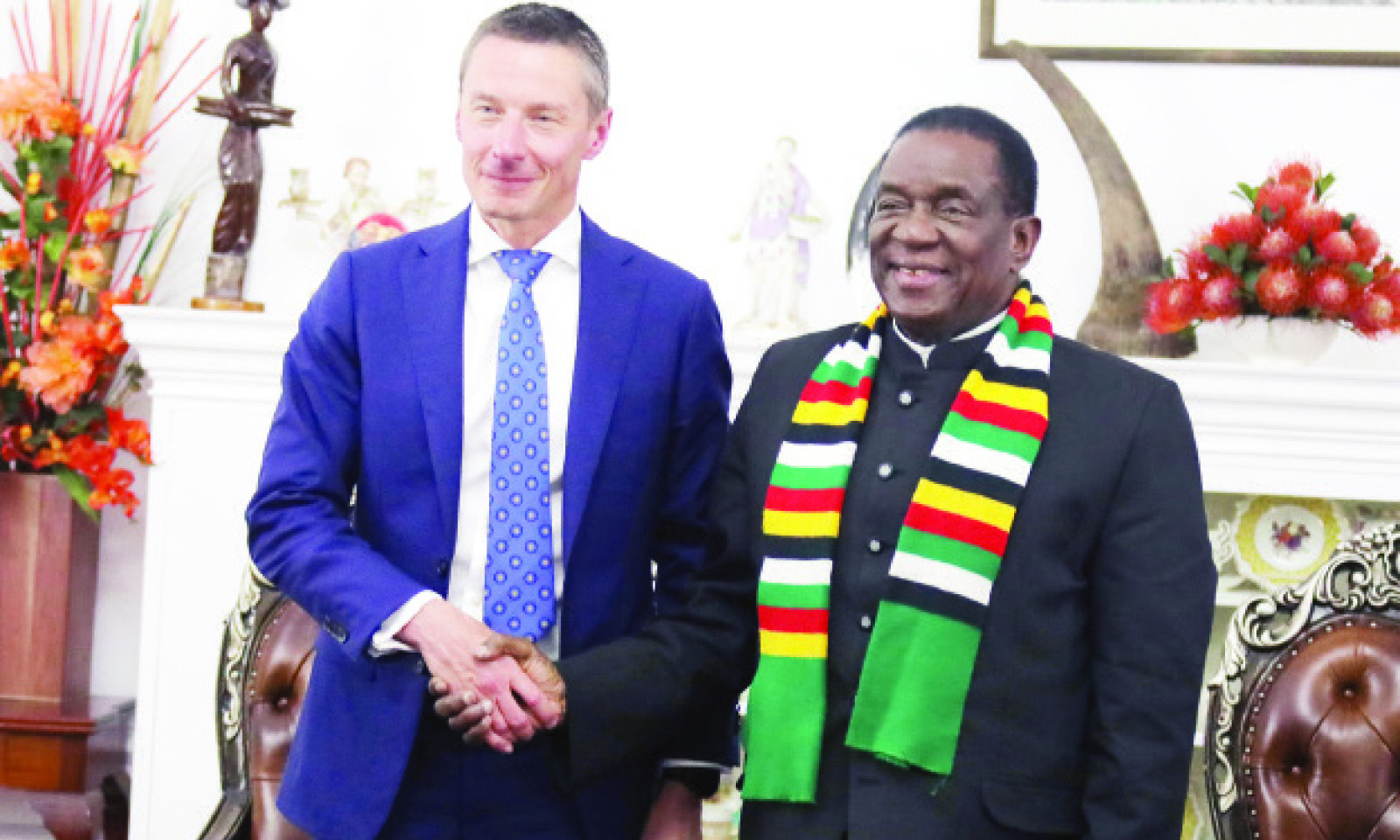
Nelson Gahadza
ZIMBABWE has made good progress in entrenching policies and measures that have enhanced economic and domestic currency stability, International Monetary Fund (IMF) mission chief Mr Wojciech Maliszewski said yesterday.
He made the remarks after paying a courtesy call on President Mnangagwa at State House in Harare.
Mr Maliszewski told journalists after the meeting the President that they were in Zimbabwe to discuss the Staff Monitored Programme (SMP) and hold consultations on Article IV Mission, which runs from June 4 to 18.
“We are here to discuss a Staff Monitored Programme, but also participate in discussions on Article 4 consultations,” he said.
“For the Staff Monitored Programme discussions, we are making good progress in terms of agreeing on policies that would be put in place to enhance stability of the domestic currency, deepen the forex market and also make sure that the fiscal discipline is fully entrenched.
“So, these were the main topics that we have been discussing; that also include fiscal discipline and the forex market operations.”
An SMP is an informal arrangement whereby IMF staff collaborate with national authorities to monitor and support the implementation of agreed economic reforms.
While it does not include direct financial assistance, successfully completing an SMP helps a country build a credible track record of sound fiscal and monetary policies — essential for re-engaging with international lenders and resolving outstanding debt arrears.
Article IV consultations are a routine and comprehensive assessment conducted by the IMF to evaluate a member country’s economic and financial health.
These engagements provide a platform for dialogue between the fund and the host government on economic policies, fiscal frameworks and structural reforms.
Mr Maliszewski said in terms of Article IV discussions, the IMF is also looking at the broader prospects for Zimbabwe’s economic development.
“We have been discussing various structural reforms that would help make sure that the development that we are seeing so far is entrenched and enhanced through the structural reforms.
“Again, the main two reforms that we are discussing were in the area of fiscal and the forex market, and for us, making sure that the fiscal discipline is in place and also strengthened through some changes in what we call the public financial management system is critically important.
“This will give the people of Zimbabwe reassurance that the macroeconomic stability that we are seeing right now will stay there for good,” said Mr Maliszewski.
The SMP’s main objective is to build a credible track record of sound economic policies that will pave the way for Zimbabwe’s re-engagement with international creditors and eventual debt resolution and arrears clearance.
Mr Maliszewski said the ZiG is presently stable and they would like to see it fully become a national currency in the sense that it is not only stable, but also widely used.
“For this, there are several measures that need to be in place, but first and foremost, we would like to see a deeper forex market that would make sure that there is a full price discovery in the market.
“Right now, we see good stability in the official market, and we also see a convergence between the parallel
market rate and the official rate, but ideally and ultimately, we would like to see an elimination of this gap,” he said.
He added that there should be one exchange rate, and it does not necessarily mean that the exchange rate needs to depreciate or fall in value to achieve the convergence.
“What it means is that the two rates need to converge, and with the good economic policies, there is a good chance that these rates will converge. This is what the Staff Monitored Programme is about: to make sure that we have these reforms that will underpin the fiscal stability, and this will in turn underpin the stability of the exchange rate,” said Mr Maliszewski.
Finance, Economic Development and Investment Promotion Minister Professor Mthuli Ncube, who accompanied the IMF team, said the Government was pleased to welcome the mission.
He confirmed that the IMF team is in Zimbabwe for the Article 4 consultations on the state of the economy.
“We are also gearing up to present the Mid-Term Budget Review as well as the Budget Strategy Paper for next year and think about our macroeconomic framework as we move towards National Development Strategy 2 (NDS2) and Vision 2030.
“Then the second issue is to talk about the SMP, which is a critical step in our arrears clearance roadmap.
“Again, we have been discussing how to make sure that we maintain the fiscal discipline that we initiated in the past and to make sure that it continues,” he said.
Prof Ncube said the Government is looking at areas where there are risks and will be able to deal with them or think about how they should be mitigated.
“On fiscal discipline, we want to make sure that we stay within our means in terms of expenditure. Then on the monetary front, again, making sure that the issues around forex; the parallel market that may then emerge and increase the gap between the official rate and unofficial rate, is what we need to deal with,” he said.
Maintaining good policies is one way of making sure that the gap is dealt with, added Prof Ncube.
He added that the ZiG has come a long way and it is “basically very stable”.
Prof Ncube said the general macroeconomic stability has been commendable, especially looking at the month-on-month inflation that has come down quite markedly.
“We have to continue with that stability, which will be able to keep inflation in check but also give a much more certain environment for companies to operate in.
“I have been visiting a few companies around the country, and it is quite clear that the stability is welcome to allow the companies to plan and allow them to invest.
“Some of them have even increased production lines and capacity utilisation just because of a more predictable environment. And the question is how do we make sure that this continues and the exchange rate also reflects the market sentiment, the confidence, and builds confidence around it?” he said
Clearing arrears will open up the floodgates for additional cheaper global capital for Zimbabwe to finance its growth, going forward.
Zimbabwe is actively pursuing a comprehensive Zimbabwe Arrears Clearance and Debt Resolution process championed by the African Development Bank (AfDB), while former Mozambique President Joaquim Chissano is the high-level facilitator.
The total public debt is estimated at US$21 billion, with external debt being US$12,3 billion while domestic debt is US$8,7 billion.



“For the Staff Monitored Programme discussions, we are making good progress in terms of agreeing on policies that would be put in place to enhance stability of the domestic currency, deepen the forex market and also make sure that the fiscal discipline is fully entrenched” In short we are NOT THERE. LET US BE REALIST AND DO THE RIGHT THINGS