admin
admin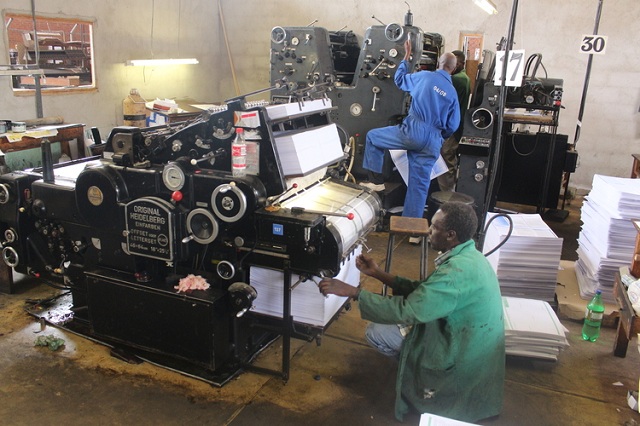

Oliver Kazunga, Senior Business Reporter
A STORM is brewing over the indigenisation and economic empowerment issues between Apex Holdings and its former workers at the group’s division in Bulawayo.
The engineering group, which is undergoing liquidation, was placed under judicial management in 2013.
The former employees claim that Pacprint Bulawayo branch’s assets were donated to them by the holding firm in 2010 following viability challenges.
The donation saw 65 of Pacprint former workers registering the entity under a new name, Revive Commercial Printers Ownership Trust.
With 54 workers, the firm provides printing services such as producing calendars, scholastic material, hymn books and pamphlet materials for organisations that include local and foreign companies and churches.
RCP managing director Eliah Zvimba, who joined the organisation in 2013, said workers were in trouble after discovering that the deed of donation from Apex was silent on the movable and immovable properties.
He feared workers would lose immovable property on stand Number 6221 in Donnington, which houses their factory and administration block.
Zvimba said the workers approached the Deeds Office, which revealed the property they were using, covering 3,0332 hectares in Donnington, was still registered in Pacprint’s name.
“When Pacprint was ceded to the workers in 2010, the idea was because they couldn’t afford to keep the business afloat. Management then came up with three options; to cede the company to the workers, retrench or look for investors.
“They then opted to cede the company to the workers. By ceding the company to the workers, they were supposed to handover the company’s asset register as well as finding lawyers to interpret what ceding means to the workers, something which they didn’t do,” he explained to Business Chronicle.
“They were also supposed to handover the Apex Pension Fund and the company’s bank account. However, the bank account was handed to the workers after a protracted struggle with the workers.
“As Apex is liquidated, we’re now talking to the liquidator (Grant Thornton Chartered Accountants), which is telling us that there’s nothing of ours.”
Zvimba said the workers have requested for sectional title deeds of the complex (factory building and administration block) from which they are operating in order to continue doing business as they were not part of the liquidation process.
“How can we be part of the liquidation process when we were weaned off in 2010?” he queried.
The property in question, Zvimba said, was bonded to the now defunct Interfin Bank at a cost of $1,6 million while the former workers were owed $3,4 million in gratuities and six-month outstanding salaries.
He also accused Apex management of looting the workers’ pension monies.
“As things stand, we’ve also discovered that the workers’ money in the Apex Pension Fund, which was administered by Old Mutual, has been looted and that pension account was under judicial management without the knowledge of RCP workers. We also vow that we aren’t vacating the premises unless and until justice is done,” said Zvimba.
He said due to the stalemate between themselves and Apex, they could not find an investor for funding because the assets that they are using are not registered under their business’ name.
“We also strongly believe that Apex deliberately rushed to claim that they had donated the company’s assets (movable and immovable) to disguise themselves from the Indigenisation and Economic Empowerment Act as the Act was topical in 2010,” he said.
“They also took advantage of the fact that most of workers at RCP by then had reached retirement age and were illiterate to understand the Deed of Donation presented to them.”
Apex Holdings managing director Bryan Hoffmann refused to comment on the matter.
“Sorry, I can’t comment on the issue,” he said before hanging up his phone.
The group ceased operations after selling off Marondera foundry and Philpot and Collins in 2011 while McMeekan foundry and Precision Grinders were sold in 2012.
The foundries and engineering group disposed of its non-performing business units among them Phoenix Consolidated Industries, to clear the contingent liabilities of $10 million.


 Online Reporter