Chronicle Editor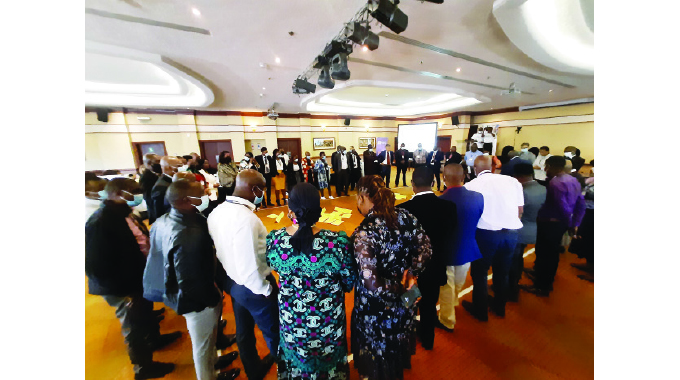
Leonard Ncube, Victoria Falls Reporter
THERE is need to speedily formalise the informal economy which employs over 80 percent of the working population in Africa, Zimbabwe included, for the sector to meaningfully contribute to national development.
In virtual welcome remarks at the Policy Dialogue on Informal Economy in Africa meeting that started in Victoria Falls yesterday, Public Service, Labour and Social Welfare Permanent Secretary Mr Simon Masanga said Zimbabwe is exploring ways to transition from informal to formality, and had completed a consultation process to come up with a strategy to enable the transition.
The hybrid policy dialogue meeting was organised by the African Union, in conjunction with Government, International Labour Organisation (ILO) and United Nations Development Programme (UNDP).
It comes as about 70 percent of Zimbabwe’s economy is reportedly now informal and employing more than 80 percent of the working population.
Mr Masanga said the informal sector in Africa is characterised by a number of challenges such as the absence of social protection, low incomes, long working hours, unsafe working environment and also lack of voice and legal protection for those in it.
“It is indeed a fact that the formal economy employs over 80 percent of the working population in Africa, and this is a sign that the informal sector cannot be ignored because it contributes so much for the development of our economies.
“The Government of Zimbabwe is cognisant of the importance of the contribution of the informal economy despite the decent work deficits which I understand are also common in most countries.
Realising the importance of this sector, the Government of Zimbabwe instructed that there be a strategy to formalise the sector and with the able support of dialogue, we did an inclusive consultative process involving all sectors in the informal sector,” he said.
Mr Masanga said very soon the validation process will be done to come up with a strategy to enable the transition to formal arrangement.
Mr Masanga said there is need for concerted efforts to address challenges and come up with resilient formal arrangement in the management of the informal sector.
He said the meeting provides a platform to discuss the increasing importance of informal economy in Africa as well as understanding gaps in the current approaches to address the needs of the sector.
Mr Masanga said policy dialogue will result in solution driven policy interventions that will culminate in detailed and informed plan to realise full potential of the informal sector.
AU Commission head of labour employment Mr Sabelo Mbokazi said there is need to create sufficient numbers of quality jobs to absorb the labour force.
“The Covid-19 response and recovery process provides us with a chance to work on existing inequities to ensure that no one is left behind. The African Union is cognisant of the fact that economic recovery alone will not suffice where the drivers of informality are not sufficiently addressed,” he said.
“In Africa, this entails unrelenting pursuit of the relevant targets of the AU Agenda 2063 and its Social Agenda and UN Agenda 2030. We all have a responsibility to play.”
ILO Regional Director for Africa, Ms Cynthia Samuel-Olonjuwon said about nine out of 10 young workers in Africa aged between 15-24 are informally employed across all sectors of the economy, where they entered not by choice but because of a lack of opportunities in the formal economy.
She said the informal economy is a major challenge for the rights of workers and working conditions, for the extension of social protection coverage and for the rule of law.
“And we need to recognise the importance of safeguarding the opportunities of workers and economic units for income security in the transition to the formal economy, by providing them with real and sustainable alternative for income generation out of informality,” she said.
UNDP senior economist for Zimbabwe Mr Ojijo Odhiambo said the informal economy can drive innovation, resilience and lead to resource-efficient production and responsible consumption.
He said there is a global call to action for a human-centred recovery from the Covid-19 crisis, to prioritise and mainstream strategies to address the informal economy and insecure forms of work.
Employers’ Confederation of Zimbabwe executive director Mrs Nester Mukwehwa said formalising the informal sector will widen revenue flows through payment of taxes. — @ncubeleon


 Online Reporter