Online Reporter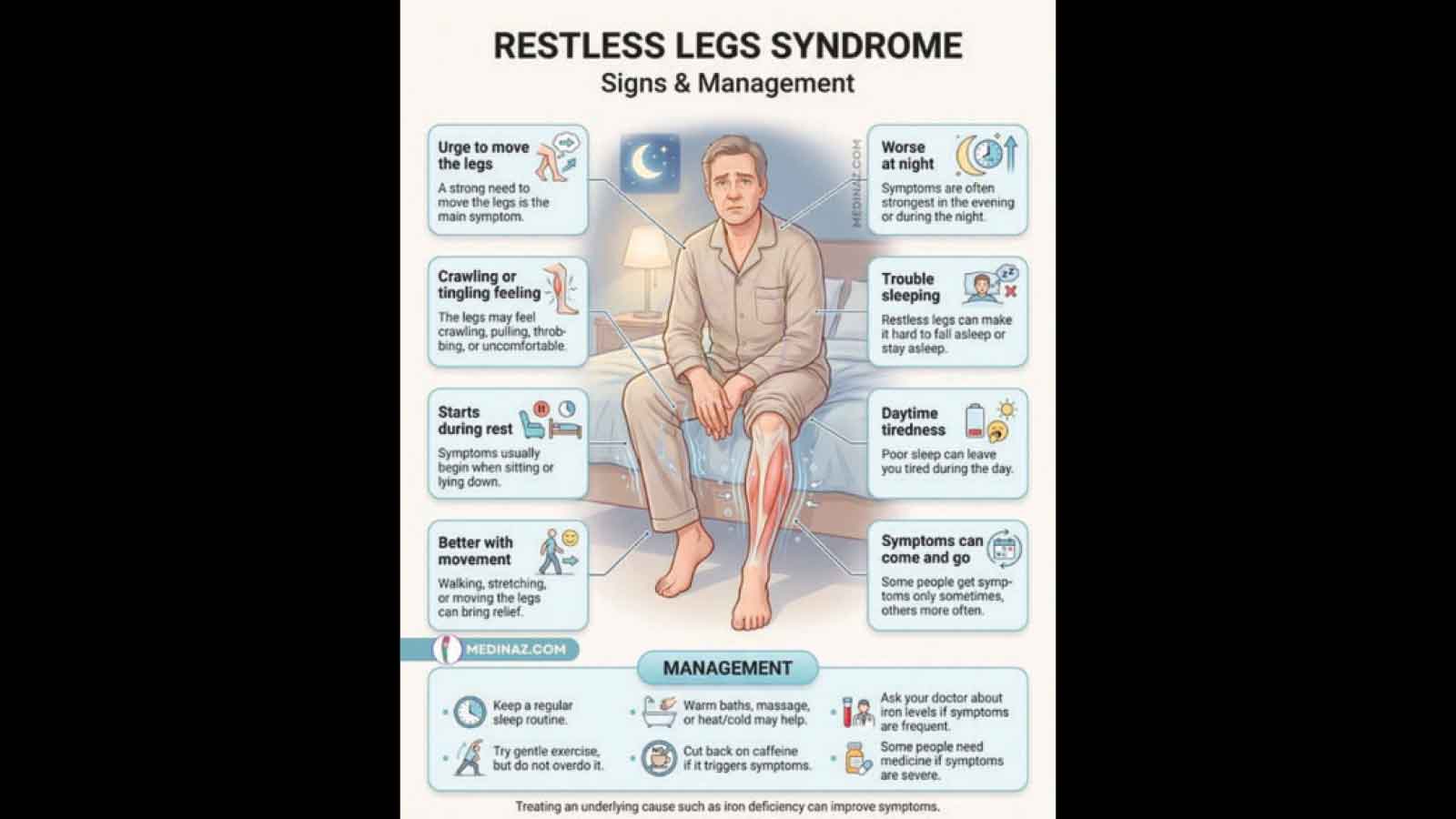
Rumbidzayi Zinyuke-Health Buzz
HAVE you ever sat beside someone who just cannot sit still? Perhaps they are constantly shifting in their chair, stretching their legs, tapping their feet or getting up to walk around when everyone else is comfortably seated.
It is easy to assume they are impatient, anxious, distracted or simply have too much energy. But for some people, the constant movement is not a choice.
It may be a sign of restless legs syndrome (RLS), a neurological condition that creates an almost irresistible urge to move the legs, particularly when a person is resting or trying to sleep.
For those affected, what may appear to others as ordinary fidgeting can be deeply uncomfortable and disruptive.
The condition, also known as Willis-Ekbom disease, is characterised by unpleasant sensations in the legs, often described as crawling, creeping, pulling, itching, aching or throbbing. The sensations usually become worse during periods of inactivity, especially in the evening or at night, and movement provides temporary relief.
This means that something as ordinary as sitting through a long meeting, travelling on a bus or watching television can become difficult.
Night-time can be even more challenging.
A person may lie down hoping to sleep, only to find that their legs seem to demand movement. They may get out of bed, walk around or move their legs repeatedly before returning to bed, only for the sensations to return once they become still again.
Over time, this cycle can take a toll on sleep.
The National Institute of Neurological Disorders and Stroke says people with RLS can experience difficulty falling asleep and staying asleep, with resulting exhaustion, daytime sleepiness, problems concentrating, memory difficulties, mood changes, anxiety and depression.
Despite being relatively poorly recognised, RLS is not rare globally.
A 2024 systematic review and modelling analysis published in the Journal of Global Health estimated that about 7.12 percent of adults aged 20 to 79 were affected by RLS in 2019 — equivalent to approximately 356 million people worldwide.
The analysis, which drew on 52 studies covering 23 countries, estimated prevalence at 7.60 percent in Europe and 6.48 percent in Africa. Interestingly, because of population size, the researchers estimated that about 90 percent of cases occurred in low- and middle-socio-demographic-index countries.
Another systematic review and meta-analysis, involving nearly 483 000 participants from 33 countries, produced a lower pooled estimate of about 3 percent.
The difference highlights one of the difficulties in measuring RLS: estimates vary considerably depending on the diagnostic criteria and study methods used.
In other words, the exact number of people affected remains uncertain, but there is little doubt that millions live with the condition.
What about Zimbabwe?
This is where the picture becomes less clear.
There is no widely cited, nationally representative study establishing the prevalence of RLS in Zimbabwe. That absence should not necessarily be interpreted as meaning the condition is uncommon.
Research from other parts of Africa has produced widely varying estimates.
A community-based study in Tanzania, for example, screened more than 35 000 people in an urban population in Dar es Salaam. While 164 people initially screened positive, detailed assessment resulted in only four confirmed cases, giving a prevalence estimate of 0.037 percent. An earlier rural Tanzanian study had also reported an extremely low prevalence.
But the picture changes when looking at people with particular health problems.
A study involving patients with chronic pain at Maputo Central Hospital in Mozambique found RLS in 8 of 118 patients, or 6.77 percent. Most of those diagnosed had neuropathic pain.
These African studies are important, but they also demonstrate why Zimbabwe needs its own research rather than simply importing estimates from other populations.
The researchers behind the Tanzanian study noted that diagnostic criteria developed largely from Western populations may not always perform in the same way in African populations, while genetic, environmental, demographic and social factors could also contribute to differences.
Why does it happen?
For many people, the precise cause remains unknown.
However, researchers have linked RLS to several biological and medical factors, including disturbances involving iron in the brain and the brain’s dopamine system. The condition can also run in families, suggesting a genetic component.
Certain medical conditions are also associated with RLS.
These include iron deficiency, kidney failure, nerve damage and some sleep disorders. Pregnancy, particularly during the final trimester, can also trigger symptoms, with symptoms often improving after delivery. Parkinson’s disease has also been associated with an increased risk.
Some medicines and substances can worsen symptoms, meaning that a person’s medical history and current medication are important when assessing unexplained restlessness in the legs.
This is particularly important because not every person who moves their legs frequently has RLS.
Other conditions can produce similar symptoms, making proper assessment necessary.
The biggest danger of dismissing RLS as simple restlessness is that its effects can extend far beyond the legs.
Persistent disruption of sleep can affect school, work, family life and overall wellbeing. Someone who repeatedly loses sleep because of uncomfortable sensations may struggle to concentrate during the day, feel exhausted or experience changes in mood.
For someone working long hours, driving, studying or caring for a family, that accumulated sleep disruption can become a significant burden.
RLS can also occur alongside other conditions, including diabetes and peripheral neuropathy. A global meta-analysis found associations between RLS and diabetes, depression, smoking and increasing age.
There is therefore a strong case for greater awareness among both the public and healthcare workers.
One of the most important clues is the pattern: an urge to move the legs that begins or becomes worse during rest, particularly in the evening or at night, and improves temporarily with movement.
There is no single laboratory test that confirms RLS. Healthcare workers generally make the diagnosis from the person’s symptoms, medical history and examination, while blood tests can help identify conditions such as iron deficiency or kidney problems that may be contributing to the symptoms.
Treatment depends on the individual and whether another condition is contributing to the symptoms.
The key message, however, is simple: persistent night-time leg discomfort and an irresistible need to move should not automatically be dismissed as bad sleeping habits, nervousness or “just being restless”.
For the person experiencing it, the struggle is real.
And sometimes, the first step towards better sleep and better quality of life is simply recognising that those restless legs may be telling them something.
Feedback: [email protected]