Chronicle Editor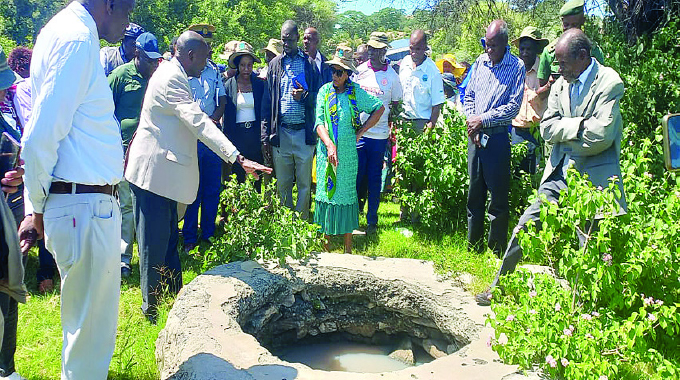
Sukulwenkosi Dube-Matutu, [email protected]
The community of Masiyephambili area in Insiza district has lauded the Government for the efforts being made to protect and preserve wetlands which can be a reliable source of water in the face of climate change.
Mpompini Wetland in Masiyephambili, which was once a source of livelihood for villagers, has been gradually running out of water following human and animal interference.

The Environmental Management Agency (EMA) has since taken a bold step to revive the wetland as part of an effort to retain its original form. A perimeter fence has been erected around the wetland to deter animals from straying into the swamp. A one-and-a-half-hectare nutrition garden has been revived and it has become a source of livelihood for 100 households. The garden has an orchard and tree nursery. Works are underway to drill and solarise a borehole which will supply the garden.
In 2021, the Government developed the Zimbabwe National Wetlands masterplan to protect and preserve wetlands.
In an interview during a Matabeleland South World Wetlands Day commemoration yesterday, Masiyephambili village head, Mr Michael Mahlangu said about seven villages have been benefiting from the wetland.
“Our area is generally dry and people from various villages have been relying on this wetland to get water to drink. The challenge is that the water is now running low and we fear that our wetland will run dry,” he said.
“We are glad that the Government has intervened through EMA to protect our wetland. The major challenge we were facing was people who were vandalising the perimeter fence thereby causing animals to stray into the wetland.”
Mr Mahlangu said EMA has also helped them by reviving their nutrition garden.

He said the education which they were getting from EMA on preserving wetlands is helping to inculcate a mind-set of responsibility among community members. Thandanani village head, Mr Hebert Ncube said the quality of water within the wetland had deteriorated as it was now muddy. He said the wetland used to supply water to small ponds outside the perimeter fence where animals used to get their drinking water.
Mr Richard Mathuthu of Masiyephambili Village said the wetland is of great significance to their community.
“In the past, you couldn’t move around in this place because of water. There was a lot of vegetation all over this place unlike now. Stiffer penalties should be imposed on whoever tampers with this place,” he said.
Continues on www.chronicle.co.zw
EMA Matabeleland South provincial manager, Mr Decent Ndlovu said the nutrition garden outside the wetland will soon be upgraded to a drip irrigation project.
“It will also house a fish farming and bee-keeping project. This is one of the wetlands in the province that we look forward to reviving. At Mpompini we have fenced off an area of two hectares so that we can keep animals out,” he said.
“We also fenced off a nutrition garden. We have also drilled a borehole outside the wetland because we don’t want people to go inside the wetland to collect water for their crops.”
Mr Ndlovu said other wetlands that are being revived in the province include Malilangombe, Mazvida and Ntunjambila.
He said the wetlands will be developed into ecotourism sites.
Speaking during the event, Matabeleland South Provincial Affairs and Devolution Minister Dr Evelyn Ndlovu said Government realised the urgent need to interrogate more ambitious and robust strategies to halt and reverse wetland loss and restore ecosystem goods and services.
“The importance of wetlands to human well-being has often been overlooked. Consequently, wetland management has been underplayed in development planning. This is evidenced by construction on wetlands, uncontrolled cultivation, and draining of wetland areas to pave the way for other uses,” she said.
“The Mpompini wetland is no exception, it is now on a moderate state that needs urgent intervention as it is under threat of degradation.”

Dr Ndlovu said wetland rehabilitation projects are underway with EMA moving around and engaging communities on the implementation of these projects.
The Zimbabwe National Wetlands Masterplan, which was developed by the Government in 2021, shows that 18 percent of the wetlands are in good condition, 56 percent are moderately degraded and 26 percent are severely degraded.
This was attributed to unsustainable human-induced activities which include infrastructure development, agriculture, and drainage, introduction of invasive alien species, deforestation, and mineral extraction, solid and liquid waste disposal, freshwater diversion as well as climate change.
This year’s World Wetlands Day commemoration is being held under the theme: “Wetlands for Sustainable Livelihoods”. The theme seeks to underpin the notion that wetlands are the ideal safety net for both the environment and human well- being, precisely amplifying the human livelihood nexus.
@DubeMatutu



 Online Reporter