admin
admin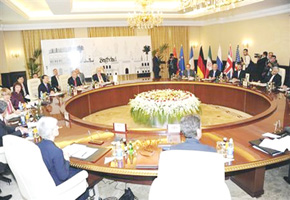
The P5+1 powers — the United States, Russia, China, Britain, France and Germany — hoped to persuade Iran in yesterday’s negotiations to suspend some of the most worrying parts of its activities but Tehran wants to see sanctions eased in return.
Iran is represented by Saeed Jalili, the lead negotiator, while the delegation from the six world powers is led by Catherine Ashton, the European Union foreign policy head.
The talks come a day after the head of the UN nuclear watchdog visited Iran and said he expected to sign a deal with Tehran on investigating suspected weapons activities connected to the country’s nuclear programme.
Yukiya Amano, director-general of the International Atomic Energy Agency (IAEA), said on Tuesday in Vienna, the Austrian capital, that he reached an agreement with Iranian officials but failed to seal the deal because of “remaining, unspecified differences”.
The last round of talks was held in April in Istanbul, Turkey, with officials describing the negotiations as “constructive”.
Iranian state media, including the Islamic Republic News Agency, all called a P5+1 proposal made to Iranian officials in Baghdad on Wednesday “outdated, not comprehensive and unbalanced”.
Press TV said the package showed the representatives of the world powers “are not serious about negotiating with Iran”.
The ISNA news agency said that, in contrast, a counter-proposal made by the Iranian side was “comprehensive . . . transparent and practical”.
It said the Iranian package was so complete that the world powers — theso-called P5+1 grouping of the five UN Security Council permanent members plus Germany could reply to them right away.
News agencies quoted diplomats from the P5+1 and Iranian media as saying the meeting in the fortress-like Green Zone of the Iraqi capital would likely go into a second, unscheduled day.
Jalili said he hoped the talks would be the start of a “new era” in relations, Iranian media reported.
“We sense that the West has realised that the time for using its pressure strategy is over,” Jalili was quoted as saying by the Fars and Mehr news agencies.
Al Jazeera’s Jane Arraf, reporting from Baghdad, said: “They have come here to the prime minister’s guest house . . . to try see if there’s actually common ground; that they can use that as a jumping off point in which Iran would agree to restrictions on enriching uranium in return for . . . a lifting of sanctions.”
But lifting sanctions is unlikely, raising questions on what the talks will accomplish, said our correspondent.
Michael Mann, a spokesman for the EU, said Ashton had put a new set of proposals on the table for Iran to consider.
“Our proposals are really to persuade Iran to come into line with its obligations. We hope they’re going to come back positively and react to those positively. Obviously the ball is in their court now,” he told Al Jazeera from Baghdad.
“We have a number of things that we want them to do. Obviously the enrichment of uranium to 20 percent is one of the major things the international community is worried about.”
Although Iran maintains its nuclear programme is intended to produce energy, the West fears a nuclear-armed Iran would destabilise the already volatile Middle East.
It also fears the decision will derail 60 years of international efforts to prevent the spread of atomic weapons, leading to a regional arms race.
Israel, Washington’s closest ally in the region, feels its very existence would be under threat and has refused to rule out a pre-emptive strike on Iran’s nuclear facilities.
At the Istanbul talks, the P5+1 and Iran managed to find enough common ground to come to Baghdad, with both sides hailing what they said was a fresh approach from the other.
But the Baghdad meeting will put these renewed efforts at rapprochement to the test as they seek to set the parameters of what will be a lengthy and arduous process of compromise requiring hitherto unseen amounts of patience and trust.
One key way for Iran to win the confidence of the P5+1 will be a suspension of 20 percent enrichment, while another would be Iran shipping its stockpiles of enriched uranium abroad. — Al Jazeera


 Online Reporter