Tawanda Musarurwa
CheckPoint Desk
ZIMBABWE has barely finished counting its harvest from a mercifully wet season when the next threat is already taking shape.
On April 29, 2026, the Meteorological Services Department (MSD) issued a stark preliminary warning: global climate forecasting centres now place an 88 to 94 percent probability on an El Niño event developing during the 2026/27 rainy season.
Historically, El Niño conditions carry a 65 percent chance of below-normal rainfall for Zimbabwe — drier-than-average conditions that have repeatedly pushed the country’s most vulnerable farmers to the edge.
The department was direct in its guidance, urging the farming community to begin adopting “climate-resilient practices, such as water conservation and the identification of drought-tolerant seed varieties.”
That single sentence contains a quiet alarm.
Water conservation — the ability to store, channel and deploy rainfall efficiently — is precisely what the country’s current irrigation infrastructure can no longer guarantee.
The rains arrived, but…
The rains did return this year. But that is not the good news it might appear to be.
After three consecutive below-average seasons, during which rainfall across Matabeleland South averaged barely 79 percent of historical norms, the country’s 2025-26 agricultural season finally produced abundant precipitation. Satellite monitoring by the Famine Early Warning Systems Network, using NASA’s CHIRPS (Climate Hazards Group InfraRed Precipitation with Station data) system, shows that most provinces received between 100 and 157 percent of their long-run rainfall averages between October 2025 and March 2026.
The numbers are striking. Harare’s catchment area recorded 918mm against a historical mean of 731mm.
Even Masvingo, one of Zimbabwe’s most drought-prone provinces, overshot its average by 57 percent.
But, FEWS NET’s latest food-security projections still classify the vast majority of Zimbabwe as IPC Phase 2 (Stressed) through at least September 2026, with pockets of IPC Phase 3 (Crisis) persisting across rural Matabeleland and Masvingo.
An exclamation mark on the classification map — denoting areas that would be one phase worse without active food assistance — covers most of the south and west.
In Masvingo’s Mushandike Irrigation Scheme, farmers say climate volatility stopped feeling abstract years ago.
“It has been a while since we noticed the changing weather patterns. I would say around 2017, that is when we started noticing that something was not right,” said Takunda Farming Group chairperson, Mr Jerifanosi Matingwinya.
“The rainfall was beginning to be erratic and yields were lower than usual.”
At the nearly 1 000-hectare scheme, irrigation has become increasingly critical as drought cycles intensify.
But even Mushandike is not insulated. Erratic rainfall translates directly into fluctuating dam levels, and fluctuating dam levels translate into uncertainty at the field edge.
“When the Mushandike Dam is full, we can harness water from it for around three years,” said group secretary Mr Proud Mhosva.
“But sometimes, because the rains are erratic, the dam does not properly fill.”
The story repeats further south. In Gwanda district, some farmers reported harvesting crops this season after years of repeated losses — a modest but meaningful relief.
In spite of that, several irrigation schemes in the area continued operating below capacity, hobbled by pump breakdowns and unreliable electricity, limiting winter production even after the improved rainfall.
Statistics from the Ministry of Agriculture, Mechanisation and Water Resources Development show that while the country has approximately 257 000 hectares under irrigation, only around 150 000 hectares are suitable for cereal production.
27 bad seasons out of 44
The paradox dissolves on closer inspection.
Food insecurity issues are never principally about any single season’s rainfall. They are the cumulative product of repeated drought shocks, weakened household resilience and the slow deterioration of the irrigation infrastructure designed to protect farmers from climate variability in the first place.
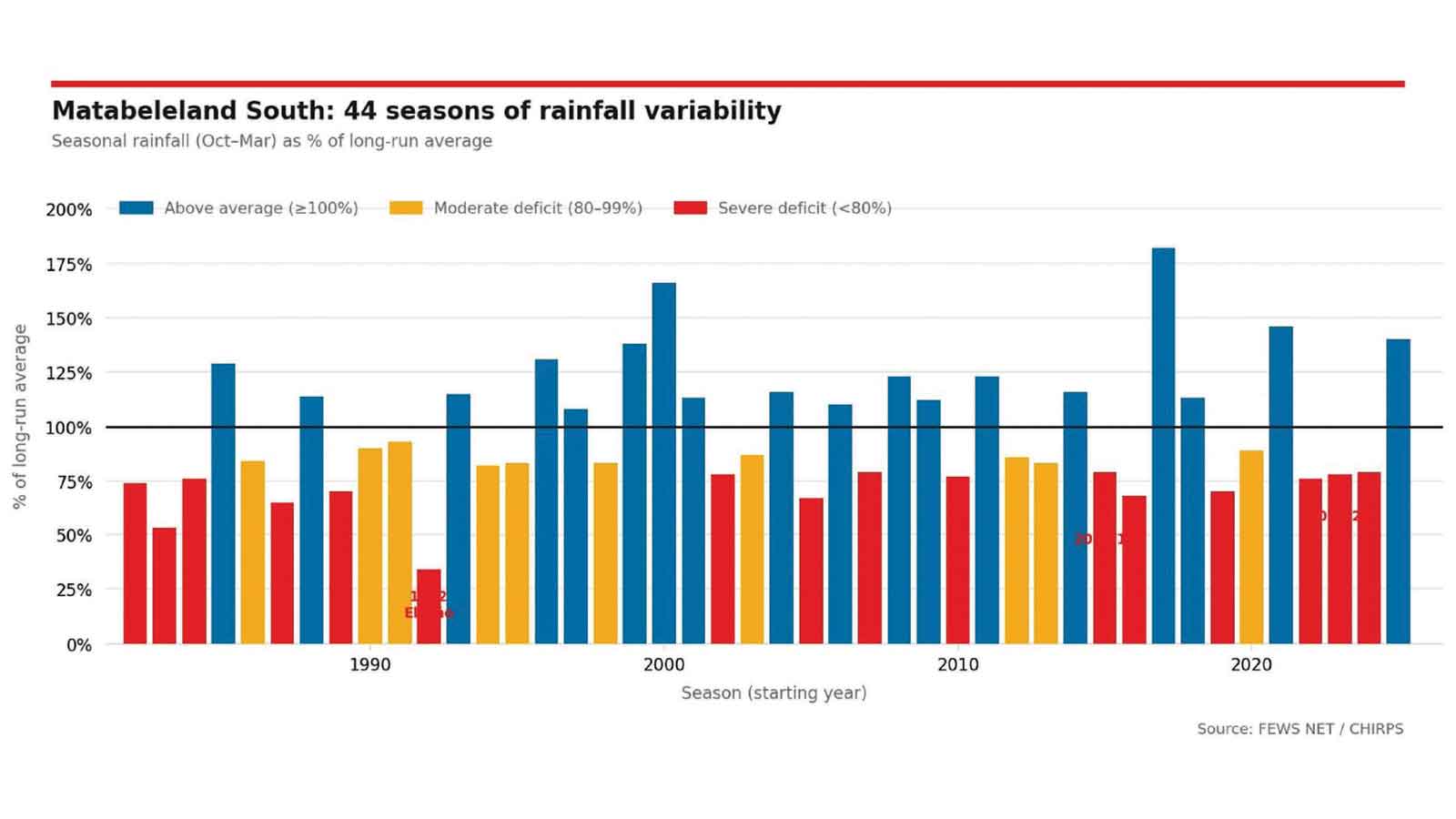
The historical record makes this plain. CHIRPS data stretching back to 1982 shows that Matabeleland South — Zimbabwe’s driest province and home to nearly one million people — recorded below-average rainfall in 27 of the past 44 seasons.
Severe deficits, defined here as below 80 percent of the long-run average, occurred in 1982-83 (53 percent), 1991-92 (34 percent, during the devastating regional El Niño drought), 2015-16 (68 percent), and across a grinding three-year run from 2021-22 through 2023-24.
Those three recent seasons are worth pausing on. Cumulative rainfall across that period amounted to roughly 230 percent of a single season’s long-run average — effectively the equivalent of losing an entire agricultural year spread across three.
The economic consequences compound with each successive failure. When households deplete grain reserves, sell livestock and withdraw children from school during one failed season, they enter the next with fewer buffers and less capacity to absorb further shocks.
In parts of Matabeleland South, improved rainfall this year replenished fields, but it did not replenish livestock herds depleted across three drought seasons.
For many households, recovery remains slower than the weather.
Good rains can refill dams.
They cannot instantly rebuild resilience.
That is where irrigation becomes critical; and where the data grows sobering.
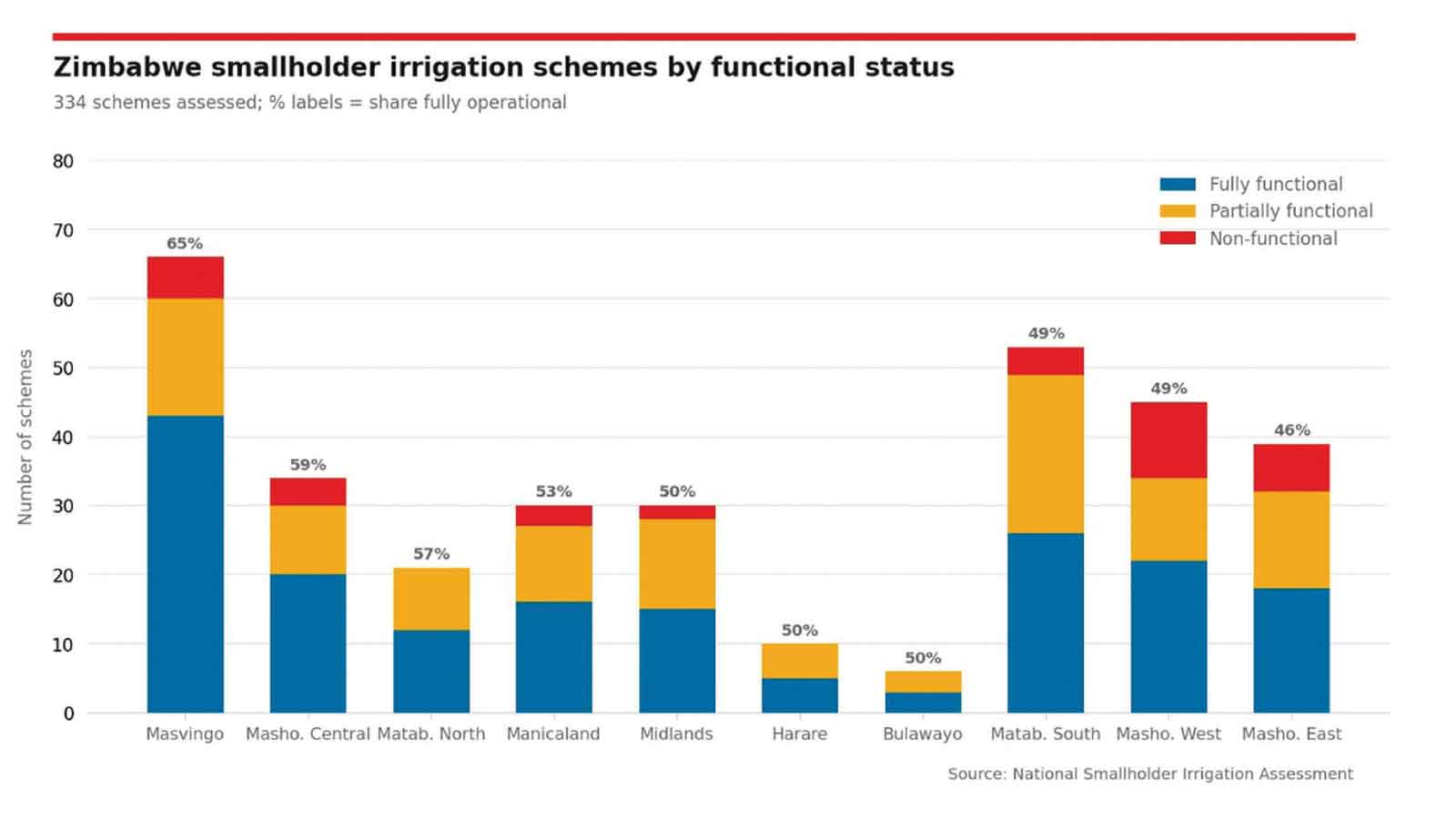
The Second Round Crops, Livestock and Fisheries Assessment, a national evaluation of Zimbabwe’s smallholder irrigation schemes, examined 334 of the country’s estimated 460 schemes. The findings are stark.
Only 180 — 54 percent of those assessed — were fully functional. Another 117 were partially functional, operating with broken pumps, silted canals or unreliable electricity, while 37 were entirely non-operational.
The provincial breakdown reveals a sharp geographic imbalance. Masvingo, despite its chronic drought exposure, recorded the largest number of assessed schemes at 66 — but six were already non-functional and another 17 operated below capacity.
Matabeleland South, whose rainfall history shows repeated cycles of stress, had 23 partially functional schemes out of 53 assessed. Mashonaland West recorded the country’s highest number of non-functional schemes at 11.
The scale of that deterioration has increasingly compelled Government toward large-scale rehabilitation.
The growing urgency is now formally embedded in Zimbabwe’s long-term economic planning: the National Development Strategy 2 (2026-2030) identifies irrigation expansion and climate-smart agriculture as central pillars for achieving food security and strengthening resilience against increasingly volatile rainfall patterns.
This week, Government announced it was rolling out a combined US$120 million irrigation investment programme under a broader climate-resilient farming model.
At its centre is the rehabilitation of all 460 irrigation schemes under a Government partnership with Maka Resources, targeting the restoration of 26 000 hectares of irrigable land.
The Permanent Secretary for Agriculture, Mechanisation and Water Resources Development, Professor Obert Jiri, framed the ambition in direct terms.
“The first step is to de-link our agricultural production from the vagaries of the weather,” he said. “We now need to move from the 150 000 (hectares) or so to at least 350 000 hectares, which will assure us of perennial food security in this country.”
Between climate recovery and structural fragility
But irrigation is not binary, and that distinction matters enormously.
A partially functional scheme — weakened by a damaged canal, an electricity shortage or a failing pump — cannot fully shield farmers from drought.
A pump operating at half-pressure reduces cultivation capacity. A leaking canal means fewer households receiving water precisely when they need it most.
The question Zimbabwe faces is not whether irrigation systems work during wet years; it is whether they can compensate when rainfall fails.
That is precisely when failing infrastructure fails hardest.
The World Bank Climate Knowledge Portal projects rising temperatures and increasingly volatile rainfall patterns across the country over coming decades.
For the roughly 70 percent of Zimbabweans dependent on rain-fed agriculture, that volatility is no longer a future threat. It is already shaping daily survival.
There is also an institutional dimension the numbers only partially capture. Irrigation schemes require reliable electricity, imported spare parts and coordinated management between Government agencies, local authorities and farming communities. Each of those systems has faced sustained pressure for years.
The gap between the 460 schemes reportedly existing and the 334 actually assessed is itself revealing — a 28 percent discrepancy suggesting that some schemes may exist more clearly in administrative records than in operational reality.
Zimbabwe’s food insecurity is increasingly shaped by whether its irrigation infrastructure still works. The rains, when they come, now fall on infrastructure that is less capable of retaining their benefit. The result is a country trapped between climate recovery and structural fragility.
This year’s above-average precipitation will buy time. Harvests should improve and some acute food stress may ease.
However, the underlying arithmetic remains unchanged: volatile rainfall colliding with failing infrastructure and financially exhausted households.
And with the MSD now flagging an 88 to 94 percent probability of El Niño conditions returning as early as 2026/27, the window for structural repair is narrower than it appears.
Unless broken irrigation schemes are rehabilitated, the country will remain one failed rainy season away from food insecurity.