admin
admin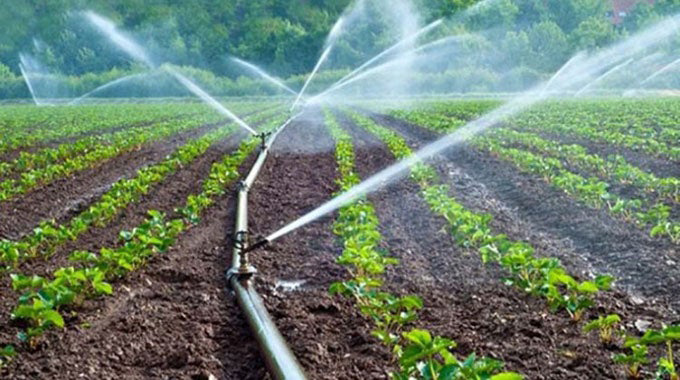
Sydney Kawadza Senior Features Writer
Agriculture is the backbone of Zimbabwe’s economy, and has helped sustain lives of millions in both rural and urban areas.
With the advent of Independence in 1980 and land reforms in 2000 which saw Government reclaiming land forcibly taken from our ancestors, more Zimbabweans ventured into farming, became employers while feeding the nation.
Empowerment had indeed come to the people. Droughts also came and left, but returned uninvited, yet they did not break the nation’s soldering spirit.
Government, realising the unpredictable weather patterns in Zimbabwe, moved in to utilise the various water bodies in the country to fight perennial food shortages through irrigation rehabilitation and development. April is Independence month and we celebrate the strides made in agriculture, the focus being on irrigation projects. One of the success stories is the 240 hectare Ruti Irrigation Scheme that has transformed the lives of many families in the arid regions of Gutu District in Masvingo.
Life is getting back to normal for villagers here. At least 270 families are engaged in agricultural activities involving crop rotation for all year round production.
The eastern parts of Gutu district, where Ruti is, receive little or no rainfall during the summer agricultural season rendering agricultural production next to zero. This has resulted in Government and its development partners taking up the challenge and providing villagers with means to fight poverty.
If anything, Zimbabwe is endowed with vast water bodies that can be utilised for irrigation purposes.
The district has, however, been divided between the “haves” and the “have nots”.
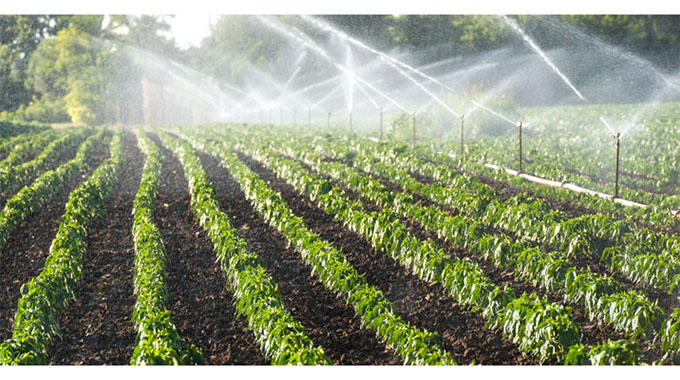
The “haves” are privileged to be part of the Ruti Irrigation Scheme benefiting from all year round agricultural activities.
They produce maize, wheat and sugar beans.
The “have nots” are stuck on unproductive and dry land in Gutu East not suitable for agriculture production.
Ruti Irrigation Scheme chairperson Mr Servious Murikitiko said the irrigation project has ensured food sustenance for the 270 members of the programme.
“The Ruti Irrigation Scheme has three phases covering 60 hectares where farmers grow maize during the summer agricultural season, beans immediately before the winter wheat season. This ensures food self-sufficiency at household level all year round,” he said.
Original members, he said, could get as much as a tonne of maize on their 0,25ha of land.
“We need to increase our pumping capacity so that we evenly distribute the water to eight hours for each phase,” he added.
Mr Murikitiko said the scheme needs a further $30 000 to rehabilitate irrigation pipes feeding the Phase 3 area of the project. There are also plans to include horticulture production.
The irrigation scheme has been part of the four-year Rural Sustainable Energy Development project co-founded by the European Union through the ACP-Energy facility and Oxfam.
While many detractors have said Zimbabwe is hostile to non-governmental organisations, such success stories have proved them wrong.
The €2 million projects are executed through supporter marketing and joint implementation by Oxfam and Practical Action.
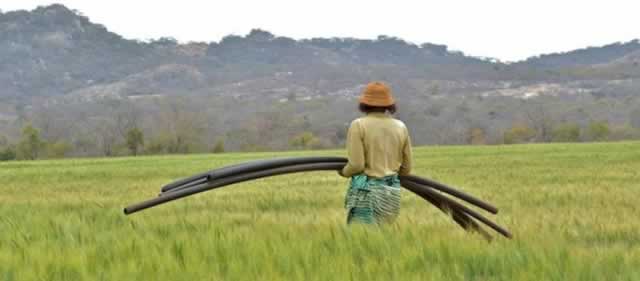
The project is in Wards 12-15 of Gutu district and aims at promoting increased uptake and access to solar powered renewable energy products.
Oxfam deputy country director Mr Kevin Ndemera says a 60-hectare irrigation scheme was handed over to the community in 2012.
“The RuSED project was therefore timely to complement these efforts in terms of providing the solar power to facilitate water pumping of 20ha irrigation,” he said.
The project also seeks to sustainably support rural communities and small holder farmers by directly improving and increasing their access to modern, affordable and sustainable energy services.
Mr Ndemera added that several solar powered enterprises have been set up around the energy kiosk model while new livelihoods options for smallholder farmers have been introduced.
“Employment opportunities have been created for the communities in form of solar technical entrepreneurs operating solar-powered energy shops,” he said.
Mr Ndemera explained that the project alignment to the Zim-Asset economic blueprint was a reflection of the work the Zimbabwean Government has done towards the formulation of relevant policies in line with global expectations on community and rural development.
The project has been a welcome development to members of the Ruti Irrigation Scheme.
Forty-year-old Kumbirai Mhasva from Ward 14 has been a member since 2011.
“Our lives are completely different from farmers in the dry lands.
“We can grow our food throughout the year primarily for our families and the market especially our colleagues from surrounding villages,” he said.
Even teenagers have been attracted to the irrigation scheme.
Sharon Kaswayi (17) believes agricultural production will help her complete her education.
“We grow enough food for the family and sell to other villagers who have no access to the water.
“Last season I got 20 buckets of beans. One bucket costs $30 and that is enough money for fees and other requirements,” she said.
However, Mercylene Chikonye (39) said there was need for increased pumping capacity to the fields in Phase 3.
“The water is still limited in our area hence the need for increased pumping so that we grow more crops,” she said.
Mr Keria Chara said they had the potential to go into market gardening and diversify their activities.
“We can grow other crops like vegetables and tomatoes. We want to grow potatoes and that is the plan we have for the future,” she said.
An additional 20 hectares of land, installation of solar water pumping and lighting systems at two clinics and two schools around Ruti irrigation community have come through the project.
An agribusiness centre and an energy kiosk in Ruti for socio-economic development has also been established.
Four clinics, Mataruse, Mazuru, Denhere and Magombedze and the two schools, Gomba and Mataruse Secondary Schools now have solar water pumping and lighting systems.
Gutu East MP Berta Chikwama hailed the irrigation project adding that there was need for its expansion.
“There are 240ha of arable land at the scheme but only 60 are under utilisation. We would want Government to increase the agriculture production at the scheme,” she said.
She also lamented the maize prices in the district.
“There are unscrupulous dealers who are fleecing desperate villagers and we hope authorities would assist us get cheaper maize for the struggling families,” she said.
Under Zim-Asset’s Food and Security Cluster, Government seeks to create a self-sufficient and food surplus economy and see Zimbabwe re-emerge as the “bread basket of Southern Africa.
Zim-Asset ultimately seeks to build a prosperous, diverse and competitive food security and nutrition sector that contributes significantly to national development through the provision of an enabling environment for sustainable economic empowerment and social transformation.
Thus Government, would, through the Zim-Asset policy blue print initiate programmes of rehabilitating irrigation equipment and adopting low cost mechanization programmes.
The other cluster, Infrastructure and Utilities, seeks to undertake work on critical areas such as the development of a robust, elaborate and resilient infrastructure especially on energy and power supply.
This would be implemented through increased usage of alternative forms of energy including solar energy.
Gutu East has seven wards with 34 percent poverty incidence, according to the poverty assessment report of 2003.
The Parliament of Zimbabwe notes that 20-30 percent of households are food insecure while there has been no electrification in the constituency.
According to a paper by scholars, Professor Nhundu and Professor Abyssinia Mushunje, the irrigation sector plays a vital role in food production and rural economies.
“Looking forward, the strong demographic and increased income push to food demand is expected to continue in the future, and irrigated agriculture needs to continue rapidly expanding and intensifying.”
The estimated irrigable area in Zimbabwe is 550 000 hectares, of which 200 000 hectares has been developed.
Feedback: [email protected]


 Online Reporter