Online Reporter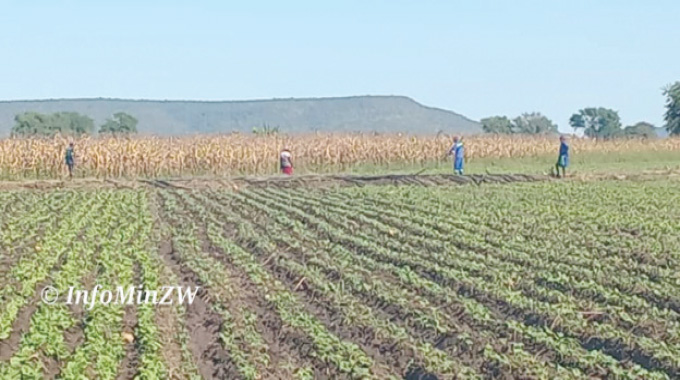
Rutendo Nyeve
Victoria Falls Bureau
OVER 200 farming households in Binga District are now seeing their food security prospects transformed following the completion of the Lungwalala Irrigation Scheme, a collaborative project spearheaded by the Government and its development partners.
The district, long plagued by prolonged droughts and erratic rainfall that have crippled food production, is now benefitting from the 150-hectare irrigation project, which is widely expected to revitalise food security and uplift livelihoods.
Historically reliant on rain-fed agriculture, which has become increasingly unreliable due to climate change, Binga farmers are now embracing year-round crop production. Maize, sugar beans, and winter wheat form the backbone of the scheme’s cropping calendar. After harvesting maize, farmers planted beans and are now preparing for a winter wheat crop.
In a major boost for the local economy and education, a local non-governmental organisation has pledged to purchase the bulk of the bean harvest for use in the school feeding programme at Kariangwe Primary School.
Speaking to Zimpapers, Chief Siansali hailed the irrigation scheme as a game-changer for Binga, a district that has long battled food insecurity due to persistent droughts.
“The irrigation scheme has been the main source of food security, particularly during the drought season. Binga is generally a dry area and we do not receive adequate rainfall.
“When more than 200 farmers get food from the scheme, they can sell to the various communities, guaranteeing their food security. They also rotate crops and plant legumes and maize,” he said.
Chief Siansali also emphasised the importance of crop rotation, which helps maintain soil fertility and ensures dietary diversity. However, he raised concerns about water usage, noting that the current flood irrigation system consumes large volumes of water from the already-stressed Lungwalala Dam.
“We need to modernise the system to more sustainable and efficient irrigation technologies that draw less water. The dam no longer reaches its full capacity due to reduced rainfall caused by climate change,” he said.
Mr Jameson Munsaka, chairman of the Lungwalala Irrigation Scheme, said the project has not only improved food security but also spurred economic activity in the region.
“We currently have 220 farmers working the land. This season, 55 hectares are under sugar beans, and we are preparing a similar area for wheat. Last year, 55 hectares of irrigated maize produced a strong yield,” he said.
Mr Munsaka noted that the other 55 hectares, which relied on rainfall, did not perform well. The limitations of the dam’s capacity have forced the community to make difficult decisions, such as leaving half the land dependent on unpredictable rainfall. The dam wall reportedly has leaks, and the overnight storage dam is heavily silted, further compounding water shortages.
“The Lungwalala Dam capacity could not sustain the entire 110 hectares under irrigation, so we left half to the natural water supply, which was the rain. We also harvested wheat last year in November, which saw our surrounding wards like Muchesu, Chilongwe and others benefiting,” said Mr Munsaka.
Despite these challenges, Mr Munsaka said the scheme continues to deliver positive results. In November last year, the community harvested wheat, which benefited neighbouring wards such as Muchesu and Chilongwe. They also delivered 22 tonnes to the Grain Marketing Board (GMB).
A partnership with Kariangwe Primary School allows 30 farmers to supply sugar beans to the school’s feeding programme. The scheme has also been contracted by the Government to grow wheat this year.
Mr Munsaka said that plans are underway to diversify production through contract farming. Farmers have reached an agreement with a local company to plant sorghum and millet on 55 hectares — crops that not only diversify income but also reduce water usage, as small grains are drought-tolerant.
Support from organisations such as Icrisat has further strengthened the community’s resilience. The organisation has assisted some farmers with small grain seed production and training, enhancing both food security and household income.
“We are confident in our ability to grow and earn more. Even with the challenges, the scheme is making a huge difference in our lives,” said Mr Munsaka. — @nyeve14