Chronicle Editor
Israel Defense Forces (IDF) spokesman Daniel Hagari has said Sinwar was killed after Israeli forces identified three “terrorists” running from house to house in the Tal El Sultan area of Rafah, in the south of the Gaza Strip.
Hagari has presented a video which he says shows Sinwar being approached by an IDF drone, masked and with an injury to his hand.
The man, who is sitting in an arm chair on the second floor of a mostly destroyed house in the footage, then throws what appears to be a stick at the drone and the video ends.
Sinwar was found with a gun and 40,000 shekels (£7,700), Hagari says.
“He was running away and we killed him,” he adds.
The IDF had seen traces of where Sinwar had been previously, Hagari says, adding Sinwar’s DNA was found in a tunnel close to where six hostages were killed a few weeks ago.
-
This is a turning point for many, says former BBC Middle East correspondentpublished at 08:27 British Summer Timepublished at 09:27
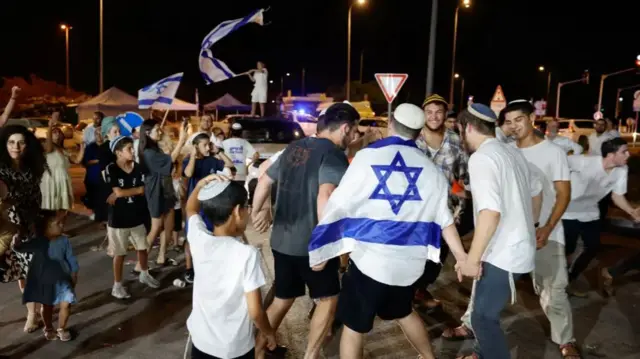 Image source, Reuters
Image caption, Israelis in Sderot have been taking to the streets to celebrate Sinwar’s killing Former BBC Middle East correspondent Jim Muir, who’s based in Lebanon, has been shedding some light on the current situation in the Middle East while speaking to BBC Radio 5 Live earlier this morning.
Muir says the death of Hamas leader Yahya Sinwar has brought “a huge wave of people” saying it’s time to put an end to the war, and calling this “a kind of turning point”.
However, he adds that Israeli Prime Minister Benjamin Netanyahu is currently an “immovable object” who is “in full war mode” and isn’t suddenly going to start making peace in Gaza.
Muir says the leadership of Hamas has now been “largely demolished” as a result of Sinwar’s death but also says Hamas will fight on, as will Hezbollah in Lebanon.
Another possible “game changer” is how Israel responds to the latest missile strike from Iran.
He says it remains to be seen whether Israel is going to do something “huge and escalatory” that will “give a big twist to the spiral of violence and possibly kind of trigger a regional flare up that would draw the Americans in”.
-
Hezbollah targets coastal area of Zvulun this morningpublished at 08:14 British Summer Timepublished at 09:14
Hezbollah says it has shelled the coastal area of Zvulun with a “large rocket salvo” this morning.
In an update on Telegram, the group says it targeted the area – located north of Haifa – at 0700 local time (0500 BST).
In a separate statement, the Israel Defense Forces (IDF) says it identified about 15 projectiles from Lebanon this morning after sirens sounded in Haifa Bay, Upper Galilee and Western Galilee.
Some were intercepted and others fell. The IDF also says overnight, a drone was intercepted along the coast inside Israeli maritime territory.
-
Aid agency condemns strike on school-turned-shelter in Gazapublished at 07:53 British Summer Timepublished at 08:53
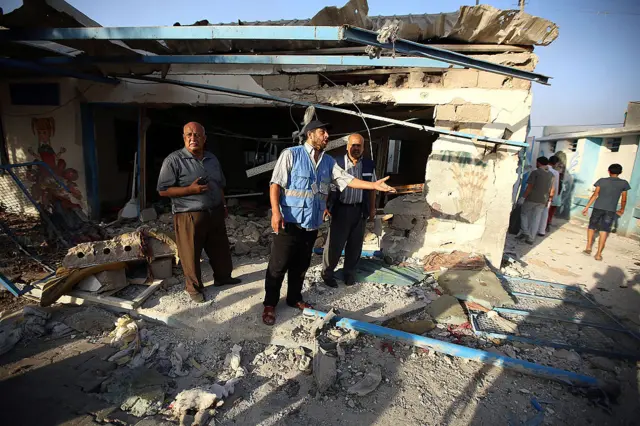 Image source, Getty Images
Image caption, The Abu Hussein School was hit in the early hours of Wednesday morning The UN agency which assists Palestinians in Gaza has condemned Israel’s air strike on a school housing refugees in Jabalia in the north of the territory.
Sam Rose, deputy director of Unrwa, told the BBC’s Today programme that the incident had killed 28 people, in an area populated by women and children seeking shelter.
The Israeli military said in a statement the strike targeted militants from Hamas and Islamic Jihad groups, who operated from within the Abu Hussein School.
Rose says Israel must do more to protect civilians as there is “nowhere for them to go” and it was just one of a series of incidents targeting Unwra schools.
Asked if he accepted Hamas militants may be using the school buildings, he argued that “two wrongs do not make a right” and called for independent investigations into what happened.
-
Too early to say how Sinwar’s death will impact humanitarian aid in Gaza, says MSFpublished at 07:41 British Summer Timepublished at 08:41
It is too early to know how the death of Hamas leader Yahya Sinwar will impact humanitarian efforts in Gaza, says a representative from Médecins Sans Frontières (MSF).
“In the beginning we thought we’d only be here for three months, but this has turned into a chronic emergency of proportions that I don’t think anybody anticipated, Sally Stevenson, emergency coordinator for MSF in Gaza tells the BBC.
Stevenson says the health system is “decimated” and the “needs of the population are extraordinary”, adding that “any recovery will take time but the impact of the death of Sinwar is really yet to be seen”.
On Sunday, the US sent a letter to the Israeli government giving it 30 days to boost humanitarian access to Gaza, or risk having some military assistance cut off.
And on Monday, the first aid in two weeks entered Gaza but the UN’s acting humanitarian chief Joyce Msuya described it as a “trickle” and said that “all essential supplies for survival are running out” in the territory.
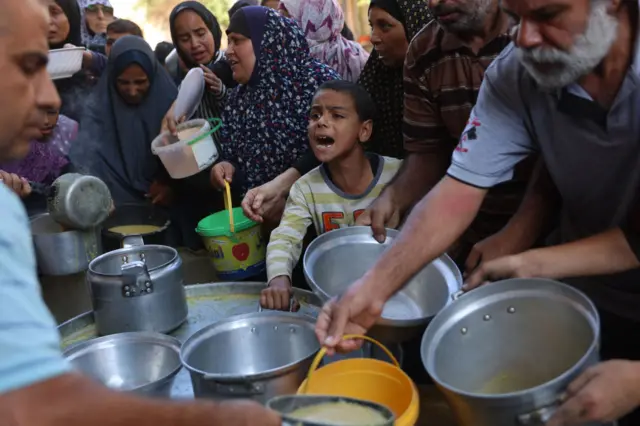 Image source, Getty Images
Image caption, People queue for food rations at the al-Shati refugee camp in northern Gaza -
Loss of Sinwar major blow for Hamaspublished at 07:25 British Summer Timepublished at 08:25
 Yolande Knell
Middle East correspondent, in JerusalemDrone footage released by the Israeli military show a fighter with a scarf tied around his face, apparently wounded, sitting on a dusty armchair in the ruins of a house in Rafah. The Israeli army says that only after he was killed did soldiers notice his resemblance to Israel’s most wanted man.
DNA testing confirmed his identity as Yahya Sinwar. Prime Minister Benjamin Netanyahu said the mastermind of a day of “sheer evil” was no more. But he insisted that Israel would continue fighting with full force until all of the hostages held in Gaza were home.
While many Israelis celebrated, the families of some held captive expressed “grave concern” for the fate of their relatives and called on Israeli leaders to use their military success to get a deal.
While the loss of Yahya Sinwar is a major blow for Hamas, Palestinians interviewed in Gaza pointed out that all of the group’s former leaders who were killed were replaced, and many see no end in sight to the deadliest war in the history of the decades-old Israel-Palestinian conflict.
Already hostilities have spread in the region. And following news of Sinwar’s death, Iran stated that “the spirit of resistance” would be strengthened.
The Lebanese group, Hezbollah, vowed to respond by escalating its confrontation with Israel.
-
Who was Hamas leader Yayha Sinwar?published at 07:12 British Summer Timepublished at 08:12
The death of Hamas leader Yahya Sinwar – Israel’s most wanted man – is a deeply significant moment in the war in Gaza as he was believed to be the mastermind behind the 7 October attacks last year.
Born in the Khan Younis refugee camp in southern Gaza, his parents were originally from Ashkelon in southern Israel but became refugees after the mass displacement of Palestinians in the war that followed Israel’s founding in 1948.
Sinwar was first arrested by Israel in 1982, aged 19, for “Islamic activities” and arrested again in 1985. It was around this time that he won the confidence of Hamas founder, Sheikh Ahmed Yassin.
He spent much of his adult life – over 22 years – in Israeli prisons from 1988 to 2011 before his release as part of a prisoner swap.
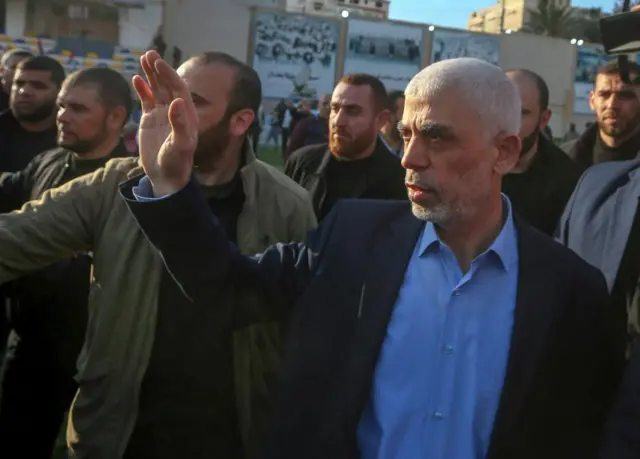 Image source, EPA
Image caption, Hamas leader Yahya Sinwar pictured here at a rally in Gaza in April 2023 -
IDF says operations in Gaza and Lebanon continuepublished at 06:57 British Summer Timepublished at 07:57
The Israel Defense Forces has given an update saying it’s operations against “terrorist infrastructure” in Gaza and Lebanon continue.
It says that overnight “the battle team of the Givati Brigade joined the expansion of the 162nd division’s operations in the Jabalia area”, which is in northern Gaza.
The IDF continues by saying that the division’s forces, and planes, have “eliminated dozens of terrorists in attacks” in the region during the last day.
The post adds that the IDF is continuing to “locate and dismantle weapons” in southern Lebanon.
-
Sinwar’s death is serious blow to Hamas, but not the end of the warpublished at 06:38 British Summer Timepublished at 07:38
 Jeremy Bowen
International editor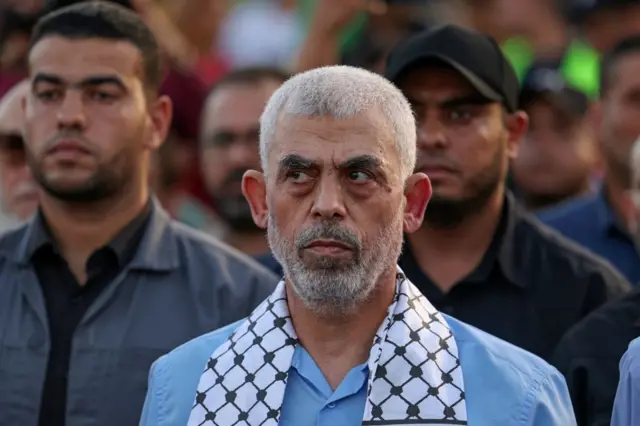 Image source, Getty Images
Image caption, Every Hamas leader since the 1990s has been killed by Israel but there has always been a successor Killing Yahya Sinwar is Israel’s biggest victory so far in the war against Hamas in Gaza.
His death is a serious blow for Hamas, the organisation he turned into a fighting force that inflicted the biggest defeat on the state of Israel in its history.
Benjamin Netanyahu, Israel’s prime minister, praised the soldiers and made clear that however big a victory, it was not the end of the war.
The remaining hostages are not free and Hamas is fighting and sometimes killing Israeli troops.
A year of war has killed at least 42,000 Palestinians and left much of Gaza in ruins.
Read Jeremy Bowen’s full article on what this means for the conflict.
-

Sinwar’s death presents another challenge for Iranpublished at 06:37 British Summer Timepublished at 07:37
 Lyse Doucet
Chief international correspondentThe killing of Yahya Sinwar presents yet another challenge for Iran in its already risky calculations in this escalating war and Israel’s accumulating tactical victories.
Sinwar was one of Tehran’s closest allies in the region. He played an increasingly key role in what Iran regards as its regional “axis of resistance” against Israel.
Ever since he was released from prison in Israel in 2011, Sinwar’s relations with the Islamic Republic kept deepening. He travelled to Tehran the next year in a delegation led by Hamas’s political leader Ismail Haniyeh who introduced him to Iran’s Supreme Leader Ayatollah Khamenei.
In 2019, Sinwar publicly praised Iran for its provision of weapons and military training. “If not for Iran’s support for the resistance…we would not have obtained these capabilities”.
There may not be the same pressure on Tehran to retaliate as when Haniyeh was killed on Iranian soil, under Iran’s protection, in late July.
It will condemn Israel and glorify another “martyr”. But Iran’s main preoccupation at this moment is Israel’s expected attack in response to Iran’s salvos of ballistic missiles on 1 October.
Before news broke of Sinwar’s killing, the commander of Iran’s revolutionary guards, Hossein Salami, warned “that if you commit any aggression against any point, we will painfully attack the same point as yours.”
But other allies, like Hezbollah and Hamas, are already indicating they will step up their attacks.
Despite being weakened, they will want to make clear – they can still fight.
-
Israel confirms death of Hamas leaderpublished at 06:33 British Summer Timepublished at 07:33
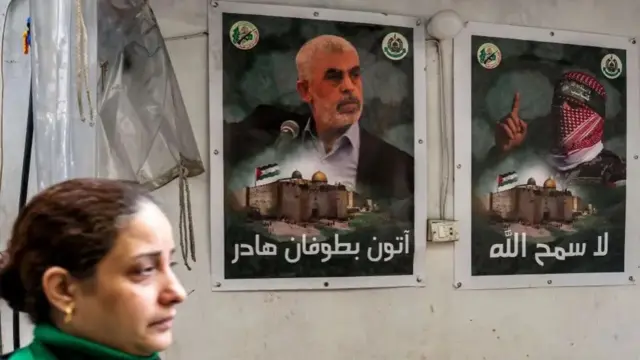 Image source, Getty Images
Image caption, Sinwar was the leader of Hamas We will now be resuming our coverage of the latest updates from the Middle East.
Yahya Sinwar, the leader of Hamas, has been killed by Israeli soldiers in southern Gaza, Israel has confirmed.
Sinwar had led the armed group in Gaza since 2017 and was described by Israel, the US and UK as the mastermind behind the 7 October attacks – when Hamas gunmen killed around 1,200 people in Israel and took 251 hostages.
Medics in northern Gaza say at least 22 people were killed, and dozens wounded, in an Israeli air strike on a school building.
Elsewhere, in Lebanon, cross-border fire between Israel and Hezbollah has been continuing.
And in Yemen the US launched what it called “precision strikes” on five weapons storage facilities in parts of Yemen controlled by the Iranian-backed Houthi group.
Stick with us as we bring you the latest throughout the day.
-
A critical moment in Israel’s war in Gazapublished at 22:52 British Summer Time 17 Octoberpublished at 23:52 17 October
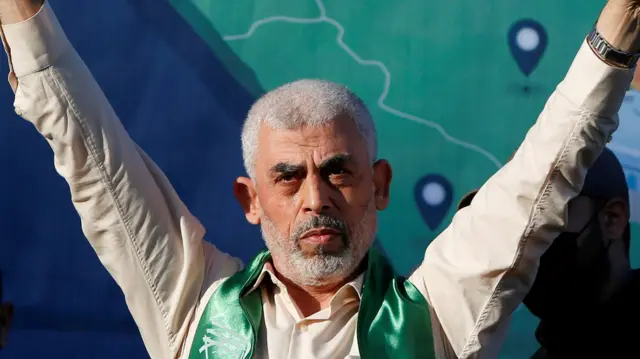 Image source, Reuters
The killing of Yahya Sinwar, who had been top of Israel’s most-wanted list, is a deeply significant moment in the war in Gaza.
Israel accused Sinwar of having masterminded the unprecedented 7 October attacks, that killed around 1,200 people in Israel and saw 251 taken hostage last year.
He took over as overall leader of Hamas after Ismail Haniyeh was killed in Iran in July. Prior to that he served as the group’s leader inside the Gaza Strip – you can read a profile of Sinwar here.
Hamas is yet to comment or confirm the death. But Israel says it has matched dental and fingerprints, from the more than two decades he spent in Israeli prisons, to that of the body found in the southern Gazan city of Rafah.
You can read the full story of Sinwar’s killing and the reaction to it here, while our international editor Jeremy Bowen’s analysis of its implications is here.
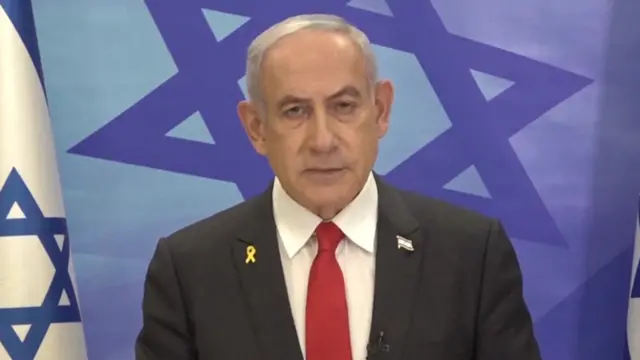
Image caption, Netanyahu makes an address confirming the killing of Sinwar Israeli Prime Minister Benjamin Netanyahu said the killing showed why Israel “insisted on not ending the war”, and added the fighting would continue until the remaining hostages were brought home.
US officials have signalled a desire for Sinwar’s death to act as an opportunity to renew efforts to agree a ceasefire deal and secure the release of the remaining hostages.
Earlier, Gaza’s Hamas-run Civil Defence Agency said at least 22 people were killed in an Israeli strike on a school building in northern Gaza. The Israeli military said it conducted a “precise strike”, claiming Hamas was using the site as a command centre, which the group has denied.
-
Sinwar’s death is serious blow to Hamas, but not the end of the warpublished at 22:38 British Summer Time 17 Octoberpublished at 23:38 17 October
Jeremy Bowen
International Editor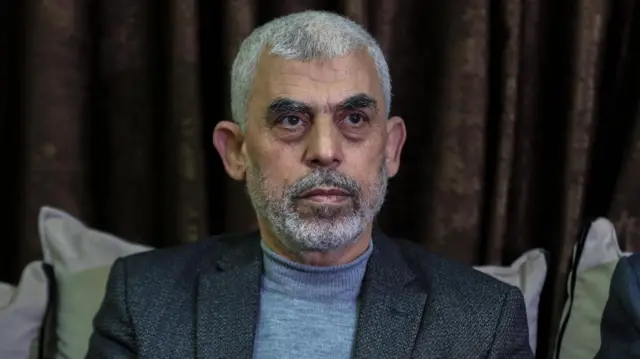 Image source, EPA
Image caption, Every Hamas leader since the 1990s has been killed by Israel but there has always been a successor Benjamin Netanyahu and the overwhelming proportion of Israelis who support the war in Gaza needed a victory.
The prime minister has repeated his war aims many times – destroying Hamas as a military and political force and bringing the hostages home.
Neither has been achieved, despite a year of war that has killed at least 42,000 Palestinians and left much of Gaza in ruins.
But the remaining hostages are not free and Hamas is fighting and sometimes killing Israeli troops.
Killing Yahya Sinwar was the victory Israel wanted. But until Netanyahu can claim that the other war aims have been accomplished, the war, as he says, will go on.
Read the full analysis of how killing Sinwar is Israel’s biggest victory so far here/
-
French president calls for end to military operationspublished at 22:25 British Summer Time 17 Octoberpublished at 23:25 17 October
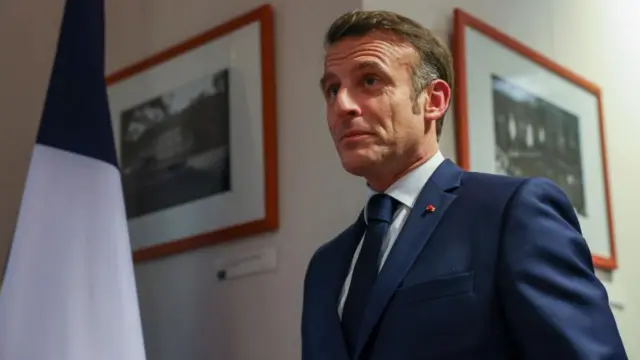 Image source, EPA
Following our reports on US reaction to Sinwar’s death, we now have a comment from French President Emmanuel Macron – who has described today as “a turning point as well as a military success for Israel”.
He says: “This opportunity must be seized to secure the release of all hostages and for an end to finally be brought to the war.”
Macron also makes the case in his statement that it is now necessary to “end military operations”.
“Now, after this result, accept the ceasefire in Gaza and finally open a credible political perspective for both Israelis and Palestinians,” he adds.
-
Recap: At least 22 killed in strike on Gaza schoolpublished at 22:21 British Summer Time 17 Octoberpublished at 23:21 17 October
For the last few hours we’ve been focusing on the news that Hamas leader Yahya Sinwar has been killed.
But here’s a quick recap of what else we’ve been reporting on in the Middle East today:
In Gaza:
At least 22 people have been killed and dozens wounded in an Israeli air strike on a school building in northern Gaza, according to Gaza’s Hamas-run Civil Defence Agency. The Israeli military says it conducted a “precise strike” on the site in Jabalia, claiming it was being used as an operational meeting point for Hamas and Islamic Jihad operatives – which Hamas denies.
In Lebanon:
Cross-border fire between Israel and Hezbollah in Lebanon continues. The Israeli military says it “struck and eliminated” a Hezbollah battalion commander in the south of the country.
In Yemen:
The US launched what it calls “precision strikes” on five weapons storage facilities in parts of Yemen controlled by the Iranian-backed Houthi group
-
UK will not mourn Sinwar’s death, Starmer sayspublished at 22:16 British Summer Time 17 Octoberpublished at 23:16 17 October
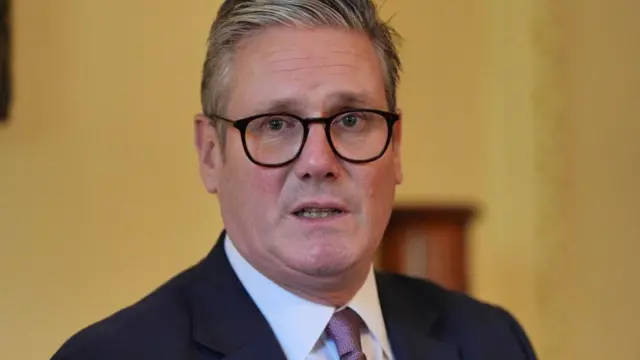 Image source, Reuters
UK Prime Minister Keir Starmer has reacted to the news, describing Yahya Sinwar as the “leader of the terrorist group Hamas” and the “mastermind behind the deadliest day in Jewish history since the Holocaust”.
Starmer adds: “Today my thoughts are with the families of those victims. The UK will not mourn his death.
“The release of all hostages, an immediate ceasefire and an increase in humanitarian aid are long overdue so we can move towards a long-term, sustainable peace in the Middle East.”
-
Sinwar killed by tank after making mistake, IDF tells BBCpublished at 22:07 British Summer Time 17 Octoberpublished at 23:07 17 October
An Israel Defense Forces (IDF) spokesperson has shared more details on how Sinwar was killed, speaking to the BBC World Service’s Newshour programme.
Maj Doron Spielman says the IDF has been operating in Rafah with the goal of capturing “the most senior terrorists” – including Yahya Sinwar.
Spielman says in their operations, IDF forces gradually closed off streets, blew up tunnels and restricted movement to a “smaller and smaller area”, which he adds forced Sinwar to “move like a fugitive” and eventually “make a mistake”.
“In fact, just yesterday he did so. He left the tunnel, went into an apartment building, and [Hamas] opened fire on Israeli troops. A tank returned fire, and he was killed in that attack.”
-
‘What does this mean for the hostages?’published at 21:58 British Summer Time 17 Octoberpublished at 22:58 17 October
 Lucy Manning
Special correspondentSteve Brisley from Wales lost his British sister Lianne and British-Israeli teenage nieces Noiya and Yahel Sharabi on 7 October when they were murdered by Hamas gunmen in their home. His brother-in-law Eli Sharabi is still being held as a hostage.
Reacting to the news, Steve says: “It’s good news on the one hand, that Sinwar is dead, but the concern is always what could happen now. What does this mean for the hostages?”
“I would have always wanted some sort of justice for Lianne and the girls. Whether his death constitutes justice I’m not really sure, but I think I was always pretty realistic about the fact that he was never going to be brought to any sort of trial. So I suppose that his death is the next best thing. But until we get our families back, the nightmare goes on.”
He calls for Israel and the international community trying to get a hostage deal to use this as an opportunity.
“It’s an opportunity to end the war, to end the suffering on both sides, to end the suffering in Gaza, to end the suffering of the families of the hostages. There has been no greater opportunity in the last six months than this.”
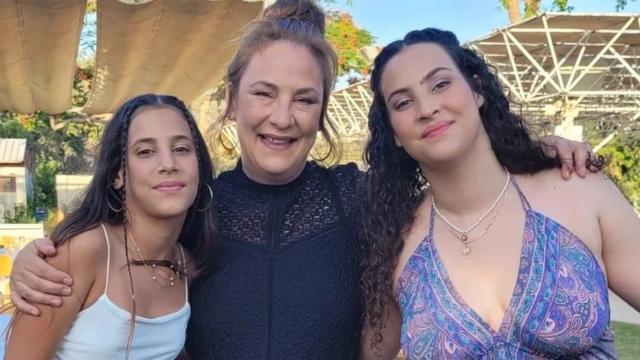
Image caption, Yahel, Lianne and Noiya -
US hopes Sinwar’s death creates opening for ceasefire dealpublished at 21:49 British Summer Time 17 Octoberpublished at 22:49 17 October
 Tom Bateman
State Department correspondentUS Department of State spokesman Matthew Miller has described Sinwar’s death as a “seismic event that changes the nature of this conflict”.
We’ve had a series of statements from President Biden downwards.
Three big observations. Biden calls it a “good day” for Israel, the US, and the world. The administration says Sinwar’s death brings a measure of justice – he had Israeli, American and Palestinian “blood on his hands”, says White House National Security Advisor Jake Sullivan.
US officials are also at pains to point out how they helped out in the run up to all this – revealing that after 7 October the White House despatched special operations and intelligence personnel with whose help Sinwar and others were “hunted and tracked and flushed out of their hiding places and put on the run”.
This might be in part to offset a dig that Netanyahu has just made in his own statement, implying he was right to send troops into Rafah earlier this year despite “all the pressures” – an operation the Americans had urged him to limit over civilian casualties.
But the big point here for the US administration is that it hopes it creates a new opening for the derailed ceasefire and hostage-release talks. In the last couple of hours Secretary of State Anthony Blinken came off the phone with the leadership of Qatar – key mediators with Hamas in Doha.
Miller says the US is “determined to try to seize that opportunity” to end the war.
-
How Biden and Harris respond to Sinwar killingpublished at 21:43 British Summer Time 17 Octoberpublished at 22:43 17 October
US President Joe Biden and Vice-President Kamala Harris have both made statements on the killing of Yahya Sinwar.
Biden says this is a “good day for Israel, for the United States, and for the world”. He calls this an opportunity for a “day after” in Gaza without Hamas in power, and for a “political settlement that provides a better future for Israelis and Palestinians alike.”
According to the White House, Biden has also spoken to Israel’s Prime Minister Benjamin Netanyahu to “congratulate him on the mission” and discuss how to “use this moment to bring the hostages home and to bring the war to a close with Israel’s security assured”.
Meanwhile, speaking to reporters during her presidential campaign in Milwaukee, Wisconsin, Harris says “justice has been served”.
She adds that Sinwar was responsible for the killing of thousands of innocent people, including the victims of October 7 Hamas attack and hostages killed in Gaza.
“This moment gives us an opportunity to finally end the war in Gaza,” she goes on to say, adding “today I can only hope that the families of the victims of Hamas feel a sense and measure of relief.”
Source BBC.com


 Online Reporter