Zvamaida Murwira and Victor Maphosa
UNIVERSITIES and other tertiary institutions are key drivers of national food security, agricultural modernisation and rural industrialisation as Zimbabwe remains on course to attain upper-middle-income economy status by 2030, President Mnangagwa has said.
The President, who is also Chancellor of all State universities, said this in a post on his X account yesterday following the graduation ceremony of 150 students at the Marondera University of Agricultural Sciences and Technology (MUAST) in Mashonaland East province.
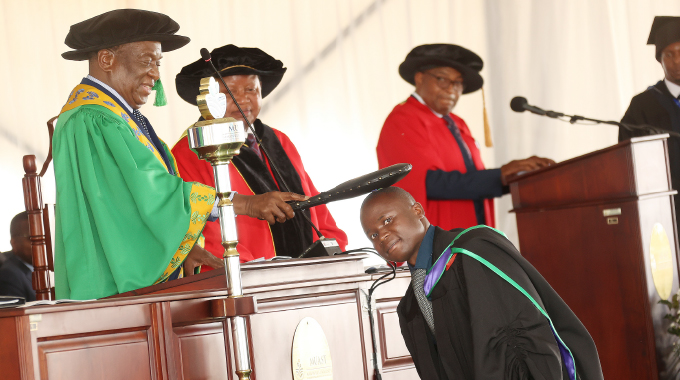
“Today, as Chancellor of all State Universities, I had the distinct honour of conferring degrees and academic distinctions at the 5th Graduation Ceremony of the Marondera University of Agricultural Sciences and Technology (MUAST),” said President Mnangagwa.
“Held under the inspiring theme: ‘Towards a Decade of Excellence in Technology, Community Engagement, Innovation and Industrialisation’, today’s ceremony is a testament to the transformative power of our Education 5.0 heritage-based model.”
He said agriculture remained the cornerstone of the country’s economic growth and a critical pillar of national food security.
“Agriculture remains the backbone of our economy and the bedrock of our national food security. As our nation marches steadily towards Vision 2030, institutions like MUAST are critical in driving agricultural modernisation, rural industrialisation, and home-grown technological solutions that uplift our communities,” he said.
“To the graduating Class of 2026: congratulations on this well-earned milestone. You are not merely job seekers, but innovators, entrepreneurs, and wealth creators equipped to transform Zimbabwe’s agricultural sector and build a prosperous future for all. Go out and make your mark!”
The graduation ceremony underscored MUAST’s growing role in agricultural development through research, innovation, resource mobilisation and strategic partnerships.
President Mnangagwa conferred Doctor of Philosophy degrees, master’s degrees, undergraduate degrees and diplomas on the graduates.
Delivering his address, MUAST Vice-Chancellor Professor Justice Nyamangara said the institution continued to strengthen its contribution to the agricultural sector through research, innovation and strategic partnerships.
“Your Excellency and Chancellor, the university continued to advance research, innovation and resource mobilisation through strategic partnerships and impactful projects that contribute to national development priorities under Heritage-Based Education 5.0,” said Professor Nyamangara.
He outlined several research and innovation initiatives being undertaken by the university to transform communities and contribute to national development.
Among these is the Tamarind Value Chain Project, which includes the construction of a fruit-processing factory in Binga.
“Construction of the factory is targeted for March 2027. This initiative seeks to promote value addition, rural industrialisation, employment creation and economic empowerment for women and youth in line with the national development principle of leaving no one and no place behind,” he said.
The university has also received funding from UNICEF to implement a project exploring locally available complementary foods.
“The project will identify, nutritionally analyse and optimise locally available food ingredients across 10 districts in Zimbabwe, contributing to improved infant and young child nutrition and community capacity development,” he said.
Professor Nyamangara said MUAST had further secured funding from the Global Biodiversity Information Facility to implement a project focusing on aquatic biodiversity data mobilisation and publication.
“MUAST will lead a consortium comprising BirdLife Zimbabwe, the Natural History Museum, the National University of Science and Technology and the Zimbabwe Parks and Wildlife Management Authority. The project will contribute to biodiversity knowledge generation, environmental conservation and evidence-based natural resource management in Zimbabwe,” he said.
Another initiative focuses on examining changes in agricultural and food systems, land use, livelihoods, governance, biodiversity and natural resource management, with the aim of informing policy, strengthening climate resilience and promoting sustainable rural and peri-urban development.
On agricultural research and climate resilience, Professor Nyamangara said the university had
developed and released a resilient finger millet variety named Muchekeranwa.
“The early-maturing variety has demonstrated high yield potential, achieving yields of up to four tonnes per hectare under optimum conditions. This innovation contributes to the promotion of traditional grains, climate resilience and improved food and nutrition security in Zimbabwe,” he said.
In commercialisation and market development, the university has established Fresh Cart, a retail outlet in Marondera’s central business district.
“The outlet provides a dedicated platform for marketing the university’s agricultural produce, value-added products and innovations, marking a significant step towards commercialisation, market development and institutional income generation in line with Heritage-Based Education 5.0,” said Professor Nyamangara.
He also highlighted the successful hosting of the university’s second innovation fair from August 3 to 5 this year.
“The fair provided a platform for showcasing state-of-the-art technological innovation and entrepreneurial initiatives developed by staff and students, demonstrating the university’s continued commitment to innovation and industrialisation,” he said.
On the Muchekeranwa Dam outgrower irrigation scheme, Professor Nyamangara said the university had continued to facilitate its expansion from 30 to 60 hectares, following Government funding of US$276 000.
“The development of the additional 30-hectare youth irrigation facility targeting youth from the Muchekeranwa area progressed in 2026, with the centre pivot and power line installation complete.
The youth-focused irrigation scheme will create productive employment and entrepreneurship opportunities for young people, helping to reduce vulnerability to drug and substance abuse,” he said.
Professor Nyamangara said the university’s enrolment had continued to grow, reaching 690 students during the August-December 2026 semester, an eight percent increase from 638 in 2025.
“Of the enrolled students, 353 (51 percent) are female and 337 are male, reflecting the university’s commitment to gender equity,” he said.
Of the 150 graduates, 55 percent were female and 45 percent male.
While the university celebrated its growing contribution to knowledge and skills development, graduates were marking the culmination of years of hard work, perseverance and dedication.
Speaking to Zimpapers after the ceremony, several graduates said the knowledge and skills they had acquired would contribute to the development of their communities and the country at large.
Six graduates received cash prizes of US$1 000 each, while other outstanding students received US$500 awards under the Emmerson Dambudzo Mnangagwa Chancellor’s Prize.
Patience Paidamoyo Ngani, who graduated with a Master of Philosophy degree in Food Processing and Technology, received the US$500 Chancellor’s Prize for an outstanding innovation project.
She said her research focused on tamarind pectin and had enabled her to acquire knowledge and skills with practical applications in Zimbabwe’s food-processing industry.
“Today I received an award from President Mnangagwa, ZB Bank and other organisations. I want to thank President Mnangagwa and other companies for these prizes and support. My research and innovation was on tamarind pectin,” she said.
The research aligns with MUAST’s broader Tamarind Value Chain Project, which seeks to establish a fruit-processing factory in Binga to promote value addition, rural industrialisation, employment creation and the economic empowerment of women and young people.
Another graduate, Mr Christopher Mavhima, who obtained a Master of Science Degree in Industrial Ecology and Environmental Management, received the US$500 Chancellor’s Prize for Outstanding Innovation.
His research focused on finding practical solutions to the challenge of disposing of used disposable nappies, which pose environmental and waste-management challenges.
“I made an incinerator to manage used diapers. As you know, as a country we are facing challenges of proper disposal of waste, including diapers.
“What makes me excited is that our President, Dr Emmerson Dambudzo Mnangagwa, is in full support of innovation and I am thankful that I received a prize from him,” he said.
An incinerator is an enclosed furnace or waste-treatment system designed to burn waste materials at high temperatures, reducing them to ash.
Mr Kudakwashe Makuro, who graduated with a Bachelor of Science Honours Degree in Development Sciences and Policy and received eight awards, said his achievements were the result of hard work and dedication.
He also thanked President Mnangagwa for the US$1 000 cash prize.
The ceremony was attended by Higher and Tertiary Education, Innovation, Science and Technology
Development Minister Dr Frederick Shava, his deputy, Simelisizwe Sibanda and the ministry’s permanent secretary, Professor Fanuel Tagwira.
Also in attendance were Minister of State for Provincial Affairs and Devolution Itayi Ndudzo, other Cabinet ministers, legislators, academics and other dignitaries.