peter
peter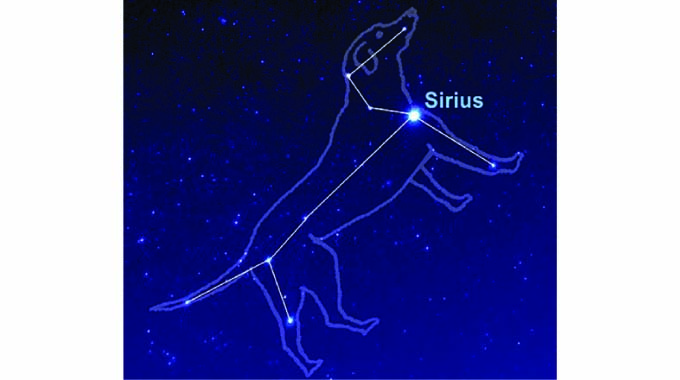
THE night sky, when it is pitch dark and cloudless, reveals several cosmic bodies that are attended with a lot of significance and meaning.
During daytime, the Sun’s brilliance dominates and dwarfs other stars. Our Earth is part of the Solar system with the Sun at its centre, around which planets, sometimes with their own moons, revolve or orbit with different cyclical durations.
Growing up at Sankonjana where we herded cattle, we were able to see cosmic bodies during the day. That we did by lying down facing up to view the heavens under some thick tree foliage. The leaf-created darkness enabled us to view the heavens. Before that experience, we used to think that stars appeared only during nighttime. How wrong we were!
There is hardly a single community in the world that did not look up to the heavens to view positions and other characteristics of heavenly bodies. What all those communities held in common was a belief that stars are sometimes revelations of the presence of gods who communicated with earthly beings.
Stars are beautiful to look at against the contrasting night sky. This is even more so when they portend good tidings. Belief was strong that the stars were communicating with human beings, rendering precognition so that impending doom was obviated.
In view of these perceptions, stargazers were out to glean the messages being communicated for their own sake. African gazers in particular sought the functional aspects being conveyed by the stars rather than mere beauty and aesthetics.
Twinkling stars are enchanting. A look at the African chants when a new moon appeared in the western sky reveal that what was being glorified were the functional aspects rather that the aesthetic aspects. Indeed, there is more to stars than their aesthetics and glamorous glitter.
Stars tell tales to the various communities. Stars may portend good or bad tidings that lie ahead. Human beings are ever keen to know what the future has in store for them. Portending stars were part of a package of phenomena that announced the future for those who were au fait with their language.
To be forewarned is to be forearmed.
Alternatively, human beings may require arranging rituals and ceremonies to welcome the star that heralds good tidings. Time has different seasons. There are times to celebrate and times to commence trading at the market square.
There is time to sleep and time to wake up. Stars played a role in announcing the various times that were associated with events that communities needed to note and take appropriate action be it to commence dances, perform rituals and ceremonies.
Tracking the movement of stars in the firmament was thus very important.
Cultural interventions have been resorted to in order to determine positions of stars and the moon. For example, stone circles were created to serve as astronomical calendars that accurately determined when solar or lunar eclipses were to occur, for example.
Among the Rozvi rulers, it was important to know when the moon did not appear either in the eastern or western sky. The king needed to terminate his political, spiritual, social and economic duties well ahead of the day when the moon was taking a rest.
He, like the moon, took a deserved rest from royal duties.
The king resumed his royal duties after the appearance of the crescent moon. Usually, there ought to have been a lapse of four days since the emergence of a new moon..
In order to monitor the movement and appearance of the moon, an artifact known as a ziso (eye) was used to gaze the western horizon to see if the moon had appeared and four days allowed before the king resumed his various royal duties.
However, African Spirituality was, through the spirit mediums, able to know the position of the moon even when it was completely covered by thick layers of clouds. Spiritual persons were able to keep track of the movement and positions of the moon through spiritual detection.
Even in cases where the moon was covered for extended periods, spiritual monitoring was still possible. Vusamazulu Credo Muthwa argued that there were more senses than the five that we are told about.
All this was done in recognition of the varying lunar potencies relating to the positions of the moon in the firmament. Lunar potency was in consonance with both the movement and concomitant positions within the firmament.
When the Ndebele soldiers took up arms in March 1896 to restore their pre-1893 political, social and economic status on 20 March 1896.
The choice of day was based on the belief that on full moon there is maximum potency and therefore high probability of scoring success.
During times of maximum potency, rituals of various kinds were arranged. For example, Inxwala, the prime Ndebele ritual and ceremonial occasion, was performed at full moon when the king partook of the first fruits to be ripened before other did the same in the outlying districts.
Similar timing with regard to potency took place at the Stonehenge.
As we shall see in subsequent articles, many cultural activities were timed to coincide with the movements and resulting positions of celestial bodies.

This was indeed the case with the commencement of the agricultural season. There were cosmic bodies that announced the appropriate time. Celestial and lunar movements could mean life or death for human beings whose sustenance relied upon the onset of the rains and commencement of the agricultural season that relied on rain-fed agriculture.
Knowledge gleaned from cosmic bodies was derived from learning through association. When a particular cosmic body appeared and in its wake, there was some particular occurrence that was repeated with similar results, the communities ended up arriving at conclusions. Knowledge was gained and therefore the appearance of a particular star was associated with proven occurrences or events.
Cycles of cosmic bodies may last long. Cycles for cosmic bodies differ from body to body. However, when the advent of a cosmic body is viewed as being important, appropriate measure were taken to keep track of its movement. The Dogon people of Mali are among the oldest settlers on the African continent.
They are thought to have migrated from Egypt and took with them some knowledge of astronomy. They now live in a precarious terrain of high mountains.
French military forces drove them away from their traditional lands. The Dogon are important in that they assigned a priest who monitored the movement of the Dog Star (Sirius) which they knew about well ahead of NASA that has access to powerful telescopes.
Most people see the star only once in their lifetime. The orbital cycle of the star is 60 years. As a result, there is hardly anyone who sees the star twice.
Celestial bodies of long cycles are recognized and celebrated at the time of their arrival. Nevertheless, the Dogon people observe cultural and spiritual practices that are very ancient.
For example, some of their icons are shared in common with those in Turkey where Gobekle Tepe monument, that is thought to be the oldest temple in the world.
Resonance ate site linked the monument with the pyramids of Giza in Egypt.
The arrival of the Dog Star is always cause for celebration. The monitoring priest notifies the community about the impending spectacle and requisite ceremonies and rituals are arranged. Carbon testing rat Nabta Playa in Egypt revealed the years when the awaited star arrived, at which time cattle were slaughtered as part of the celebrations and rituals.
Belief has compelling power for those who hold it. It is not whether or not those who do not share in the belief and what they say that matters. It matters to those who uphold the belief whose conseqences to them are real. It is true with perceptions regarding the stars. Communities hold ideas relating to the origin myths for the various cosmic bodies.
The San people have their own ideas different from those of the Zulu. A stellar phenomenon may appear the same but how it came into being may differ from one community to the next. Similarly, attached explanations and meanings may differ accordingly.
Origin myths vary from one community to the next. The same is true of interpretations that different communities attach to the various cosmic bodies. Where communities share a common history both their origin myths and their interpretations and even the names of the same cosmic bodies may be the same or similar.
In forthcomimh articles, we shall look at the various origin or creation myths pertaining to the various cosmic bodies. The Milky Way and its origins differ from one African community to the next. It makes sense.
The knowledge that people possess influences their understanding of new situations and phenomena. Such possessed knowledge serves as a tool that individuals make use of to make sense out of new situations that confront them.
What we are going to meet is communities that project knowledge of their world upwards to the heavens so that they derive meaning out of them,.
This is what I termed, “As below, So above.” It is a two way process where the opposite adage applies — “As above, So below, when communities seek to replicate the heavens on earth.”
When we deal with the various communities, we shall seek to see the applications of the two adages.



 Online Reporter