admin
admin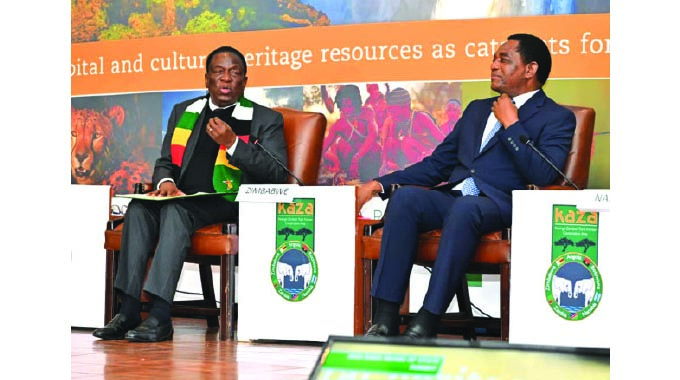
Kuda Bwititi in LIVINGSTONE, Zambia
President Mnangagwa has castigated some international organisations for their penchant to regulate Southern Africa’s conservation of its elephants when they failed to preserve wildlife in their own countries.
He made the remarks at the Kavango Zambezi Transfrontier Conservation Area (KAZA TFCA) Heads of State Summit that ended here yesterday.
The KAZA TFCA, which includes Angola, Botswana, Namibia, Zambia and Zimbabwe, is the largest transfrontier conservation area in the world spanning 520 000 square metres with over 200 000 elephants that are also the biggest herd in the world.
However, the region is banned from selling ivory or culling the elephant herd under the Convention on International Trade in Endangered Species (CITES).
In Zimbabwe’s case, the elephant population has overgrown, leading to overgrazing, soil erosion, habitat degradation and incidences of fatal conflict with adjacent communities.
In his remarks, President Mnangagwa, who is also the incoming SADC chair, said some of those pushing for harsh conservation measures that have negatively affected Zimbabwe do not even have elephants in their home countries.
“I have heard in some countries in Europe, where they were saying we should sell our elephants. I am sure we should agree to donate 40 000 elephants to Europe and see where they can keep them,” he said.
“It is disheartening, most unfortunate and unacceptable that those who are opposing our conservation philosophy have themselves failed to manage their own wildlife populations, some to the point of extinction.
“In contrast, we in Southern Africa, and more specifically in the KAZA, have managed to grow our wildlife populations substantially. We should never allow those with dubious agendas to dictate the way we manage and utilise our own God-given resources as well as the conservation models we deploy within our own jurisdictions.”
The President said in this context, Southern Africa needs a common voice in defending its conservation policies, people and sovereignty.
KAZA TFCA nations, added the President, must make use of forthcoming international conventions to ratchet up pressure against policies that repress them.
“The upcoming international engagements such as the CITES 20th Conference of Parties (CoP 20) in 2025, should provide a platform to defend our policies and values.”
The KAZA TFCA has provided frameworks to enable its five countries to meet obligations towards attainment of national visions and the United Nations Sustainable Goals.
In implementing international protocols, KAZA TFCA member States should have convergence on conservation related matters, taking into account their unique circumstances, said the President.
“Particularly, we must be holistic in the strategies we proffer to address challenges in the conservation of our elephants, given the bulging populations and ever-increasing incidences of human-wildlife conflict.
“The principle of sustainable utilisation has been effectively used in our region through the issuance of hunting and management offtakes to reduce our elephant population and curtail human-wildlife conflicts.
“Regrettably, these approaches are being resisted and opposed by some quotas on the global stage,” he said.
The SADC region, President Mnangagwa said, has a proud history of wildlife conservation and should use this to deliver benefits to its people.
“Among us, we have the largest herd of elephants and other mega fauna in the world. This should provide us with an edge in global conservation matters and enable us to create the much-needed benefits for our people,” he said.
President Mnangagwa said the SADC region was facing other challenges related to conservation in the region, including climate change, which caused the El Niño-induced drought.
“Our response to the resulting disruptions to the ecosystems coupled with negative impact on wildlife, agriculture and water resources must be met with robust and pro-active interventions to build greater resilience.
“To accelerate climate action, the importance of access to quality, timeous and accurate climate, weather and other environmental information cannot be overemphasised.
“This involves collectively strengthening infrastructure, developing early warning systems, improving disaster preparedness and enhancing community resilience through education and capacity-building programmes,” he said.
Zimbabwe, said the President, has responded to human-wildlife conflicts by creating a fund to provide support to victims of such conflict.
The fund will focus on relief to victims for death, injury or maiming as a result of problem animals.
Host President Hikainde Hichilema said the benefits of conservation should trickle down to ordinary people.
“We have carbon trading. We want to do it and create value. That value must stay in the region. Let’s define carbon markets properly, second pricing…and thirdly let’s look at how benefits trickle to the communities, so that they realise more value for themselves,” he said.
Namibia President Dr Nangolo Mbumba said:
“The summit’s theme, ‘Leveraging Kaza’s natural capital and cultural heritage resources as catalysts for development of the eco-system’, perfectly aligns with our strategy and vision for our green economy which safeguards the environment.”
Botswana Vice President Slumber Tsogwane, who represented his President Dr Mokgweetsi Masisi, said KAZA TFCA was one of the great initiatives in SADC.
“It acts to enhance regional coordination in tourism and conservation. We hope to see KAZA TFCA continue to flourish,” he said.


 Online Reporter