admin
admin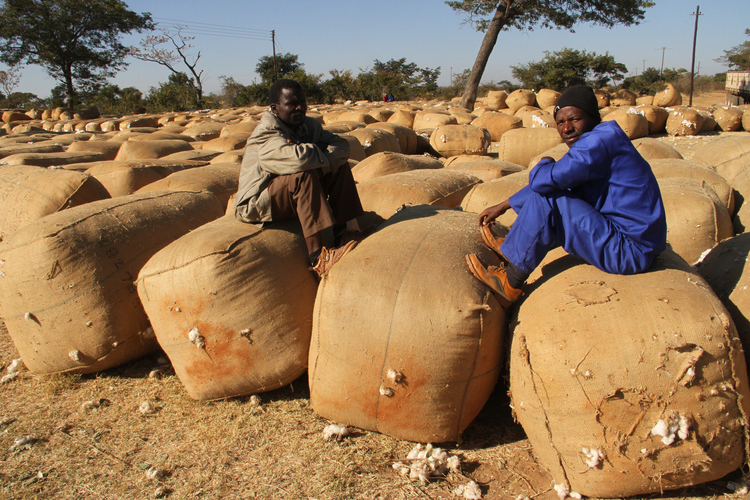

A cocktail of anxiety and despair engulfs the cotton farmers gathered at the Gokwe Centre collection point.
Unshaven, hungry and visibly tired, the majority of the farmers lean against their huge cotton bales.
Others wander aimlessly around the massive complex, killing time.
A distance away, a few vendors are unenthusiastically laying out their sparse wares on the ground.
The fact that these farmers are dispirited cannot be debated.
The days when cotton was king could well and truly be over, and more and more farmers are turning to tobacco.
To Mr Peter Mavela of Mavela Village, about 7km outside Gokwe Centre, this is the worst cotton marketing season ever.
“For four days, I have been sleeping in the cold. The buyers are saying they have run out of money and they don’t even know when they will pay us. I wish this nightmare was just a dream,” Mr Mavela says.
Apart from the delays in getting payments, Mr Mavela and other cotton farmers are unhappy with the producer price of 30c/kg. The Cotton selling season begins in April and can stretch up to July.

“Cotton is different from maize in that if one is not happy with the price, they can use the maize as stock-feed. What can you use cotton for? Making pillows? I brought my cotton here simply because I cannot just throw it away,” Mr Mavela adds.
Last year, Mr Mavela sold the three bales that he produced at 35c/kg.
Like the other farmers, Mr Mavela was holding on to his cotton in the hope that the price would improve.
“Last year, the prices were increased from 30 to 60 cents. We thought if we held on to our produce, the price will be increased but this was not the case this time around.”
He swears that he will never grow cotton again.
The picture was the same at Tshoda Business Centre, 100km North of Gokwe Town Centre. Mr Champion Chigayo, like Mr Mavela, had slept in the open for three days awaiting payment.
“I am a bitter man. I travelled for a long distance, slept in the cold and then received paltry $50 as payment for the Cotton I had,” a bitter Mr Chigayo says.
From the contracting company, Mr Chigayo received inputs and $108 cash. His one-hectare plot produced three bales that were bought for US$60 each.
After paying his loan obligations, Mr Chigayo took home US$50. That is $50 for months of hard work.
The majority of farmers we interviewed wanted between 70 and 80c/kg. About 95 percent of farmers grow the crop, once hailed as “King Cotton” under contract farming.
Buyers representing the seven cotton buying companies operating in Gokwe are not forthcoming when asked to reveal the amount of cotton that they have so far acquired.
Mr Stanford Mahambire, who is in charge of Cottco’s Gokwe Centre depot, asks: “We have six other companies buying cotton here in Gokwe. Why are you interested in Cottco alone? You can get the information that you want from the other companies.”
Some contracted farmers are in the habit of side-marketing their product, depriving contractors the fruits of their investment.
The Agricultural Marketing Authority says it has deployed field officers to cotton-buying points to combat side-marketing.
“We are encouraging our farmers to honour their contractual obligations. Our officers are currently on the ground monitoring the farmers as we seek to nip side marketing in the bud,” a Press statement on the authority’s official website reads.
In March this year AMA said cotton farmers and ginners faced serious pricing issues that discouraged continued large-scale production.
AMA is a statutory body established in terms of an Act of Parliament to regulate the participation in production, buying and processing of agricultural products. For years, farmers have called on Government to fix the cotton producer price.
Deputy Minister of Agriculture, Mechanisation and Irrigation Development (Cropping) Dr Davis Marapira says Government cannot do this.
“As far as fixing the price of cotton is concerned, that is something that Government cannot do on its own.
“Cotton prices are determined by world market prices and Government cannot do anything about it,” Dr Marapira explains.
Dr Marapira says farmers must improve yields per hectare so that King Cotton regains its throne.
“Our farmers should be taught good agricultural practices so that they improve the yields.
“Cotton farmers must aim at achieving yields of say, five tonnes per hectare and not the less than 300kg per hectare than most farmers are producing.”
Plant yields in Zimbabwe are at 17 000 plants per hectare, compared to 45 000 to 50 000 in other countries.
According to AMA, output for 2013 and 2014 was stagnant at 143 000 metric tonnes.



 Online Reporter