admin
admin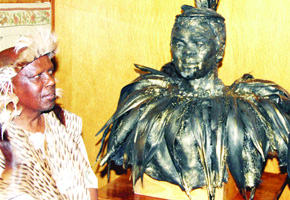
following the renaming of the Hall of Chiefs, Hall of Kings.
The development is in honour of the pre-colonial leaders, kings Mzilikazi and Lobengula, whose legacy was not recognised, according to the Natural History Museum.
A number of people from Bulawayo and other parts of the country and South Africa thronged the Natural History Museum hall to witness the unveiling of the bust, amid calls for the revival of cultural activities that seek to preserve the Ndebele culture.
The event marked the second day of the International Museum Week, which started on Monday and will culminate in the International Museum Day commemorations tomorrow.
The national commemorations will be held in Mutare.
The unveiling of the bust of King Mzilikazi was decided after realisation that King Mzilikazi’s history was missing at the museum despite the fact that he left a rich legacy.
Speaking at the unveiling ceremony, Mr Pathisa Nyathi, a renowned historian who gave a speech on the history of the Ndebele kingdom, said the idea of having King Mzilikazi’s bust was to recognise and preserve a legacy in memory of a lasting figure.
“It is all about legacy, to honour a lasting memory of a lasting figure. Some men are forgotten soon after their death but people like Mzilikazi are remembered forever,” said Mr Nyathi.
“The legacy left by King Mzilikazi included Mzilikazi township built in 1945 when there was a boom after the World War 2, Mzilikazi Memorial Library built in 1968, and Mzilikazi Memorial Centre at Mhlahlandlela, courtesy of the Rotary Club.
“Mzilikazi commemorations are held worldwide in countries such as the United Kingdom, South Africa, United States of America and in Zimbabwe. He left the Ndebele language and culture and the Ndebele chieftainship in Matabeleland and the Midlands provinces.”
The bust, made of ostrich feathers, was made by Ms Ntombi Philomina Silonda, the chief exhibition officer at the museum.
“I got the image from the Mzilikazi Memorial Library. We could have had it somewhere else but the realisation that there was not enough in terms of recognition of our kings pushed us to have King Mzilikazi’s bust in the museum,” Ms Silonda said.
The Khumalo royal family, led by Mr Leo Zulukandaba Khumalo, led the proceedings.
King Mzilikazi’s bust was mounted on a one-metre high wooden pedestal a few metres away from that of his son, King Lobengula, in the new look Hall of Kings.
It has a feather cap (isiphika) made of ostrich feathers, a heading (isidlodlo), and a pompom from feathers of a lilac-breasted roller bird (isifefe) also nicknamed Mzilikazi’s roller.
There was concern by people that King Mzilikazi was getting more recognition in other countries while little was being done locally.
“Why not have a plaque like in Pretoria, South Africa, where at the Union Building it is written that this area was owned by Mzilikazi?” said one person from the crowd.
Mr Titus Sibanda from KwaZulu-Natal in South Africa said: “I am from KZN and we know King Mzilikazi as a king from Buqulusi in South Africa. I came to listen and witness this event because we are really interested in the history of Mzilikazi. We are happy that you are reviving the Ndebele culture because it is saddening to note that most places in Matabeleland now speak a different language. Let’s not be shy to speak our own language. Our wish is to make a film of King Mzilikazi’s legacy, iqaleni ibhebhezeleke ingabe isacima (push ahead).”
Mr Khumalo, who spoke on behalf of the royal family, urged people to visit the museum to see the bust and learn more about history, saying King Mzilikazi was a peaceful leader who loved everyone especially the poor, hence the name Mthwakazi for his state.
He drew laughter from the crowd when he said his attire (amabhetshu) did not allow him to speak in English.
“This bust is not for the royal family alone because inkosi yinkosi ngabantu. King Mzilikazi did not love only his children but everybody. He would not have any meal before knowing what was happening in his state on any particular day from his trusted chief, Gwabalanda. He was as humble as a dove but powerful as a lion,” said Mr Khumalo.
The unveiling was done in style with the Khumalo royal family singing traditional songs like Akeni limlondoloze and Bayethe zulu kandaba.
The Natural History Museum has for the past four days been holding afternoon discussions led by historians and researchers on a number of issues.
The co-ordinator of the commemorations, Ms Dorothy Madamba, a curator in entomology, said the programme was tailor-made to afford Zimbabweans, especially in Bulawayo, an opportunity to learn their history.
“There are eight research departments and each has a curator who opened an information point in the gallery to explain to people some of the aspects in their different departments for the whole week. There has not been a recognition of our pre-colonial leaders as kings hence the need to rename the Hall of Chiefs, Hall of Kings,” said Ms Madamba.



 Online Reporter