Online Reporter
Patrick Chitumba.patrick, [email protected]
KWEKWE Polytechnic College has made significant strides in promoting industrialisation by establishing five business units, including a construction start-up that has spearheaded impressive infrastructure refurbishment on campus.
This initiative has resulted in considerable cost savings by reducing reliance on external contractors, underlining the institution’s commitment to the Government’s drive to stimulate industrial growth.
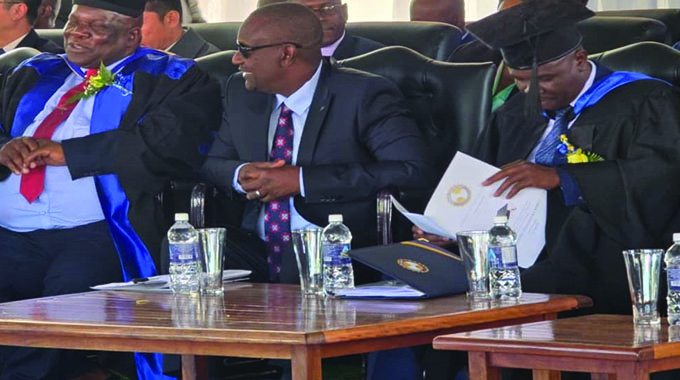
Speaking at the college’s 2025 graduation ceremony yesterday, the Deputy Minister of Higher and Tertiary Education, Innovation, Science and Technology Development, Simelisizwe Sibanda, commended the institution’s progress. A total of 1 596 students graduated, with 40 percent being female.

He stressed the importance of closing the gender gap, encouraging more women to pursue engineering and other traditionally male-dominated disciplines.
“Against a background of under-representation of women in scientific and technical fields, the Ministry continues to make significant inroads in fostering an enabling learning environment that supports greater female participation in STEM areas,” he said.
Deputy Minister Sibanda urged female students to challenge gender stereotypes by embracing science and to lead innovations that address health, environmental and other socio-economic challenges.
He highlighted that under the National Development Strategy 1 (NDS1), Zimbabwe had adopted the Heritage-Based Education 5.0 philosophy, a transformative model that repositions higher education institutions as innovation and industrialisation hubs rather than mere knowledge consumers.
“Polytechnics are now producing tangible, scalable solutions to real-world problems,” he said, noting that this aligns with President Mnangagwa’s declaration of 2025 as the Year of Commercialisation of Innovation Outputs.
“It’s a call to action for our institutions to ensure that innovations and prototypes are not only created but also commercialised to generate employment, drive industrial growth and improve our export competitiveness,” he said.
“In the same spirit, my ministry continues to promote student-led consortia as a means of empowering our graduates to become job creators and masters of their own destinies.”
Deputy Minister Sibanda said the Government had put supportive frameworks in place, such as assistance with company registration, to facilitate the launch of student start-ups.
“We commend Kwekwe Polytechnic for responding to the national call to promote industrialisation. Notably, in 2025 alone, the institution registered five business units. One such example is a construction start-up responsible for the outstanding refurbishment works across campus,” he said.
“Through these forward-looking policy initiatives, we are fostering an environment that supports human capital development aligned with industry and commerce needs.
“I urge the institution to scale up and commercialise these innovations by strengthening collaborations with industry. The ministry has prioritised support mechanisms such as access to technical mentorship, market linkages and incubation services.”
He added: “We envision a future where graduates leave our institutions not just with a certificate, but also with a registered business, a working prototype and a pathway to scaling up operations.”
On student welfare, the Deputy Minister reiterated the Government’s commitment to inclusive tertiary education through the “Work for Fees” policy, ensuring that no student is left behind due to financial hardship.
He also announced the introduction of the Integrated Skills Expanded Outreach Programme (ISEOP), aimed at expanding access to skills training in line with the Government’s “leaving no one and no place behind” philosophy in education and national development.
“Through these efforts, we are laying strong foundations for rural industrialisation — anchored on relevant skills development and decentralised production. Institutions like Kwekwe Polytechnic must serve as engines of economic growth in their regions by supporting community-based industries led by graduates who understand local needs and opportunities,” said Deputy Minister Sibanda.
“This includes manufacturing agricultural implements, food processing machinery, and basic industrial tools that serve rural economies and reduce import dependence.”
In his welcome address, the Minister of State for Midlands Provincial Affairs and Devolution, Owen Ncube, emphasised the New Dispensation’s resolve to attain a resource-based skills and knowledge-driven upper-middle-income economy ahead of 2030.
“The implementation of Education 5.0 under the stewardship of President Mnangagwa aligns perfectly with our national vision by integrating teaching, research, community service, innovation and industrialisation,” he said.
Minister Ncube highlighted that synergy between education and industry has become the cornerstone of the Second Republic’s development strategy to drive sustainable economic growth and recovery.