admin
admin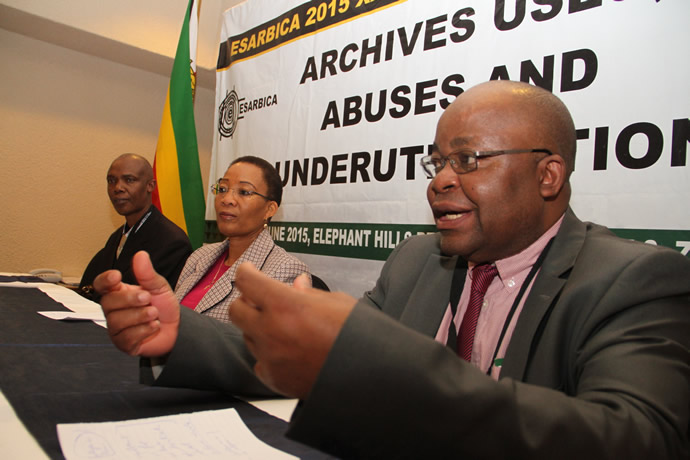
Lloyd Gumbo in VICTORIA FALLS
African national archives must balance the needs of both archivists and ordinary people who are the users of documented information if they are to remain relevant.
Delegates to the 23rd East and Southern Africa Regional Branch of the International Council on Archives (ESARBICA) said without consulting the end users, national archives would become irrelevant.
Professor Nathan Mnjama of the University of Botswana said there was need for a paradigm shift at national archives that were predominantly inundated with Government or administrative documents.
“There are very little documents about ordinary people in the villages out there because what we find in the national archives are records of administrators,” he said.
“Most of those documents are one-sided. They are telling the story of administrators and not ordinary people. We need a totally new approach to build records otherwise our archivists will remain useless if we don’t involve ordinary people.”
Presenting a paper on the National Archives of Zimbabwe, NAZ director, Mr Ivan Murambiwa and Mr Livingstone Muchefa said there was no direct engagement with ordinary record users as NAZ relied mainly on archivists and historians.
Said Mr Murambiwa: “Users of archives are hardly involved in the appraisal of archive processes. There is no legislation to include users at the moment.”
Added Mr Muchefa: “There is need to balance the interests of both archivists and users because at the moment we are relying on veteran users such as historians in records collection.”
A delegate from Namibia National Archives said they collaborated with the Namibia Broadcasting Corporation to transfer their files that would be between three and five years old to the National Archives.
As a result, she said they were able to document and process information from ordinary people.



 Online Reporter