

 daniel chigunwe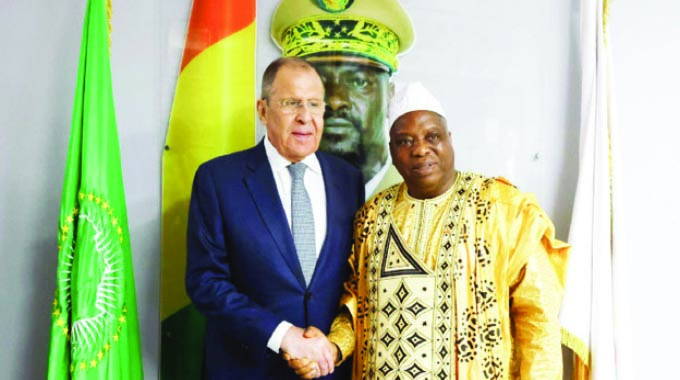
MOSCOW. – This week marked the start of Russian Foreign Minister Sergey Lavrov’s traditional annual tour to African countries.
This time, he has focused on countries in the Sahel (such as Guinea, Burkina Faso, and Chad) and the Republic of the Congo. Last year in May, he visited East Africa, and in December, he was in the north of the continent.
Over the past year, Lavrov’s engagements with African politicians have become more frequent, transitioning from something exceptional a few years ago to now being seen as routine.
The minister now speaks with Africa almost every week.
In January, he met with representatives from the Algerian Ministry of Foreign Affairs, in February with colleagues from Egypt, Mali, and South Africa, in March – Nigeria and Namibia, and in May, Sierra Leone, among other contacts. He has also had meetings with the King of Eswatini and phone calls with diplomats from various African countries.
It is worth noting that Sergey Lavrov often easily finds a common language with African colleagues, many of whom studied in the USSR/Russia.
For instance, the current head of Sierra Leone’s Ministry of Foreign Affairs, Timothy Musa Kabba, is a graduate of the St. Petersburg Mining University, while the head of the Ministry of Foreign Affairs of the Republic of the Congo, Jean-Claude Gakosso, studied at St. Petersburg State University (when it was still known as Leningrad University).
The intensity of these interactions is set to continue: following his tour, Lavrov will take part in the St Petersburg International Economic Forum (SPIEF), where the President Mnangagwa is expected to attend, along with representative delegations from Sudan, Burkina Faso, and other countries.
The BRICS summit is scheduled for October in Kazan, followed by the Russia-Africa ministerial conference in November. Despite this busy schedule and high frequency of contacts, it does not negatively affect their essence.
Critics tended to view Lavrov’s African visits in 2022-2023 through the prism of the Russian-Ukrainian crisis – ostensibly in 2022, Lavrov went to Africa to explain Russian approaches, and in 2023 – the prospects of the Black Sea grain deal.
At that time, there could be three or four high-level delegations from influential powers on the continent at once, seeking to win Africa over against the backdrop of events in Europe.
By 2024, external factors have already become routine, African countries are unwaveringly following their course of neutrality, and the grain deal has ceased to exist – which, by the way, did not lead to catastrophic consequences for global food security.
Despite this, the need for regular high-level contact remains.
Russia’s approach in Africa is becoming more comprehensive and proactive, and aims to inform other countries on the continent about its actions and intentions.
By engaging on multiple fronts simultaneously, Moscow can pursue a balanced approach that considers the interests of the widest possible range of friendly forces, yielding positive results already.
During his visit to Guinea, Lavrov met with his counterpart, Morissanda Kouyate, and transitional president Mamadi Doumbouya to discuss the prospects for economic and military-technical cooperation, as well as in the field of medicine.
Guinea stands out as one of the leaders on the continent by the volume of accumulated Russian investments due to RUSAL projects for bauxite mining and alumina production. Lavrov’s visit reaffirmed Conakry’s interest in maintaining friendly relations with Moscow.-Russia Today


 Peter Tanyanyiwa
 Online Reporter