Online Reporter
We continue our interview with former freedom fighter, Lieutenant-Colonel (Rtd) Njabulo Obert Ngwenya, pseudonym Cde Dokotela Makhalima.
In our previous edition, Lt-Col (Rtd) Ngwenya spoke to our Assistant Editor, Mkhululi Sibanda (MS), about how he joined the liberation war and his journey to Botswana en route to Zambia. In this week’s edition, he picks up the conversation by discussing his arrival in Botswana and his early days in Zambia, where he began his military training. Below are excerpts from the interview. Read on . . .
MS: May you please pick up the conversation by telling us about your arrival in Botswana.
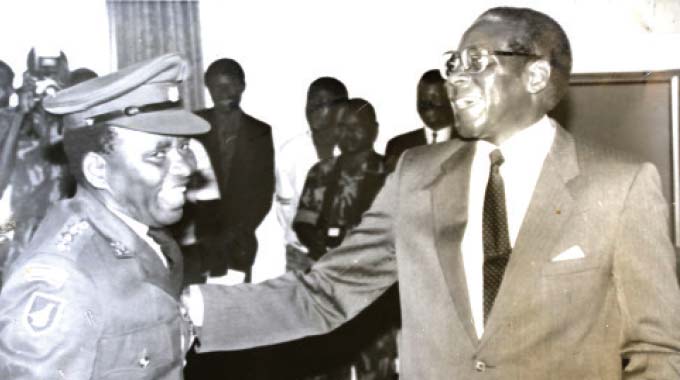
Lt-Col (Rtd) Ngwenya: I crossed into Botswana after spending the night perched on a tree. Once in Botswana, I got a lift to Francistown. I reported to the local police station where I was screened before being taken to Minestone, where other recruits were based. That is where I met ZPRA intelligence officers such as Black Swine (the late Lt-Col Elliot Mnyamana Sibanda), Nomali Ndlovu, and my former teacher at David Livingstone, Manyimo. Meeting him was a pleasant surprise. Among those waiting to be transported to Zambia for military training was the late national hero, Cde Zenzo Ntuliki, known as Maphekapheka, who later on became an Assistant Director in the Central Intelligence Organisation (CIO). At that time, the number of recruits was around 20, though the numbers quickly grew. Some recruits were also being held at Francistown Prison. During our stay in Botswana, we were tasked with constructing a refugee camp. I was part of the group that worked on the drainage system, septic tanks, and pit latrines. However, we left for Zambia before completing the construction.
MS: When did you leave Botswana for Zambia?
Lt-Col (Rtd) Ngwenya: It was in November 1975 when we were flown to Zambia. Upon arrival at Lusaka International Airport, we were met by trucks from the Zambian Defence Forces and taken to the famous Nampundwe Transit Camp.
MS: How was Nampundwe at that time? Some have spoken about the tough conditions created by the instructors there.
Lt-Col (Rtd) Ngwenya: I know what you are referring to. When we arrived in 1975, we were still few in number, so the situation was different from later years when recruits flooded into Zambia. With our small numbers, there was plenty of food, provided by the United Nations. We were also not subjected to the infamous initiation drills used to simulate a meeting with Joshua Nkomo, which instructors used to toughen up new arrivals. At that time, other recruits from both ZPRA and Zanla were based at Mboroma Camp. When we arrived at Nampundwe, we found just one guerrilla there — a Mozambican trained under ZPRA known as Cde Touch & Go. He had trained alongside comrades like General Philip Valerio Sibanda aka Cde Annanias Gwenzi.
MS: What was the Mozambican guerrilla doing at Nampundwe?
Lt-Col (Rtd) Ngwenya: He was not doing much militarily, but he introduced us to physical drills. Nampundwe was previously a Zanla camp, and we found a large stockpile of clothing there. Some comrades began stealing clothes to sell to locals, using the proceeds to buy beer and engage in other youthful mischief.
MS: How long did you stay at Nampundwe?
Lt-Col (Rtd) Ngwenya: About five months, if I am not mistaken. During that period, plans for the formation of ZIPA (Zimbabwe People’s Army) were underway. We were selected for training at Mwembeshi, which became the first ZPRA training camp inside Zambia. Before that, training was held outside Zambia — in countries like Tanzania and the Soviet Union. When we moved to Mwembeshi, it was still bushland. We cleared it ourselves to make it habitable. Recruits from Mboroma joined us to bring the number to 800. We became known as the Group of 800 — the largest intake ZPRA ever had. In contrast, the group training ahead of us at Morogoro had just 137 recruits. The size of our group excited both the ZPRA command and the Zapu leadership. Among the 800 of us were girls.
MS: Take us through your training at Mwembeshi.
Lt-Col (Rtd) Ngwenya: The camp commander of Mwembeshi was Sam Madondo, Stanley Gagisa as the Chief of Staff while Elias Ndou was the Commissar. As for the instructors we were handled by Busobenyoka, Velaphi, Boston Ngwenya, Phinda, Richard Mataure, Thodlana (Tshaka Moyo), Moto, Billy Mzamo and Jones. We spent only about two months at Mwembeshi before being informed that we were to move to Tanzania to join Zanla recruits at Mgagao. Meanwhile, other Zanla recruits moved to Morogoro, a ZPRA camp, to train alongside ZPRA comrades.
MS: You mentioned going to war at a young age. How did you find the transition from civilian to military life?
Lt-Col (Rtd) Ngwenya: I never regretted joining the struggle. I felt at home, especially being with former schoolmates from David Livingstone Mission in Ntabanzinduna. I teamed up with Glen Moyo from the Maphenduka family, who later became camp commander at Gwayi Mine Assembly Point after the war. Others from my school included George Muringani, Peter Mpala, Vusumuzi Ngwenya, and Sidingumuzi from the Sivako family. I also met comrades from my home area in Nkayi.
MS: Tell us about the move to Tanzania.
Lt-Col (Rtd) Ngwenya: We travelled as a group of 800, along with our camp commander Cde Madondo and his Chief of Staff Cde Gagisa, plus our instructors. The UN provided the trucks for our transport. When we arrived at Mgagao, we were surprised by the slogans being chanted by Zanla comrades denouncing our leader, Dr Joshua Nkomo. While we understood the criticism of other figures like Ndabaningi Sithole as internal Zanu matters, equating Nkomo with Sithole and Muzorewa offended us. Despite the political slogans, we admired the structure and organization at Mgagao. The camp commander was the late national hero, Lt-Gen (Rtd) Amoth Chingombe, also known as Cde Agnew Kambeu or Sparrow Kanyama.
MS: Was the intention to unite the two groups for joint training?
Lt-Col (Rtd) Ngwenya: Yes, but suspicions existed from the start. Zanla comrades suspected we were already fully trained, though we had only completed two months at Mwembeshi. They thought we were at Mgagao for revision, so there were no joint training sessions. We just did road runs while they continued with their programme, under our commanders Madondo and Gagisa. Eventually, clashes at Morogoro — where Zanla recruits were killed — sparked retaliations at Mgagao. We were shot at and we were defenceless as we did not have arms. We had to use the training that we had gained at Mwembeshi to escape including the girls we had. They also applied the military knowledge we had gained at Mwembeshi to duck the bullets to safety. This ended ZIPA’s hopes of unified training. We later resumed our training at Morogoro.
MS: As that was happening where were you?
Lt-Col (Rtd) Ngwenya: I escaped gunfire to take cover on the outskirts of the camp and I managed to conceal myself from the group that was making a follow-up on us. I was fortunate enough to find a God-given cover in the form of a huge tree that had fallen down. I squeezed myself under it. Later on when I realised that the shooting had stopped and it was at night then, I started making my way back to the camp to assess the situation. On my way I found a fellow recruit, Barnabas near the perimeter of the camp sitting and was in a terrible state of confusion. He updated me on what he had observed and we quickly left the place following the Iringa-Mgagao Road. On our way we met others and we briefed them about the situation at the camp, those ones were in hiding. They then joined as we moved away.
MS: How long were you at Mgagao?
Lt-Col (Rtd) Ngwenya: Around two months. When we moved to Morogoro, the camp was under Cde Sam Mfakazi, with Cde Tjile Nleya (aka Dubhu) as Chief of Staff and General PV Sibanda as his deputy. The instructors included Eddie Sigoge, Dry Phetsheya, Jack Mpofu, and Moses Phinda (Lawrence Makwarimba).
To be continued next week as Lt-Col (Rtd) Ngwenya talks about training at Morogoro and deployment to the front where he operated in the Kariba area.