admin
admin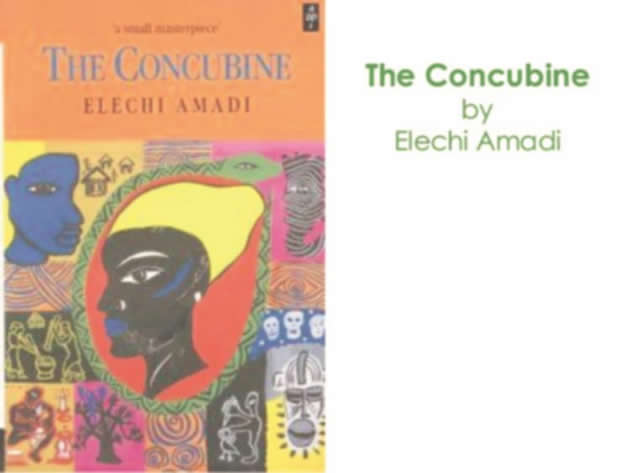
Book Review:
The Concubine
“The Concubine” is a novel by Nigerian author Elechi Amadi.
The novel was published in 1966 after which the author published a number of other literary works; some of which include “The Great Ponds” (1969), “Sunset in Biafra” (1973), “The Slave” (1978) and “Estrangement” (1986).
It is, however, “The Concubine” which stands out as the author’s crowning achievement.
The title of the book “The Concubine” is symbolic as its meaning is only revealed to the reader in the closing chapters of the novel.
It becomes clear that “the concubine” is none other than Ihuoma – a beautiful lady and the main character in the novel.
“The Concubine” has its setting in rural Nigeria, as the author makes an effort to depict the African traditional way of life in its totality; its religious, social, cultural and even economic practices.
A number of Nigerian rural villages are mentioned by the author, all of which aid in building the African authenticity of the novel.
The storyline of the novel revolves around the main character – Ihuoma, a beautiful and equally attractive lady in her village.
She gains the admiration of all and sundry, not only for her beauty but how gracefully she conducts herself in everything she does.
At the beginning of the novel, we get introduced to Ihuoma as married to Emenike.
Emenike had succeeded to get Ihuoma’s hand in marriage after another young man – Madume – had failed to win Ihuoma’s acceptance. Madume’s rejection by Ihuoma and her consequent marriage to Emenike causes hatred in Madume towards Emenike. Later on an argument over a piece of land results in a fight between Emenike and Madume.
Emenike succumbs to wounds resulting from the fight and dies of “chest lock”.
Madume suffers guilt for being responsible for the death of a kinsman.
It is easy to associate Emenike’s death to fate considering that he is a husband to Ihuoma and “protector of his home”.
Madume sees the death of Emenike as an opportunity to woo Ihuoma. She, however, refuses his advances which results in Madume harassing her. One day, Madume tries to stop Ihuoma from harvesting crops on the piece of land that had caused an argument between him and Emenike.
In the process a snake – cobra – spits into his eyes, resulting in blindness.
At this point, it becomes clear that a power stronger than that of a human is behind Ihuoma. Ekwueme is another young man who tries to woo Ihuoma after Emenike’s death.
Ihuoma tries to discourage Ekwueme, since she already has children and he is younger than her. After tirelessly trying to win Ihuoma’s approval, Ekwueme is unsuccessful and eventually marries Ahurole, who was betrothed to him in childhood. A marriage devoid of love towards Ahurole leaves Ekwueme “empty” and “lonely” and still attracted to Ihuoma.
Ahurole feels distanced from her husband and decides to administer a love charm to him, as per her mother’s advice.
The “medicine” has a negative effect on Ekwueme, who turns mentally unstable and pushes him more towards Ihuoma.
Meanwhile, Madume becomes unable to cope with his predicament – blindness – and decides to end his life; which is an abomination in his community.
On the other hand, Ekwueme recovers from his sickness after being granted the permission to marry Ihuoma. Prior to the wedding, “divine inquiry” is made, which reveals that Ihuoma is a concubine to a “Sea –King”. The divine being is behind the deaths of Ihuoma’s suitors – as a result of jealousy.
Despite the revelation of the impending misfortune, Ekwueme and Ihuoma consider it too late to reverse their relationship and thus go ahead with their wedding preparations.
During the wedding preparations, Ekwueme is shot by a stray arrow, shot by Ihuoma’s son during play. Ekwueme succumbs to the arrow wound and dies. Ihuoma is left devastated and wishes for her own death. The novel ends with Ihuoma in a state of devastation.
Themes
The author has explored a number of themes in the novel the major ones being; role of the supernatural on human lives. Supernatural forces are evidently seen to have an upper hand on human relationships and control the course that such relationships take.
This is evidenced in the novel where the “Sea-King” has a hold on Ihuoma’s life and eliminates all who try or succeed in winning her love. In line with the theme on the role of divinities in human lives, is the theme of superstition.
Superstitions were common in tradition African societies and are seen in the novel when community members consult mediums before undertaking various quests.
The theme of love is also explored in the novel by the author. Emphasis is on how strong love is. The author depicts love posing a challenge to the supernatural forces surrounding Ihuoma’s life.
Love is expressed through various suitors to Ihuoma, while the supernatural forces take the form of the “Sea-King”. Ekwueme is certain of his fate if he marries Ihuoma, but goes on, driven by love.
Characters
There are a number of characters in the novel, among them:
Ihuoma – a lady and the leading character in the novel
Emenike – Ihuoma’s husband at the beginning of the novel
Madume – One of the rejected suitors by Ihuoma and husband to Wolu
Ekwueme – A young man and suitor to Ihuoma
Ahurole – A beautiful lady from Omigwe and wife to Ekwueme. – Reproduced from African Literature Reviews



 Online Reporter