

 admin
admin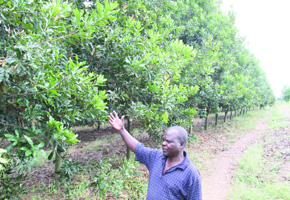
Macadamia, a lucrative and easy-to-grow nut is another crop that thrives in Chipinge’s excellent conditions. The commonest cultivars grown in the area are beaumonts and integrifolia.
“It is very easy to grow macadamia,” said Mr Julius Chinheya, manager at Plot 4, in Newcastle farming sector.
“You don’t stress about it as you do with coffee or tobacco for instance, but the rewards in terms of producer prices are the same, even better when you consider the limited investment and attention you put in. It is a tree, so you don’t need to weed as much as you do a crop like tobacco — you simply get workers to manually slash the field or to get a tractor do that. Yes you need some fertiliser but it is only about a kilo of Compound X per season per tree. But one thing you must do is to spray the trees at flowering stage. This is the major pressing task a farmer has so that you kill pests that, if unattended, contaminate the nut otherwise it is a lucrative crop which does not demand much.”
A macadamia tree gives a farmer around 100kg of the nuts per season and a tonne of dehusked nuts sells for at least $2 000. Some estimates are that a good crop can earn a farmer $7 000 per hectare, per year.
About 120 farmers grow macadamia nuts across the country. Apart from Chipinge, the nut is also grown in Nyanga, Chimanimani and Marondera. There is potential for its production in parts of Midlands. It grows best in sub-tropical climates, which are sunny and receive lots of rain. Zimbabwe, Australia, South Africa, Kenya, Guatemala, Malawi and Brazil, are the world’s main growers of the crop.
A macadamia is a very hard-shelled nut which can be eaten or processed into as many as 36 products. It can be eaten raw or roasted. It is native to the eastern coast of Australia, where it is popular, either eaten alone or in cooking. The crop is also known as the Queensland nut or, in some areas, bauple nut.
Macadamia nuts can be processed into soap, body lotions and cosmetics while the crushed nut can also be put on cakes. Zimbabwe exports the product to South Africa, which in turn exports to Europe and England.
Ms Hilda Sabeka, a senior worker at another farm some 30km east of Chipinge town, said they have 48ha under macadamia. In some cases, she said farmers pick the nuts from fully-grown trees, but in others, they can do grafting on smaller, one year-old trees. Grafting is a horticultural technique whereby tissues (in this case small branches) from one plant are inserted into those of another so that the two sets of vascular tissues may join and grow. The smaller tree bear fruits on the grafted part.
“Macadamia production is profitable. Some say it is also easy,” she said.
“It can pass as an ordinary, useless tree to those who don’t know, but is in actual fact a lucrative crop. We have been farming here for three years, so we are not yet there. But we are confident we will be there. In 2011, we harvested 75 tonnes, but this year, it was bad because of poor rains. We harvested 47 tonnes. Next season we hope for a better harvest because we will soon start irrigating the trees. The system is there, so nothing can stop us from growing bigger.”
To grow the crop, a farmer collects nuts and sows them in a nursery. After it grows to 30cm in height, the seedlings are lifted and planted in the field at a spacing of three metres all-round. It grows into a three to four metre tall tree in five years at which age it begins to bear a lot of fruits. It continues to do that for as many as 30 years. The tree is a fast growing, regular-shaped, medium-sized tree with heavy, dark green foliage. Leaves develop in whorls of three, paired, or in fours. Its flowers are small, whitish, tasseled, and grow on long spikes.
The nuts ripen in about 10 months and in Chipinge are picked around March. They fall on their own if the variety is integrifolia. Beaumonts normally do not fall on their own so the farmer can enforce that by shaking the tree vigorously. The nuts are then picked manually.
The nut is encased in a leathery two-halved case that is about two centimetres in diameter. The case encloses one spherical nut or two hemispherical nuts. The nuts have a smooth hard shell that encases a white kernel.
The highest quality macadamia kernels are free of defects and insect and fungal damage, and they contain at least 72 percent oil. The kernel is the main product from the macadamia nut tree. After harvesting, the husks covering the nuts are removed. The nuts are fried, the shells are cracked, and the kernels are removed to be oil-roasted or dry-roasted. So macadamia has two layers of hard shells that are removed before one gets the oil-bearing nut.
In some cases, the kernels are sold as snack nuts and chocolate-covered candy. Ice cream manufacturers and the baking industry also use macadamia kernels as an ingredient. The shell and husk also have their uses. Shells can be used as mulch, fuel for processing macadamia nuts, plastic manufacture and as a substitute for sand in the sand-blasting process. Husks are used as mulch or composted for fertiliser.
Oil can be extracted from culled nuts. The cosmetic industry, especially in Japan and to some extent, China, uses the oil in soaps, sunscreens and shampoos. The remaining press cake might be used for animal feed.
Of the 70-hectares at the Newcastle plot, 40ha are under beaumonts, 15-ha under coffee and another section planted with potatoes. Mr Chinheya said the past two harvests have been good. They could have been better if trees in about 20ha of the farm were not razed by a wild fire last year.
“Also, there was not enough rain last year,” he said.
“Because of the fire, we could not irrigate as our pipes were burnt. We feel that if we re-develop our irrigation infrastructure and start irrigating, we will harvest more. We already have a reservoir in place, so if we lay new pipes, we will simply get off.”
Macadamia nuts must be de-husked within 24 hours after picking. Leaving the husk on for more than two days causes mould and increases processing time as the husk tends to harden. After de-husking, the nuts must be carefully sorted for size and quality. They must then be air-dried in a shade for at least two weeks. During this drying process the moisture content of the nut is reduced and it becomes firm.
In Zimbabwe, macadamia production started around 2000 in the eastern border highlands, although it can be grown in agro-ecological regions one to three, said Mr Lazarus Dhliwayo, technical adviser of the Macadamia Growers’ Association of Zimbabwe. He has high hopes for the crop, despite the fact that many growers are still new in the sector.
“It can be more viable than tobacco,” said Mr Dhliwayo, who also grows the crop.
“Many of us have been on the farms for three seasons or so, which is not a long period on a farm. I am positive about macadamia. Give us a few more years.”



 Online Reporter