admin
admin
Elita Chikwati
Features Editor
Diversifying livelihoods can be a key strategy for building resilience to drought and climate related disasters in different communities.
These are the sentiments of the Madabe community in Mangwe who have called on authorities to assist with alternative sources of livelihoods other than farming.
The Mangwe community like many other parts of the country has been negatively affected by the El-Nino induced drought which decimated the district’s agricultural sector and left many people without the means to support themselves and their families.
Alternative forms of livelihoods such as mopani worms and wild fruits were also affected during the 2023/24 summer cropping season leaving people with limited survival options. Mangwe district is in the western part of Matabeleland South Province.
The district which is made up of 17 rural and six urban wards, falls within agro-ecological regions IV and V, with more frequent droughts due to longer dry spells and an erratic distribution of rainfall ranging from 250mm to 450mm annually, leading to low yields.
Farmers in the area have been growing drought-tolerant crops such as millet, rapoko, groundnuts, sorghum, and cowpeas. When the rainfall season is normal, the average harvest per household may last a single season.
Most wards in the district have experienced food deficits since 2002 and most households have over the years been relying on food/cash assistance mainly from Government and its development partners such as the WFP and World Vision through the Lean Season Assistance (LSA) and the social services grain distribution programme.
The LSA usually runs from January to March every year.
Other livelihood activities that support the Madabe community include remittances and subsistence farming, which is dependent on natural rains.
Due to the El Niño-induced drought, most crops have failed, and water for livestock has dried up.
The community has thus called for income generating projects so they can maintain their livelihoods even during drought years.
According to the people in Madabe, while food assistance is good it will be more sustainable if they are empowered with income generation projects that are not linked to agriculture.
Through self-projects, the community will be able to sustain itself even after being weaned off from the food assistance programmes.
Mrs Talent Jingo from Madabe Village said this season the traditional grains were affected by the drought and most families were not expecting much from the fields.
“Even after the lean season we will still be in need of food assistance.
“In a normal season we harvest mopani worms (Madora/macimbi for sell but this season the drought was so bad that there were no worms. There were no wild fruits which we also rely on.
“Our situation could improve if we have other income generating projects other than relying on rain-fed agriculture. We can seed money to start income generating projects. If we have other sources of livelihood we will have an alternative source of income even when rains are scarce.
“We need help to diversify sources of income to reduce dependence on rainfed-agriculture. We can have projects such as bee keeping, poultry farming and fish farming to supplement incomes and cope with food shortages caused by droughts,” she said.
Witness the Jubani from the same area said he was grateful to Government and the development partners for ensuring they had food but said there could be other interventions such as expansion of irrigation activities.
“We produce traditional crops and also offer farm based causal labour to other farmers. This season the situation was so bad that casual labour opportunities were not available as the crops failed at an early stage.
“Self-help projects such as carpentry, dress making and soap making can also help the youth in Madabe. If we have skills, we can provide for ourselves even if our crops fail,” he said.
Madabe Village head, Mr Joseph Nleya said the situation could also improve if locals get food for work projects.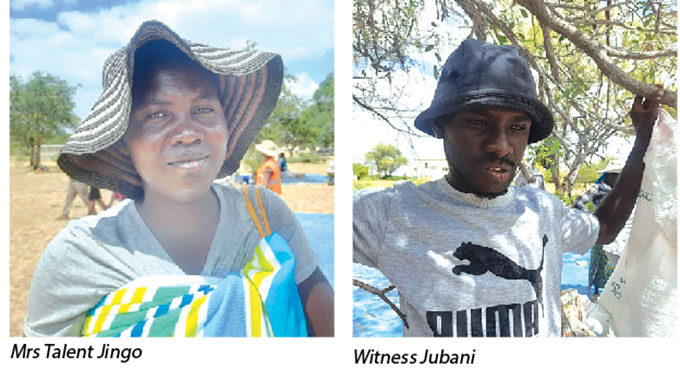
“We hope we can have food for work projects where locals can work and get paid. The situation could also improve if we had access to irrigation facilities. This year our dam is drying up and the river bed has gone dry. There is need to have more irrigation facilities,” he said.
USAID mission director, Mrs Janean Davis said they were waiting for the ZIMVAC report to know the number of food insecure people who require assistance.
“It is also important for us to provide additional opportunities so that even throughout the year, people have the means to support their families and households.
“We appreciate the WFP’s support for Zimbabwean smallholder farmers for sourcing some of the commodities from local manufacturers who purchase the produce from farmers,” she said.
Minister of State for Matabeleland South Provincial Affairs and Devolution, Dr Evelyn Ndlovu, urged people not to despair as Government was working with developmental agencies to assist those facing food shortages and ensure food security.
She said people should also unite and help each other in times of need as better times were coming.
“You should have hope as we are coming back as Government together with the WFP, USAID and World Vision to help you. Not even one person will die of hunger in Zimbabwe, even the President says so.
“No one will die of hunger this year. When the cropping season comes we will also give you seeds and fertilisers for next year. Let us keep together as Zimbabweans and love each other,” she said.
WFP country director, Ms Francesca Erdelrmann said the organisation was not only concentrating on food distribution.
“We are also working with communities to build resilience, infrastructure that will allow them to do local production of cereals and fruits and vegetables and bring them to the market.
“We are working with the Mangwe community to bring new, climate smart agricultural techniques and at the same time benefit from traditional practices that the elders bring to the table so that together we look for solution not only to this year’s drought but to climate changes they will be experiencing in the years to come,” she said.
The 2023/24 agricultural season has not performed according to expectations due to the El Niño- induced drought. More than 80 percent of the country received below normal rainfall.
About 1 728 897 hectares had been put under maize and other cereals and from this, the country is expecting 868 273 tonnes from this season’s harvest leaving a deficit of 680 000 tonnes of grain. This deficit will be bridged by imports.
President Mnangagwa last week declared a nationwide state of disaster due to the El Niño-induced drought.
The President also called on Zimbabweans of goodwill, including those in the diaspora; the international community, United Nations agencies, development and humanitarian partners, international financial institutions; the private sector, churches and other faith-based organisations, as well as individuals to generously donate towards ameliorating this State of Disaster.
President Mnangagwa assured the nation that “No one and no place will be left without sustenance”.
Climate change is having a significant impact on crop production not only in Zimbabwe or Southern Africa but also in many parts of the world.
In Zimbabwe, Government through the Lands, Agriculture, Fisheries, Water and Rural Development has come up with different initiatives to boost agricultural productivity.
These include establishing irrigation schemes for small holder farmers, promoting conservation agriculture popularly known as Pfumvudza/ Intwasa and promoting production of traditional crops that are nutritional and at the same time tolerant to drought.


 Online Reporter