Online Reporter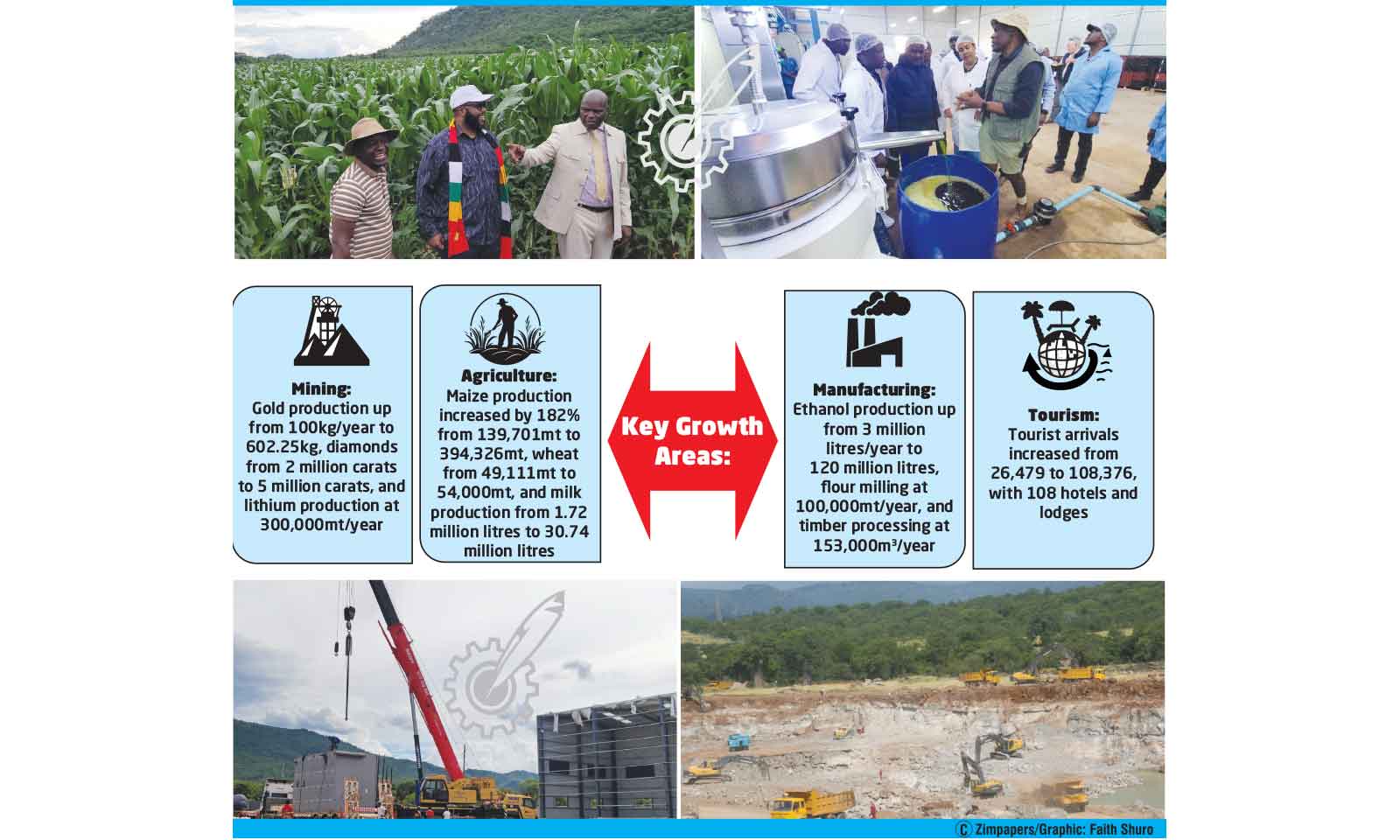
Samuel Kadungure
News Editor
MANICALAND’S Gross Domestic Product (GDP) has surged by 132 percent under the National Development Strategy (NDS1), catapulting the province’s economic output from US$1,46 billion in 2021 to US$3,4 billion per annum in 2025 – Minister of State for Manicaland Provincial Affairs and Devolution, Advocate Misheck Mugadza has revealed.
Speaking in an exclusive interview with The Manica Post, Minister Mugadza revealed that the province’s per-capita income has also risen from US$1 261 in 2021 to US$1 705,64 in 2025, reflecting improved economic fortunes for citizens in the province.
The driving forces behind this remarkable growth are the mining and quarrying, agriculture, and manufacturing sectors, which collectively contribute over 50 percent to the provincial GDP.
GDP, a key indicator of economic performance, represents the final value of goods and services produced within a given area’s geographic boundaries over a year. Per capita GDP, calculated by dividing the area’s GDP by its population, provides insight into the standard of living and citizens’ economic benefits.
Manicaland’s population has grown from 2 037 762 in 2022 to approximately 2 098 110 in 2023, marking a 2,9 percent growth rate.
“Per capita income value improved steadily over the National Development Strategy (NDS1) period, with the current value being US$1 705,64.
“We are the most populous rural province – hence, population growth rates usually match and even sometimes outweigh GDP growth rates, thus negatively impacting GDP per capita income.
“Our target, as we transition to NDS2, is to increase it to US$4 000, anchored on increased investment in agro-processing, manufacturing and mineral processing.
“Unemployment rate has reduced significantly from 27,2 percent in 2021 to around 14 percent in 2025 owing to massive investment of over US$500 million realised in the province during the NDS1 period, and massive value addition projects which have been established. We intend to further reduce unemployment to below 10 percent through increased investment in infrastructure and manufacturing,” said Minister Mugadza.
He revealed that the value of investment has risen from US$50 million to US$171 million per annum in 2025.
“Between 2021 and 2025, Manicaland recorded a significant increase in total investment value from US$50 million to US$171 million, reflecting a more than threefold growth. This achievement is attributed to improved ease-of-doing-business reforms, increased investor confidence, and deliberate provincial efforts to promote key sectors such as mining, agriculture, tourism, and manufacturing.
“Enhanced infrastructure development, investment promotion initiatives, and policy stability also played a critical role in attracting both local and foreign investors, positioning Manicaland as an emerging investment destination in Zimbabwe,” said Minister Mugadza, adding that the province targets US$150 million in new investments per year.
He said tourism growth has seen the number of hotels and lodges going up to 108, while value of investment in the sector rose from US$3 708 748 in 2021 to US$8 683 432 in 2025.
Tourist arrivals went from 26 479 to 108 376 per year, and under NDS2 focus will be on promoting MICE industry and construction of a convention centre and five-star hotels in the province.
“(We need to) promote Manicaland as the ‘Gateway to the Sea’ for tourism and trade as well as secure strategic investment for international tourism infrastructure like border posts and airports,” he said.
Minister Mugadza said under food and nutrition, the province was the most food secure except in extreme droughts.
Under the period, maize production rose from 139 701 metric tonnes to 394 326t in 2025, wheat (49 111mt to 54 000t), sorghum (34 168mt to 40 368t), beans (4 329t to 7 069t), milk (1,72 million litres per annum to 30.74 million litres in 2025. Area under timber went up from 65 168ha to 66 343,43ha, and the provincial cattle herd from 615 190 to 650 484 in 2025.
“The province adopted smart agricultural practices as well as crop tailoring. The major food baskets are the districts of Chipinge and Makoni.
“Maize production increased by 182 percent from 139 701mt in the 2020/21 season to the 2024/25 season. Wheat contribution rose gradually from 49 111mt in 2021 to 58 000mt in 2025 season and the provincial contribution to national output has been maintained at seven percent over the period.
“The focus under NDS1 was to increase hectarage, improve on productivity and quality.
“ Since the introduction of the Presidential Silage Scheme in 2022, milk production has increased from 1,72 million litres to 30,74 million litres, contributing 27 percent to national output. The area planted under coffee is increasing as smallholder farmers come on board.
“The province has potential to plant 120 000 hectares of timber plantations. Despite the adverse effects of the January disease, the cattle herd is on an upward trajectory,” said Minister Mugadza, adding that the dairy sector targets to increase milk production to three million litres per month by improving and increasing the dairy herd as well as participation of the smallholder farmers in the dairy industry.
He said the number of irrigation schemes has increased from 40 to 71 in 2025, while the area under irrigation went up from 4 248ha to 27 000ha to date.
“Irrigation schemes were expanded and rehabilitated, with some being modernised, improving access to agricultural water. As a result of the Smallholder Irrigation Revitalisation Programme (SIRP), the area under irrigation improved from 4 248ha in 2021 to 27 000ha.
“Notable irrigation schemes include the Cashel Valley (602ha), Musikavanhu (570ha), Romsley (384ha) and Chibuwe (370ha). In total, the schemes are set to benefit over 5 000 families.
“The province is targeting to construct five dams, starting with the Kondo Dam, which will be the largest inland dam,” he said.
Minister Mugadza said value addition capacity utilisation rose from 55 percent in 2021 to 67 percent in 2025.
Ethanol production rose from three million litres per year to 120 million litres in 2025, while flour milling shot up to 100 000mt per annum in 2025.
Milk processing went up from 800 000 litres/month in 2021 to 2,5m litres/month in 2025, while timber processing rose from 65 000m³ per annum in 2021 to 153 000m³ per annum in 2024.
Avocado oil processing stands at 170 000kg/month.
“Capacity utilisation of local industries improved from 55 percent in 2021 to 67 percent in 2025. This is attributed to stability in power supply, as most industries opted for investments in renewable power options. The growing confidence of investors, coupled with stable prices, also resulted in the utilisation of installed capacities.
“Gains in capacity utilisation are also evidenced by increased availability of domestically produced goods in supermarket shelves, accounting for about 80 percent. Contribution of the manufacturing sector to exports also improved in the province to over US$25m due to improved value addition in the province in avocado, macadamia, citrus fruits and many other agricultural products.
GreenFuel increased the hectarage under sugarcane to 12 000ha, and increased the distillation and holding capacity, while Mega Market set up a state-of-the-art US$25 million flour processing plant in Mutare,” he said.
Minister Mugadza said gold production went up from 100kg per year in 2021 to 602,25kg in 2025, diamonds from two million carats to five million carats in 2025, while lithium production stands at 300 000mt per annum.
“The province’s mining sector increased production of the major minerals by over 300 percent as new minerals such as lithium came on board and existing mines such as Zimbabwe Consolidated Diamond Company (ZCDC) expanded.
“Under NDS2, exploration in gold and diamond mining are in progress and preliminary results are encouraging. Mineral beneficiation industries are envisaged in the province especially with expected completion of the Gemmology Centre,” he said.
Minister Mugadza said housing units delivered rose from 368 per annum in 2021 to 4 575 in 2025, while the number of serviced stands rose from 356 stands to 6 064 stands in 2025.
He also said the number of hospitals still stands at 35, while the number of clinics has gone up from 214 in 2021 to 435 in 2025. Maternal mortality ratio has gone down from 115/100 000 in 2021 to 90/100 000 in 2025, while HIV coverage has gone up from the 95, 95, 95 in 2021 to 96, 97, 96 to date.
He added that the province has witnessed improved Water, Sanitation and Hygiene (WASH) coverage from 26 percent in 2021 to 45 percent in 2025.
“We recorded increased education institutions – primary schools were 822 in 2021, and we now have 1,259, while secondary schools were 298 in 2021 and 476 in 2025. This corresponded with an improved pass rate at Grade Seven (58,48 percent 2021 to 59,78 percent); ‘O’ Level (27,49 percent to 35,69 percent) and ‘A’ level (89,28 percent to 97,11 percent),” he said.