Online Reporter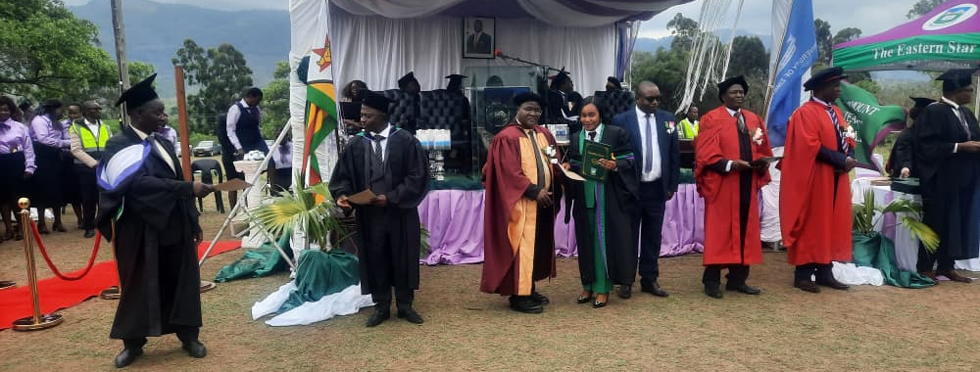
Tendai Gukutikwa
Post Reporter
MARYMOUNT Teachers’ College has been commended for establishing two high schools, and working towards opening a third, a move that strengthens the link between teacher training and practical classroom experience, while expanding access to education in underserved communities.
Speaking during the college’s graduation ceremony held in Mutare last week, Higher and Tertiary Education, Innovation, Science and Technology Development Minister, Ambassador Dr Frederick Shava, who was represented by Chief Director in the ministry, Dr Engineer Willie Davison Ganda, praised the institution for translating the national Education 5.0 philosophy into tangible development projects.
He said the practising and consortium schools being established by tertiary institutions like Marymount Teachers’ College are instrumental in connecting theoretical learning to practical application, while also responding to national goals of industrialisation, innovation and community empowerment.
“Marymount is establishing practising schools that reinforce the connection between theory and practice. These schools, including the high school in Headlands, and the upcoming Foroma High School in Chipinge, expand access to education in marginalised communities, and help absorb graduates into the workforce,” said Minister Shava.
He said the college’s initiatives demonstrate how higher education institutions can be centres of innovation and self-reliance.
Minister Shava further urged higher learning institutions to emulate Marymount Teachers’ College’s model by commercialising their innovations to generate income and promote sustainable growth within communities.
“Looking ahead, I am encouraged by the college’s efforts to commercialise more products. Let us support this pride for it to generate income, and serve as a model of self-reliance and entrepreneurship for the learners we teach,” he said.
The Minister also commended the college’s strong participation in national educational and research programmes, exhibitions, and innovation fairs, as well as sporting and cultural competitions.
Marymount Teachers’ College principal, Mr Martin Mukwazhe, said the establishment of the schools is part of the institution’s broader transformation under the Education 5.0 model, which mandates tertiary institutions to be hubs of teaching, research, community service, innovation and industrialisation.
He said through the Practising and Consortium Schools Programme, the college had this year opened two new schools, one in Headlands, Makoni District, and another in Foroma, Chipinge District, while work is underway to establish a third one in Zimunya.
“This year alone we have established two schools, one in Headlands, which opened its doors in February 2025, with an initial enrolment of 180 learners, and another in Foroma, Chipinge, which is expected to open in January 2026,” said Mr Mukwazhe.
He added that the Headlands project is growing steadily, with plans to construct boarding facilities and increase enrolment to 300 learners next year, and to 1 000 learners by 2027.
Mr Mukwazhe said plans for the third project in Zimunya are already advanced, as the college works with a group of former students to regularise land acquisition and begin construction early next year.
The Zimunya project will take the form of a student-led consortium primary school, promoting innovation and entrepreneurship among teacher trainees.
He said the practising schools serve as platforms where students on teaching practice can apply theory in real classroom environments, while also contributing to rural development and job creation.
“At Marymount Teachers’ College, we have fully understood that today’s teacher must be an innovator and an entrepreneur. Our curriculum has been transformed in light of national priorities to drive production and commercialisation of goods and services,” said Mr Mukwazhe.
He added that beyond school establishment, the college has scaled up its production units to promote self-reliance and practical learning.
These include agricultural projects, honey processing, garment manufacturing, and detergent production, all providing students with hands-on experience aligned with industrial engagement.
“Our agriculture operations now meet the college’s food requirements and provide valuable exposure to our students. The productive activities ranging from farming to garment making offer practical lessons that tie into Education 5.0’s goals,” said Mr Mukwazhe.
He said the institution’s heritage-based education approach also ensures that innovation is rooted in local culture, values and identity.
“Our education must reflect who we are, where we come from, and where we aspire to go. By integrating local histories, languages and practices into our teaching, we empower students to tell their own stories through education,” he said,” he said.
The principal also expressed gratitude to Government and the college’s stakeholders for supporting its efforts to strengthen the education value chain through innovation, community engagement and the creation of employment opportunities.
He said the college’s progress illustrated what Education 5.0 could achieve when implemented with purpose and commitment.
“Marymount Teachers’ College’s transformation is, not just about building schools, it is about building a legacy. We are producing educators who are thinkers, innovators and change-makers, ready to serve Zimbabwe with excellence and pride,” said Mr Mukwazhe.