

 dyton mupawaenda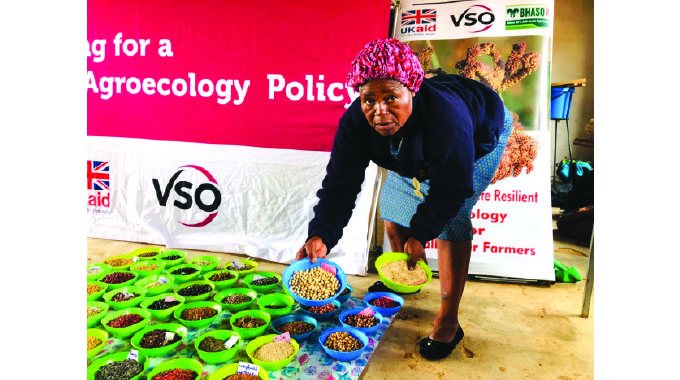
Lungelo Ndhlovu
Mr Nelson Mudzingwa’s homestead in Shashe mining village, Masvingo, welcomes visitors with a delightful green setting dotted with orange trees, a variety of green vegetables, pawpaw trees, banana trees, goat and cattle pens, and two fish ponds.
The farmer and his fellows are into horticulture. They produce vegetables and fruits. The farmers are also into apiculture, aquaculture and eco-tourism.
Mr Mudzingwa also has also established a seed bank and focus on farmer training programmes.
The small-scale farmer is an expert in agro-ecology, a form of agriculture that emphasises interactions between species of various classifications such as plants, animals, people and the environment.
Agro-ecology is farming that involves food production using locally available resources in a sustainable way.
Agro-ecological farmers seek to improve food yields for balanced nutrition, strengthen fair markets for their produce, enhance healthy ecosystems, and build on ancestral knowledge and customs.
“Within the Shashe blocks of farms we have the Shashe Agro Ccology School,” said Mr Mudzingwa.
“This is an initiative by local farmers, those that have gone onto the new land, through the Government supported land reform programme in 2000.
“As we acquired the new land, we already had a wealth of experience regarding our relationship with the vital key resources that God has created, including the earth’s waters, soils, and all biological resources, flora, and fauna that are contained in our mother earth.”
Mr Mudzingwa said the community was part of a connected ecology.
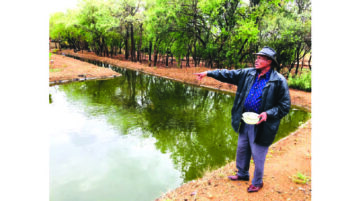
Mr Nelson Mudzingwa points at a fish pond at his homestead in Masvingo. Inset: The seed bank he kept for the next farming season.
“We chose to build the Shashe Agro Ecology School on the new land, which is 184 hectares divided between two families, each of whom has a farm within a farm,” he said.
“We have also reserved an area for grazing livestock because the location is a desert and receives only 400 millimetres of rain on average each year.”
Mr Mudzingwa urged other farmers in Masvingo to adopt agro- ecology to be food and nutrition secure.
“Agro-ecology is a practice that farmers must adopt if they want to attain food sovereignty,” he said.
“When we discuss food sovereignty, we are referring to the variety of foods that we must eat to obtain the balanced nutrition that each and every household must provide. “I have personally significantly reduced costs for buying food. We only purchase a few items that we cannot produce such as salt.”
According to Mr Mudzingwa, their seed bank distributes free seeds to communities, who then return new seeds to the bank after harvest.
“Since the year 2000, we have not purchased any seed from retailers; instead, we rely on our own high-quality seeds from crops that we collect from our agro-ecology activities,” he said.
Shashe Agro-ecology School chairperson, Mrs Elizabeth Mpofu, said the community created these centres of excellence so that they could share experiences with other farmers in Shashe communities and across the country.
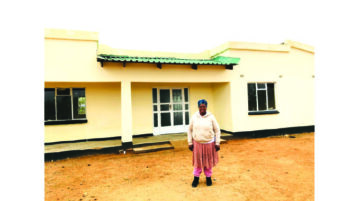
Mrs Elizabeth Mpofu at the Shashe Agroecology School of Excellence in Masvingo. — Pictures: Lungelo Ndhlovu.
“We also host farmers who come from different nations, such as South Africa, Mozambique, Uganda, and Lusaka, to learn about agro-ecology,” she said. “For us, agro-ecology is something that we think was given to us by our ancestors, who we believe had been using it for a very long time. It means using what is around you. We do not even consider going to buy fertiliser or seeds, instead we use what is around us and our traditional seeds.”
Smallholder farmers in the Shashe area are also preserving all traditional varieties of corn, coffee beans, chillies, vegetable seeds, sunflowers, and other crops.
Shashe village leader of Chief Bere area, Mrs Happymore Mudyahoto, indicated that community members in the Shashe block of farms began practicing agro-ecology in 2001, learning how to cultivate crops without the use of fertilisers, as well as farming all types of traditional seeds despite the prolonged dry spells faced by farmers in Masvingo.
“We are very happy with agro-ecology because our soils work well with traditional small grains,” she said.
“We have harvested enough traditional crops from the previous farming season. These are enough to last us to the next season. Traditional food is good for our health.
“For example, we have peanuts to make peanut butter or mutakura. Peanut butter and beans can also be prepared as relish or porridge and this food is ideal for those suffering from chronic diseases such as diabetes.
“We do all this farming (agro-ecology) without the use of fertilisers. Our crops are short season varieties and they mature early as compared to maize.”
The Voluntary Services Overseas (VSO) organisation, which works with women smallholder farmers, has formed partnerships with farmers in Masvingo to promote traditional grains, water conservation, and support the Shashe Agro-ecology School.
VSO programme manager, Mr Simba Guzha, said the organisation collaborated with farmer networks, farmer movements and small-scale farmers because they have been the hardest hit by climate change and the related food inflation crisis.
“We are also capacitating or training farmers so that they increase their resilience and adapt to this climate change through growing traditional grains which are drought tolerant and also disease tolerant,” he said.
“Custodians of the traditional grains are women. We also try to empower women by growing these crops so that they can improve in terms of food security at household level.
“We would like to push for agro-ecology to be recognised as part of the action plans in our climate change adaptation plans.”



 Online Reporter