Chronicle Editor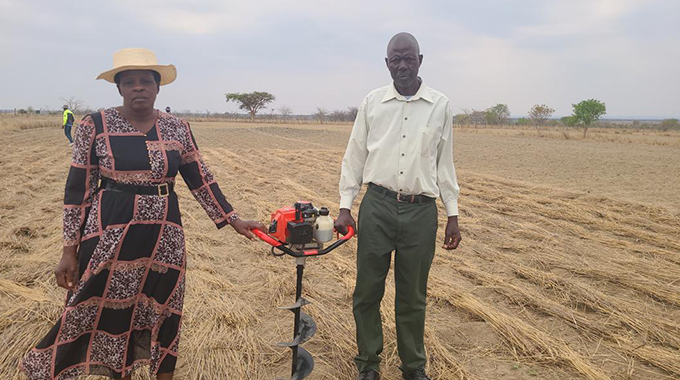
Sukulwenkosi Dube-Matutu, [email protected]
FARMERS in Matabeleland South province have embraced the mechanised Pfumvudza/Intwasa programme, which has eased the burden of hard manual labour while enhancing production efficiency.
Mr Fackson Moyo and his wife, Lungile, who are farmers in Umzingwane District said they managed to prepare six plots using an auger machine, which helped them meet their target. The couple also received training on how to use the machinery.
“We adopted the Pfumvudza/Intwasa programme a couple of years back and we have been able to harvest every year despite the amount of rains received,” said Mr Moyo.

“This time around, it was even easier to prepare our plots as we were using an auger. We have prepared six plots and we are looking forward to a bumper harvest since we have been assured of normal to above normal rains this season.
“The model of using basins is very effective as these trap water and we also feed our crops with the much needed mulch.
“We borrowed an auger machine from a relative and it came in really handy and we plan to buy one for ourselves to make our farming easier,” he added.
Mr Moyo and his wife recently hosted the Umzingwane District Pfumvudza/Intwasa launch and showcased how they were able to complete their plots timeously through mechanised digging of holes.
He said using an auger machine also helps to create good basins and applauded extension services support from the Government.

Speaking at the field day recently, Matabeleland South provincial Agriculture Advisory and Rural Development Services (Aards) director, Mrs Shupikai Sibanda, said her office has upscaled efforts to encourage farmers to adopt the Pfumvudza concept. This year, the province is targeting 500 000 plots under the Pfumvudza/Intwasa programme.
She also urged farmers to embrace mechanisation saying where farmers cannot afford to buy the machinery they can come together and mobilise resources to buy the equipment, which they can share.
Mrs Sibanda said communities have to embrace various Government support programmes to cushion farmers against the effects of climate change. She said the prevailing weather conditions require farmers to depart from the traditional way of farming.

“It’s high time all farmers transform their farming activities. We don’t want any farmers to die of hunger when they have resources such as livestock and land,” said Mrs Sibanda.
“As Government, we are saying farmers must adopt the Pfumvudza/Intwasa programme and now, we are also encouraging farmers to adopt the mechanised method.”

Mrs Sibanda said farmers should also grow fodder for silage to boost livestock production. Government has set a target of reaching 3,5 million rural and peri-urban households under this year’s Pfumvudza/Intwasa programme. To ease the workload on farmers, especially the elderly, the Government is encouraging the adoption of mechanised Pfumvudza/Intwasa, which requires less manual labour than traditional methods.
Since its introduction under the Second Republic, Pfumvudza/Intwasa has been lauded as a transformative tool for smallholder farmers, moving subsistence farming towards commercial viability. The distribution of inputs is underway at the Grain Marketing Board (GMB) depots across the country.

As dry conditions in places such as Matabeleland continue, experts recommend farmers to consider cultivating traditional grains that are drought tolerant.
The Second Republic led by President Mnangagwa initiated the Pfumvudza/Intwasa programme a few years ago to counter the effect of low rainfall caused by climate change. Pfumvudza/Intwasa has helped the country attain food security, at the same time boosting farm incomes as subsistence farmers are converted to small scale commercial growers.

The programme entails use of mulch to retain moisture for some time in the event of rains. Many countries are keen to learn about the Pfumvudza/Intwasa scheme from Zimbabwe so they boost their yields.
The main aim of the Pfumvudza/Intwasa concept is to address problems of low productivity, low production and low profitability in farming, which have, in recent years, been negatively affecting the food security situation in the country. — @DubeMatutu



 Online Reporter