

 admin
admin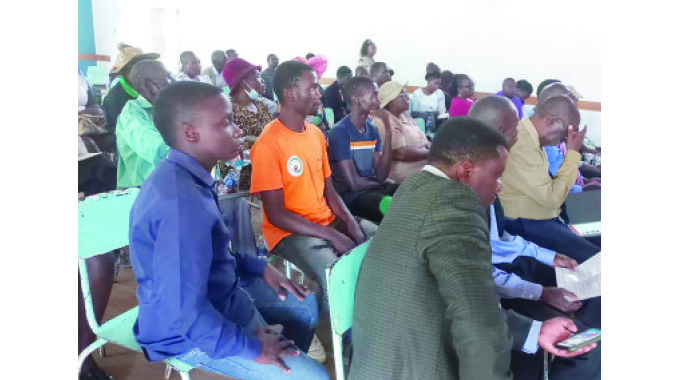
Sukulwenkosi Matutu and Thupeyo Muleya, Chronicle Reporters
STAKEHOLDERS in Matabeleland South expressed mixed feelings over the retention of the death penalty with some arguing that it should remain as a deterrent measure to reduce murder cases while others are of the view that it should be abolished.
Government is conducting a two-week public hearing consultation on whether the country should scrap the death penalty. The hearings which are being led by the Ministry of Justice, Legal, and Parliamentary Affairs started on March 27 and will end on Friday.
On Monday, the meetings were held in Beitbridge and Gwanda districts. Today the consultation is being held in Matobo District.
While the country’s Constitution upholds the death penalty, no persons on death row has been executed since 2005 despite the High Court still continuing to impose capital punishment.
The public consultations are expected to guide the country on the policy position that needs to be adopted with regard to the death penalty. Two teams have been deployed to conduct the public consultation, one in the northern parts and the other in the southern parts of the country.
Speaking during a consultation meeting at the Gwanda District Club on Monday, Ntalale village head, Mr Kelibone Mavula said the death penalty is a cruel act that should be abolished as it promotes a culture of revenge among citizens.
“If we say as a community we will kill someone because they killed another person then we are no better than the murderer. As a country we should be governed by what is wrong and what is right and the bottom line is that killing a fellow human being is not right,” he said.
“Some might see killing as an act of getting justice, but it will not bring back the lost life. What we will be doing is getting revenge rather than justice.”
Mr Mavula said when a victim is murdered the family is left without a breadwinner and equally when the perpetrator is also killed, it leaves the two families without breadwinners.
He said as a country, there is a need to draw the line between cruelty and punishment.
Gwanda Rural District Council chief executive officer, Mr Ranganai Sibanda said murder convicts should not be given a death penalty but life imprisonment without the option of amnesty.
Mr Thembinkosi Mutsapa said following the eye for an eye approach will not build the country but compromise its moral values.
Stakeholders who were in support of retaining the death penalty said it would help to reduce murder cases which are on the rise.
Gwanda Community Share Ownership Trust chairperson, Mr Coster Nkala said people below the age 21 should also be subject to the death penalty.
“These youngsters below 21 years are the ones who are killing the most and some are even killing their parents. The death penalty will serve as a deterrent to discourage people from taking other people’s lives willy-nilly,” he said.
“We shouldn’t protect killers as they are a danger to society. I believe that we would record fewer murder cases once as long as the death sentence continues to be in force,” he said.
Ms Zimhlophe Ndlovu said the death penalty has to be implemented when a murder is committed under aggravated circumstances.
In Beitbridge, residents who gathered at Vhembe High School on Monday said it would be ideal to abolish the death penalty.
They suggested that those convicted of murder in aggravating circumstances should serve life imprisonment.
“We appreciate the efforts by Government to consult its citizens and it is my view that instead of killing the convicts, they can be jailed for life. Some of these criminals are of productive age and hence they must be subjected to hard labour in prison so that they feel the pain. Killing the perpetrators won’t solve anything,” said Beitbridge town clerk, Mr Loud Ramakgapola.
Ms Rebecca Ndou echoed Mr Ramakgapola’s sentiments. “The death penalty will not help people reform but is necessary for those convicted of capital crimes to stay in prison for life,” she said.
Another resident, Mr Chris Kaurimbo was of the view that the death penalty should only be imposed on repeat offenders of heinous crimes.
Mrs Pathutshedzo Shumba said criminals must feel the pain.
“In my view, killing such people will not help. Instead, these are the people we need to use for infrastructure development and major productive projects while they remain in prison for life,” she said.
Reverend Tsvakai Gudlanga said instead of retaining the death penalty, Parliament should urgently review the rights to amnesty for murderers and repeat offenders of violent crimes.
“It is disturbing for us as members of the communities to see murderers being released on amnesty. These should not be entertained at all and they should stay in prison until they die of natural causes,” he said.
Ministry of Justice, Legal and Parliamentary Affairs’ director in the law development division, Ms Netsai Zvakasikwa said the response to the public consultations was overwhelming countrywide.
She said after carrying out the consultations countrywide, they will compile a report for further action by their principals.
“We are moving around, consulting Zimbabweans over the death sentence. As you are aware we have a moratorium on executions and not the sentence,” she said.
“So, it means the High Court continues to hand down death sentences, but as a country we have not been executing the perpetrators since 2005.
So far the attendance has been overwhelming in most areas we have visited and as a ministry we are not carrying any position but we will compile a report pending further action.”
Section 48 of the Constitution states that a person’s right to life is limited through the sentence of death and those who are sentenced to death are the men from the ages 21 to 69.
“Women and men older than 70 years can’t be sentenced to a death penalty. We are not executing and as a member of the African Union and United Nations we are bound to come up with a position as a country,” said Ms Zvakasikwa.
She said some sister countries have come up with their resolutions by either abolishing or retaining the death penalty.


 Bongani Ndlovu
 Online Reporter