

 admin
admin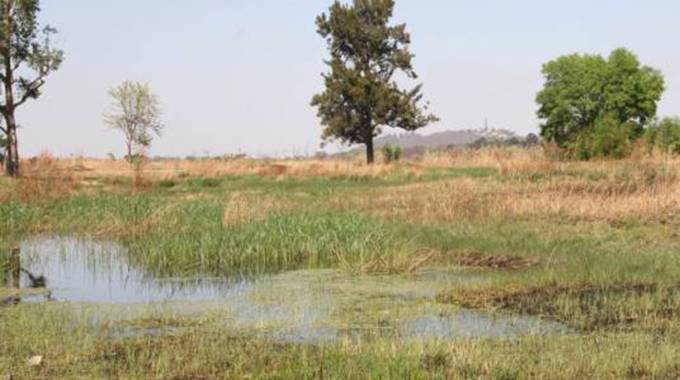
Fidelis Munyoro
Chief Court Reporter
A Harare family wanting to develop cluster housing on their 16 hectare stand in the Monavale Wetland must now rectify procedural irregularities before approaching the Environmental Management Agency (EMA) and the Harare City Council for their project approval following a recent Supreme Court ruling.
The Monavale stand is held under a private title deed and earmarked as residential zone under Harare town planning scheme, but the area is now considered a wetland as defined in the Ramsar Convention.
The family, represented by Mr Sharadkhumah Patel, has been embroiled in a fierce legal combat with the Conservation Society of Monavale (COSMO Trust), an environmental trust and pressure group concerned with wetland preservation in Monavale.
The Patel family has since challenged the inclusion of their private property in the area defined as a wetland since it is private land and they had not been consulted by Cosmo and relevant authorities.
The Administrative Court was first approached by the Patel family who were appealing against the new status of their property.
The Administrative Court found that the environmental impact assessment and the development permit had not been properly issued but then went further to delve into the merits of the case and then to dismiss the appeal, meaning the family was barred from developing the property. So they appealed to the Supreme Court.
The Supreme Court heard the appeal on the decision from the Administrative Court, and ruled that once that court had found the paperwork was irregular, that should have ended the matter and the court should have allowed the appeal.
So the Supreme Court confirmed the Administrative Court’s ruling on the irregular paperwork, but dismissed the probe into the merits and the ruling arising from that.
The family lawyer, Mr Fungai Chimwamurombe, said the matter was not yet over as the Supreme Court concluded that the Administrative Court ought to have referred the matter to the City of Harare and EMA to deal with their administrative functions after the family had addressed procedural irregularities which were in the application of permit to develop cluster homes as well as the on the environmental impact assessment.
“Mr Patel is endeavouring to deal with those errors and proceed to develop the family property,” he said.
“This judgment has also come at a time when the Ministry of Environment and EMA has put a finality on the issue of wetlands developments by producing a wetlands guideline, which expressly allowed owners of land in wetlands with title deeds to develop with the guidance of an approved environmental impact assessment.
“This move by the Government obviously comes as a reprieve to persons like Mr Patel who would want to adopt wise and sustainable use of wetlands.”
Zimbabwe is a signatory to the Ramsar Convention on Wetlands of 1971, and there are domesticated provisions for the protection of wetlands under the Environmental Management Act and a 2007 Statutory Instrument giving the regulations on dealing with environmental impact assessments .
The Administrative Court ruled that the issuance of the environmental impact assessment certificate and development permit violated various procedural requisites as well as environmental law, which the Supreme Court agreed. Writing the judgment for the Supreme Court Justice Paddington Garwe noted that the lower court should not have proceeded to deal with the merits of the dispute between the parties after finding that procedurally, the environmental impact assessment certificate and development permit had not been properly issued.
Having found that the two documents to had been irregularly issued, the judge said the Administrative Court should have allowed the appeal on that basis alone. “Such an approach would have permitted the appellants to take steps to correct these documents,” said Justice Garwe.
“It was irregular, having found that the application before the city council was invalid for want of correct procedure, for the court to delve into the merits of the main dispute between the parties and proceed to dismiss the matter.”
However, the Supreme Court exercising its review powers set aside the lower court’s decision on the merits.
Monavale wetland forms part of the headwaters of the Marimba River and is crossed by the Avondale Stream on its way to that river.



 Online Reporter