admin
admin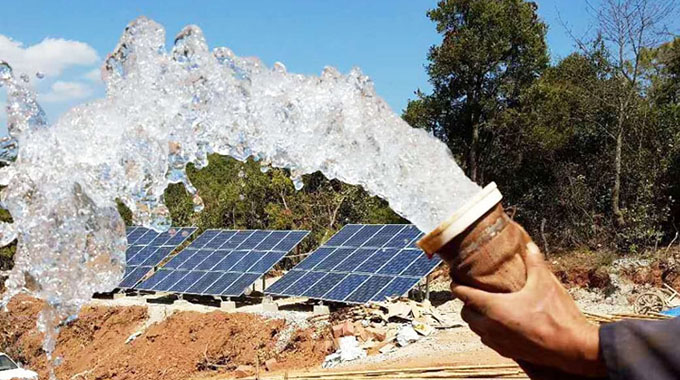
Thupeyo Muleya Beitbridge Bureau
Climate change in Zimbabwe tends to reduce average rainfall amounts and shorter growing seasons have resulted in more farmers in the drought-prone Beitbridge district turning to smart agriculture to maximise production.
The use of solar-powered boreholes, water harvesting, drip irrigation and the growing of fast maturing crops has become a model for many in the area.
Drip irrigation is a type of micro-irrigation system that has the potential to save water and nutrients by allowing water to drip slowly to the roots of plants, either from above or below the soil surface. It uses less water than flood irrigation or overhead sprays, or to put it another way, allows irrigation water to irrigate a larger area.
Under this type of irrigation, water is placed directly into the root zone of the plant to minimise evaporation. In previous years, farmers used canals, sprinklers, or flood irrigation but they have since raised the red flag over depleting water sources for irrigation farming and livestock production, induced by climate change.
Mr Suta Sibanda of Khololombe Village (Ward 3) said he had drilled several boreholes on his 4ha plot and constructed an 80 000 litre reservoir to store water.
The plot has sugar beans on 1ha and green maize on the other 3ha and he rotates these with tomatoes, onions, green pepper and cabbages.
“We have had challenges with water and to address that, we drilled boreholes which are solar powered,” said Mr Sibanda.
“Irrigation water is then pumped into an 80 000 litre reservoir to ensure there is production throughout the year. So we use the drip irrigation system to water crops. This is the best method we are using to get results with the little water available”.
He said the horticulture farm had reduced imports of vegetables to Beitbridge from other towns and South Africa.
Another farmer in Ward 15, Juta village, Mr Brian Matura said he had adopted the use of drip irrigation and water harvesting at his 3ha plot. He was working on expanding the project to produce more vegetables for the local market, especially schools and shops.
Mr Matura has also constructed a 300 square metres greenhouse at the plot which has become a model for the community, where he is producing tomatoes throughout the year.
“As an upcoming horticulture farmer, I have noted that we need to embrace technology and modern farming methods to maximise production,” he said.
“So, on my 3ha I have planted 12 000 cabbages (4 000 in groups of three) and constructed a greenhouse of 300 square metres in size at a cost of US$6 000 to ensure production is continuous and irrigation is done via drips.
“In the greenhouse, we currently have 1 200 tomato plants of the candela variety which are harvested for 8 to 12months.”
“We have also constructed a fowl run that carries at least 4500 birds which are regularly slaughtered by people from the village in groups of 12. These have become seasonal workers”.
Mr Justice Ndou of Langeni area in ward 5 said he started off his project drawing water from a communal borehole to turn around the lives of many people in Beitbridge East who get fresh vegetables for resale.
He has been growing tomatoes, green pepper and cabbages on his 3ha plot since 2019 with the aid of drip irrigation.
He said, after noting load shedding challenges, he invested in three solar powered boreholes to ensure that he has irrigation water through the year.
“We are blessed with good soils and we need to make the most out of it by employing the most effective ways of saving water, but with more production,” said Mr Ndou.
He had planted water melons, green maize, cabbages and tomatoes. The use of smart agriculture, Mr Ndou said has helped in to increase his output and employ more people, especially women and youths.
“Beitbridge is a dry area where crops do well under irrigation farming, hence the need to maximise on the little water we are having. Generally, drip irrigation saves water compared to flooding or using sprinklers or other types of irrigation,” he said.
Mr Ndou said it was important for farmers to look at the varieties to plant in their fields which are conducive to climate conditions around Beitbridge.
The farmer said they were looking at expanding their market share from Beitbridge to the rest of Matabeleland South and the country.
According to agriculture experts, Beitbridge requires an average of 400mm of rain water for a successful farming season, but most areas have in the last season received less than 80mm.
“Drip irrigation is extremely efficient in terms of time and energy, water saving, labour saving, and can be used for multi- purposes,” said district crops specialist, Ms Eve Kuza.
“There is limited leaching of nutrients and the great potential to produce high yields.
“The uptake of such farming methods is high mostly in individual irrigators. In irrigation schemes, the plot holders are interested in the system but they have a fear of destroying the current system due to financial constraints.”



 Online Reporter