

 Chronicle Editor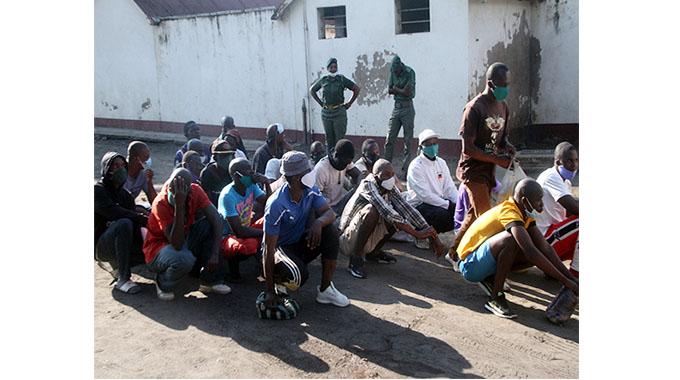
Yvonne Ncube
ZIMBABWE, like other countries, has adopted rehabilitation programmes in prisons and correctional services for ex-convicts in order for them to lead sustainable livelihoods after they are released from prison.
Some of the rehabilitation programmes include maize production, poultry, vegetable gardening, cattle ranching, academia, technical courses such as carpentry, motor mechanics and welding among others. These programmes are offered as psychosocial support, moral generation and violence reduction initiatives.
A significant number of inmates have become quite knowledgeable in their preferred areas of specialty and have since graduated from prison.
However, despite the involvement of ex-convicts in rehabilitation programmes, some continue to commit new offences after release and are rearrested, reconvicted and re-imprisoned for fresh offences.
Many do not get to taste the freedom they yearn for as they are immediately rearrested, convicted and jailed after repeating undesirable behaviour despite having been trained to extinguish criminal habits.
This is contrary to the Zimbabwe Prisons and Correctional Services whose main focus is to rehabilitate and reintegrate offenders into society as law abiding citizens.
Prisoners are released after serving their prison terms, paying relevant fines for their criminal offences, paying bail and or granted Presidential amnesty.
It is not a secret that a clean criminal record is one of the prior requirements that some companies require when one is seeking employment, leaving some ex-convicts unemployed or resorting again to unlawful ways of income generation.
Stigmatisation is another challenge that ex-convicts encounter. Society is generally unforgiving, ex-convicts walk around with tags on their foreheads written “ex-convict”, they are labelled for the crimes they paid for in a correctional facility and that itself haunts them.
For their full recovery, they need to forget but forgetting is next to impossible as society keeps reminding them of their past lives.
President Mnangagwa recently pardoned more than 3 000 prisoners countrywide in a bid to ease overcrowding in jails amid the Covid-19 pandemic.
The Government gazetted the legal instrument that saw scores of prisoners falling under selected categories being released from correctional facilities.
All female prisoners, juveniles under the age of 18 years, prisoners serving effective sentences of 36 months and below, and all prisoners aged 60 years and above except those convicted of specified offences qualified to benefit from the clemency order. The announcement of the amnesty by President Mnangagwa came as a huge relief for those who qualified.
However, upon release from prison, ex-convicts are confronted by innumerable challenges such as unemployment and lack of capital to start their own businesses with utility to the skills obtained.
Amongst the 50 inmates that were released from Bulawayo Prison was a 26-year-old who only identified himself as Vodloza. He told Chronicle that he was looking forward to walking his way to the outskirts of Plumtree which is approximately 100km from Bulawayo.
“I am preparing myself for the long journey to Plumtree on foot. None of my family members are here to receive me, they probably don’t know that I’m being released today. I don’t have money with me nor a cellphone to contact them.
“I don’t know when l will get there but I have set myself to it,” he said.
Lack of family and community support is a setback to the full rehabilitation of ex-convicts. However, they must be accepted into society without any constraints if they are to reintegrate into society.
Raison Chenjere (23) who was also released through the Presidential Amnesty was re-convicted just a few days after being pardoned after he stole a bottle of face lotion from OK Supermarket in Matabeleland North.
In mitigation, Chenjere said he stole because he was hungry and wanted to sell it to raise money to buy food as he had not eaten anything since his release from prison.
He was sentenced to six months in prison before bringing into effect one month that was suspended in November.
Where a prison term is set aside on condition that the convict will not commit a similar crime within a stipulated period, the state checks if the condition is breached upon re-arrest. If so the suspended sentence is brought into effect.
These are some of the problems that confront prisoners upon release and force them to resort back to crime as they fail to reintegrate into society.
Standard rehabilitation programmes would properly transform offenders to reintegrate into society as the re-arrests demonstrate the need for prison authorities to scale up their efforts in rehabilitation and reformation of criminals.
Ex-prisoners have no social or economic starting point upon release because of the stigma associated with having been convicted.
As a result of this, prison populations are continuously increasing with the large number of offenders being repeat offenders.
Bulawayo ZPCS provincial public relations officer, Garainashe Moyo said rehabilitation programmes for inmates are aimed at changing the mind-set of inmates from criminal thinking to law abiding citizens.
“Furthermore they equip inmates with skills, professions and knowledge that will be useful to themselves, the community and the country at large after their release from prison. It is a fact that some people commit offences due to failure to identify what they are capable of doing in order to live a clean life, hence such programmes unearth their potential.
“Inmates are interviewed upon admission to prison. It is through such interviews that inmates disclose their areas of interest regarding rehabilitation programmes. Rehabilitation officers then spearhead the execution of these programmes with support from both internal and external stakeholders,” said Moyo.
“Psychosocial services are provided in prisons and are one of the four facets of rehabilitation. The other three are academics and skills development, moral rehabilitation and sports and recreation,” he said.
However, prisons do not offer any form of financial support to prisoners upon their release.
“The support to ex-convicts is usually provided by well-wishers such as churches and non-governmental organisations which give starter packs. Our rehabilitation section does follow ups on ex-prisoners to try and find out if they utilise skills obtained while in prison. The outside world also assists in this regard,” said Moyo. He said identifying how many ex-prisoners return to prison would require a lot of time to research.
In the case of financial support, measures such as loan schemes should be introduced to capacitate ex-convicts upon release.
The problem of companies denying ex-convicts jobs needs to be addressed as it strains the hopes of ex-convicts being able to make use of their learned skills thereby forcing some of them to resort to crime. Families and society must not stigmatise and label ex-convicts so that they are more easily absorbed into society once again. Uniting families with ex-convicts before their release would limit scenarios where they are stranded and alone.
Intensifying full force on rehabilitation programs might limit the number of ex-convicts that return to prison as it strains the social and financial resources of the nation as well as overcrowding prisons.
The rate of ex-prisoners who return to prison also puts the effectiveness of rehabilitation programs into question.
Prisons are correctional facilities hence prisoners undergo correction in those facilities and should not be crucified for what they did before undergoing correction.
Most of all, society should learn to forgive these people so as to contribute to their full rehabilitation and encourage them to desert crime.-@SeehYvonne


 Online Reporter