Online Reporter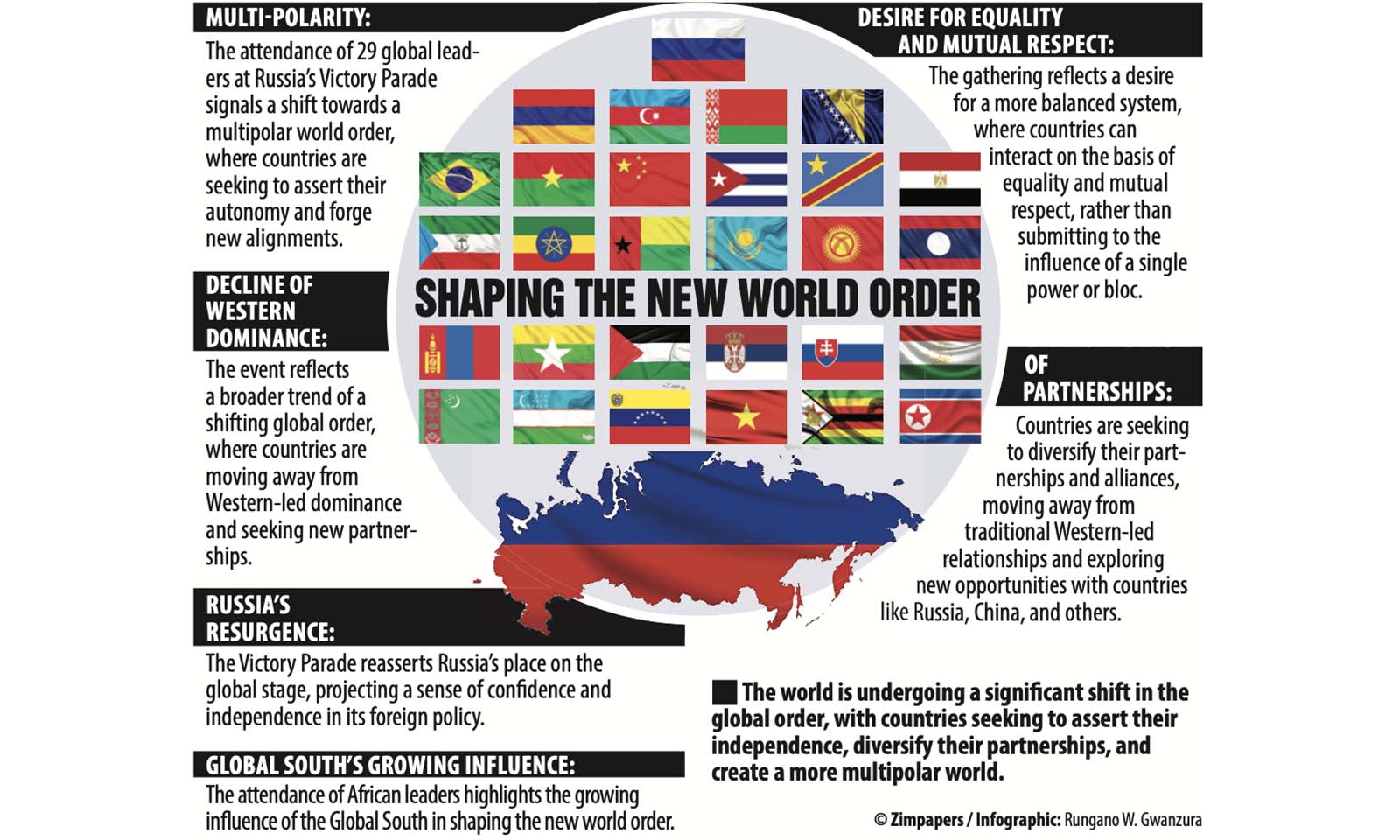
Ranga Mataire-Group Political Editor
ON May 9, Russia’s Red Square was awash with the thunder of marching boots and a show of the latest in military hardware.
But the real spectacle of Russia’s Victory Parade was not just the military might on display, it was the gathering of 29 global leaders, a bold diplomatic counterpunch to Western efforts to create a unipolar world.
This year’s Victory Day Parade was nothing short of a diplomatic coup against the West’s campaign of isolation.
Far beyond the solemn remembrance of the Soviet Union’s role in defeating Nazi Germany, the parade became a vivid emblem of a shifting world order – one moving away from Western hegemony and towards a multipolar reality.
Among the dignitaries was President Mnangagwa, not only representing his country, but also bearing the mantle of Chairperson of the Southern African Development Community (SADC).
His presence alongside other African and Asian leaders underscored a deliberate recalibration of alliances, rooted in historical solidarity and a shared vision for an international system that resists domination by any single bloc.
More than military pageantry, the presence of 29 world leaders sent a potent message: the era of unilateral dictates is waning. For a nation under sweeping Western sanctions, such a turnout could not be easily dismissed.
It gave the event the gravity of a global summit and symbolised the failure of isolationist strategies pursued by the West.
Western leaders attempted a counter-narrative. In a parallel scene, the heads of France, Britain, Germany, and Poland visited Ukraine to meet with President Volodymyr Zelensky, ostensibly to intensify calls for a ceasefire.
But the attempt to draw attention away from Moscow only highlighted the global divide.
President Putin, unmoved, used the moment to reaffirm Russia’s long-standing opposition to a US-led unipolar world – a position he first made clear in his landmark 2007 Munich Security Conference speech, where he criticised the post-Cold War dominance of the United States.
Russia no longer sees itself, nor accepts being treated, as a junior partner in the global order dictated by NATO or Washington.
The Victory Parade thus emerged not merely as a commemorative event, but as a defiant statement of sovereignty and the rise of an alternative global narrative.
What brought the leaders to Moscow?
Each country that attended the Moscow Victory Parade had its own variant motivations mainly guided by individual national interest considerations.
In the case of Zimbabwe, its ties with Russia date back to the liberation struggle days when Moscow provided weapons and training.
Many of the freedom fighters received their military training in Russia, a country that never colonised Africa and has always supported the fight against neo-colonial tendencies.
Zimbabwe’s attendance at Victory Day is consistent with its foreign policy thrust of seeking an equitable world order where all countries have an equal voice regardless of size or economic power.
Attending the Victory Parade did not reflect any anti-West sentiments, for Zimbabwe has always articulated its foreign policy as being anchored on being “a friend for all and an enemy to none.”
Zimbabwe thus took advantage of the Victory Parade to engage Russian counterparts on the need to strengthen bilateral ties.
In a bilateral meeting with President Mnangagwa, President Putin said the two sides should work to make sure that economic ties match the strong political relations.
He pointed to opportunities in geological exploration, agriculture and energy as areas that present the best potential for further cooperation.
A recent visit to Zimbabwe by Alrosa, the world’s largest producer of diamonds, which is exploring opportunities in the country, indicates the potential that lies ahead.
Already, on March 6, 2025, Zimbabwe’s Minister of Foreign Affairs and International Trade, Professor Amon Murwira, signed comprehensive bilateral agreements, including strengthening trade and economic cooperation.
Space technology and information and communications technology are among key areas of cooperation. As President Putin himself said: “Zimbabwe has been our reliable partner on the African continent.”
In a broader context, Russia views stronger ties with Africa as one of its foreign policy priorities.
The African contingent, including Zimbabwe, Burkina Faso, Congo, Equatorial Guinea, Ethiopia, and Guinea-Bissau, attended the 80th Anniversary of the Great Victory in Moscow, emphasising equality and mutual respect.
Russia aims to assist African nations in rebuilding economies and preventing conflicts, and African leaders recognise Russia’s role in solving issues on the continent. The Victory celebrations provided a platform for exploring opportunities, especially through public-private partnerships.
The attendance of 29 global leaders at Russia’s Victory Day celebrations signals a fact; multipolarity is becoming a reality for many in the Global South, hastened by fissures in the liberal international order.
Countries are progressively seeking to assert their autonomy and forge new alignments, whether with the West, China, Russia or each other. For Zimbabwe, it is time to carefully consider our position in a fast-changing world order.