admin
admin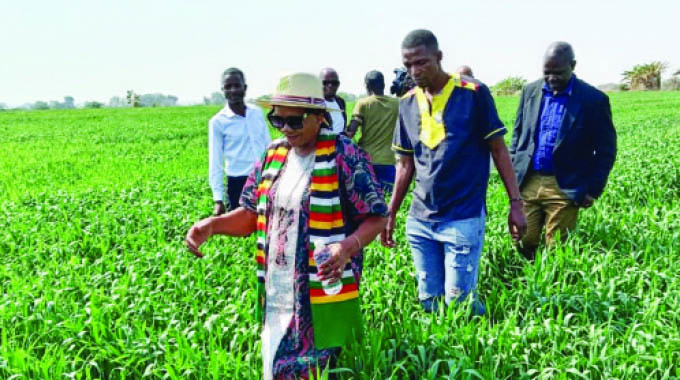
Mkhululi Ncube-Bulawayo Bureau
TUCKED deep in the heart of Bulilima District in the semi-arid Matabeleland South Province, Moza Irrigation Scheme has transformed the lives of about 400 smallholder farmers whose livelihoods have for the past two decades, revolved around irrigation farming.
For years, a vast tract of arable land has been lying idle despite its huge potential to improve the locals’ livelihoods. Established in 1987, the irrigation scheme was recently rehabilitated after going underutilised for years due to water challenges.
Today, the irrigation scheme, which is situated in Ward 5 in Gampu Village, has been turned into a green belt.
This year, farmers planted 41 hectares of wheat and expect to harvest about 100 tonnes, which will be delivered to the Grain Marketing Board.
On Wednesday, a wheat field day was held at the irrigation scheme as farmers had started harvesting vegetables and a maize crop.
The smallholder farmers are defining the successful farming story as they contribute significantly to food security for the nation in line with the Agriculture and Food System Transformation Strategy (2020-2025) whose national thrust is to see Zimbabwe achieve a US$8,2 billion agriculture economy by 2025.
President Mnangagwa launched the strategy in August 2020 whose objective is growing the economy and ensuring Zimbabwe grows its own food and ensures the majority of rural families move from poverty to affluence.
In interviews, plot holders said the farming project has proved to be a game changer for the local community.
In a report, the Food and Agriculture Organisation (FAO) noted that irrigation is among the measures that can improve yields, reduce vulnerability to changing rainfall patterns, and enable multiple cropping practices.
Through hard work, commitment, and dedication, the farmers at Moza Irrigation Scheme have transformed the 90-hectare irrigation into a green oasis.
A plot holder, Mr Marshal Tshuma (28), said he left his job in South Africa and retraced his footsteps back home to venture into farming.
Some of his success stories include buying a kombi, which he later traded for trucks using returns from the irrigation scheme.
“I have been a member of the irrigation scheme for several years. I left employment in South Africa and since then this irrigation scheme has been my employer. We grow many crops on a rotation basis,” said Mr Tshuma.
“Since we started growing wheat three seasons ago, we are reaping good returns. We have opened bank accounts to receive the money we get from GMB. I grew beans some time and got R65 000, which I used to buy my first car, and today I have a truck which I bought using proceeds from the irrigation scheme.”
Mr Never Sibanda (65) said he has spent his entire working life farming at Moza Irrigation Scheme and managed to raise nine children through proceeds from farming.
“I shelved plans to go to South Africa when the irrigation scheme was established. I have nine children whom I supported using proceeds from this irrigation scheme,” he said.
Mr Sibanda said from last year’s proceeds, he bought five goats and built a two-roomed house.
Moza Irrigation Scheme chairperson Mr Nkosinathi Ngwenya said they have since increased the hectarage under winter wheat to boost returns.
“The whole irrigation is 90 hectares and we grow different crops which include winter wheat, and a variety of vegetables. Last year we planted 22,1 hectares of wheat and this year we have increased to 41 hectares and anticipating to harvest 100 tonnes,” he said.
Mr Ngwenya said their members are supporting their families and sending their children to school using proceeds from farming.
Speaking during the field day, Matabeleland South Provincial Affairs and Devolution Minister Dr Evelyn Ndlovu said she was impressed with the farming project in the face of climate change.
“Those with irrigation schemes must work hard to produce more so that we do not import food. We want Bulilima District to be food secure and also help feed the province,” she said.
“It is time the country bid goodbye to food imports since we have the land and water bodies that can be put under irrigation.”
Dr Ndlovu noted that Bulilima has the potential to produce good crops if enough water is available.
“Wheat, as a staple crop, plays a crucial role in our diet and economy. Historically, we have relied heavily on imports, but it is time for us to take charge of our agricultural destiny. The district, with its rich soils and favourable climate, presents a fantastic opportunity for commercial wheat production and rural industrialisation,” she said.



 Online Reporter