Chronicle Editor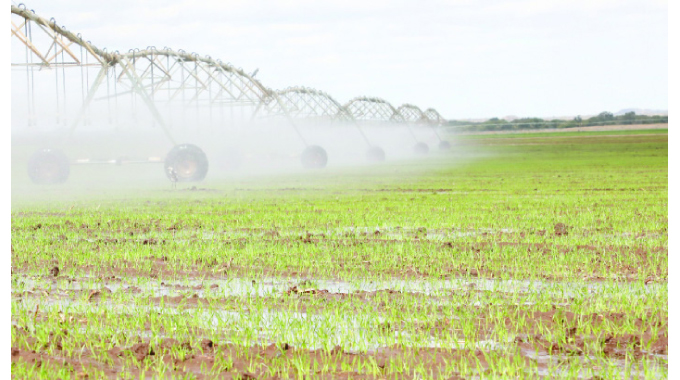
Sukulwenkosi Dube-Matutu, Chronicle Reporter
FARMERS at the newly established Mtshabezi Irrigation Scheme in Gwanda are expecting a wheat output of 225 tonnes after planting on 45 hectares of land.
The farmers are also looking to increase the area planted to 100 hectares during summer cropping.
The irrigation scheme which had remained a pipe dream for 87 years has finally taken off following intervention by the Government.
Last year in September Government channelled $177 million towards establishment of a 200-hectare irrigation scheme in Gwanda as part of accelerated efforts to revitalise irrigation schemes in pursuit of sustainable food security.
The funds were used to develop infrastructure such as installation of water pipes and pumps and purchase of a centre pivot.
Farmers at Mtshabezi Irrigation Scheme, which was first mooted in 1935 have also received a $20 million loan through the Land Agricultural Development Bank of Zimbabwe (LADBZ) for land preparation and planting.
Government introduced LADBZ last year to drive agriculture growth through the provision of affordable financing to farmers.
It supports the overall agrarian transformation process to expand the provision of agriculture and rural finance service across the entire agricultural value chain.
Mtshabezi Irrigation Scheme farmers have used part of the money to hire graders and tractors for land preparation.
They also received inputs which comprise seed and fertilisers under the Presidential Input Scheme.
They received seven tons of seed, 17 tons of Compound D fertiliser and 15 tonnes of top dressing.
Mtshabezi Irrigation Scheme is set to improve livelihoods. The scheme has 157 farmers from six villages in Ward 6.
The chairman of the scheme, Mr Ndabezinhle Nyoni said the farmers were relieved as they had completed planting their first crop.
“We started the planting process late but we were able to work together as farmers and we capitalised on the little time we had.
We were targeting to plant 50 hectares and we managed to plant 45 hectares of wheat. As farmers we are pleased with the progress that we have made so far,” he said.
“We are looking forward to a successful harvest.
This is our first crop and although we didn’t manage to plant the entire 200 hectares, we are looking forward to having a good crop.
Moving forward we will introduce more crops and increase our hectarage.”
Arda Mtshabezi Irrigation Scheme business manager Mr Sindiso Mlalazi said they expected an average output of five tonnes per hectare.
He said the irrigation scheme was operating with one centre pivot and they were awaiting delivery of a second one. Mr Mlalazi said the second pivot will enable farmers to increase the area planted to 100 hectares.
Government working with various partners is rehabilitating irrigation schemes that have been lying idle in Matabeleland South Province and establishing new ones in order to improve food and nutrition security and ensure attainment of Vision 2030.
Government aims to rehabilitate and develop 350 000 hectares of land by 2025 across the country to safeguard the country against the negative effects of climate change and ensure food security.
Under the Second Republic, Government is prioritising the revival of the agricultural sector through the development of irrigation schemes to alleviate food insecurity and poverty particularly in rural communities.
A number of irrigation schemes that had been lying idle in the province have been revived while some that were being underutilised have been capacitated and expanded.
Government has also rolled out various agricultural schemes meant to transform subsistence agriculture at household level into commercial agriculture.
Managers have also been deployed to irrigation schemes across the country to maximise production, thereby ensuring food security and nutrition.–@DubeMatutu


 Online Reporter