Online Reporter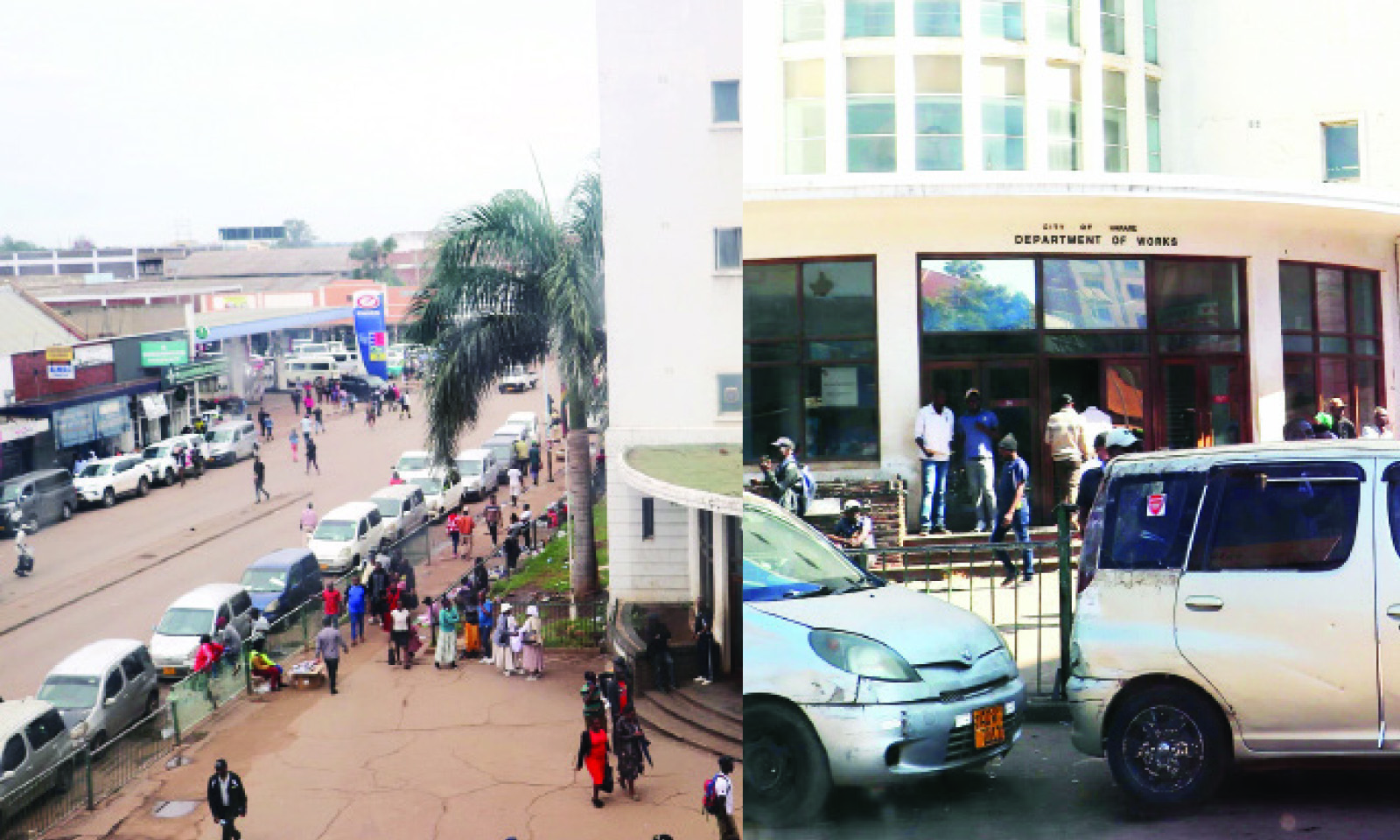
Trust Freddy
Checkpoint desk
HARARE City Council officials are allegedly colluding with pirate taxis (mushikashika) operating an illegal rank along Leopold Takawira Street, conveniently located near the city’s Works Department, Cleveland House, in the central business district (CBD).
This also comes amid revelations that a mere 3 000 of Harare’s estimated 16 000 kombis are registered with the city, sparking accusations that municipal police are corruptly colluding with unregistered operators, reportedly receiving kickbacks.
The illegal rank, popularly known as the Avondale rank, operates just a block away from Townhouse, where officials have a clear view of the illegality through the windows, yet it continues to function unchecked.
Unlike their counterparts who operate in stealth, dodging police patrols and picking up passengers at other busy intersections, the pirate taxis on Leopold Takawira Street queue openly.
City council enforcement agents can be seen standing alongside their clamping vehicles, parked right next to the pirate taxis they are supposed to be clamping down on, as the illegal operators queue openly without fear of arrest.
An investigation carried out by the Checkpoint Desk reveals that every morning, a municipal traffic truck passes through the illegal rank, yet turns a blind eye and instead targets other illegal ranks and private cars.
The vehicles, predominantly Toyota Fun Cargo, Honda Fit, Toyota Sienta and Nissan AD Van, are easily identifiable as mushikashika due to their dented fronts and rear bumpers, scratched bodies, and the tendency for bumpers to kiss as they inch forward.
These illegal pirate taxis have taken over another lane, forcing motorists to use only the far-right lane and take turns picking up passengers directly at the zebra crossing line.
“This is a pedestrian crossing point, but it’s now being used as a rank,” said Mr Trymore Chihwa, a concerned Harare resident. “Look, the vehicles are positioned very close to each other, leaving no space for pedestrians to cross.
“We are often forced to use other points that aren’t designated for pedestrian crossing, rendering this zebra crossing useless.”
The unscrupulous pirate taxis are also being accused of harbouring pickpockets with a number of people losing their cell phones to thieves.
“It is a crime zone now, people are losing their valuables daily,” an airtime vendor who requested anonymity said.
“Passersby are being targeted by thieves who snatch phones, handbags, or wallets as they try to navigate through the vehicles blocking the passage, with the thieves often hiding in taxis or disguising themselves as touts.”
Greater Harare Association of Commuter Operators (GHACCO) secretary general Mr Ngoni Katsvairo said: “The law is being enforced heavily on those who are trying to improve the professional conduct in the public transport sector while those who are operating illegally have created syndicates to skirt around the law and operate illegal.
“As is happening now, there is need for continued implementation of policies that are friendly to legal operators while being stringent on illegal operators. The law needs to be concentrated more on illegal operators and allow legal operators easy passage so as to increase and maintain compliance.”
He, however, said he was optimistic council enforcement policies were moving in that direction after their several engagement meetings.
The Zimbabwe Union of Drivers and Conductors (ZUDAC) president, Mr Fradreck Maguramhinga, echoed similar sentiments, stating that while they have had productive discussions with the city’s planning department, they feel let down by the municipal police.
“We are suffering as a result of selective law enforcement,” Mr Maguramhinga said. “We’re suffering due to the proliferation of mushikashika, and it seems like not much is being done to address them, to the point where we’re starting to suspect that they’re operating in collusion with the council.”
He also revealed that municipal police are going as far as Avondale and other suburbs to crack down on operators trying to run formally, while leaving mushikashika operators to function freely in the CBD.
“They issue fines claiming the vehicle was clamped in the CBD, but the municipal police are actually tracking down operators as far as Avondale; fortunately, most of our operators have trackers, which expose the false claims and helps resolve the fines.
“Our operators have all the necessary council paperwork, yet we’re being targeted. We’ve discovered that the issue is they don’t want us to be compliant because it eliminates their opportunity for financial gain. When operators are non-compliant, they know a protection fee becomes mandatory.”
However, he said while the “commanders seem supportive, the law enforcement agents on the ground,” are harassing registered operators.
It also emerged that these municipal officers do not interact directly with mushikashika drivers but instead work with touts operating at the ranks.
“The touts act as agents, collecting money every Monday, known as “rank fees,” which range from US$5 to US$10 depending on the route, in exchange for protection,” a close source said.
“The municipal police are particularly feared, as after a first arrest, any bribe demanded is unlikely to be less than US$40.”
The Checkpoint Desk also observed that the Avondale rank, which reportedly enjoys immunity from the council, only temporarily ceases operations when municipal officers conduct joint blitzes with the Zimbabwe Republic Police.
When contacted for comment, Harare City Council’s chief traffic officer, Mr Martin Chimombe, defended the municipal police, citing a manpower shortage.
On the proposal for joint investigations with the Checkpoint Desk into municipal police working with mushikashika in broad daylight, Mr Chimombe said: “I am against the selective focus on variables that suggest municipal police are corrupt and presenting them as fact without considering the broader context.
“Instead, I suggest either increasing fines or adopting electronic systems to prevent people from evading responsibility.”
He also said that dealing with mushikashika was almost impossible with their current manpower, equating the task to trying to empty the sea with a bucket.
“It means there will be need for a continuous presence of municipal police, which we cannot afford. As a municipal officer, my interest lies in installing cameras, for example, at the corner of Jason Moyo and Fourth Street (Simon Muzenda ), the cameras are working perfectly well, and they need to be extended to other areas with mushikashika operations.
“In other countries where compliance is 100 percent, it’s because of cameras. We should follow that approach; otherwise, we would end up requiring over 50 000 municipal police.”