Online Reporter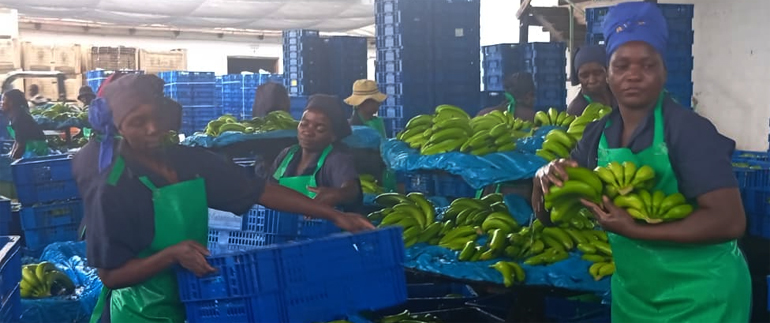
Ray Bande
Senior Reporter
BANANAS grown in Burma Valley, nestled in Zimbabwe’s Eastern Highlands, have become highly sought after in neighbouring South Africa — a key springboard in the nation’s ambitious drive to build a US$2 billion horticultural industry by 2030.
The Government has set this target under its comprehensive horticulture recovery plan, positioning strategic crops such as bananas at the heart of the sector’s revival.
Speaking during a tour of Matanuska Private Limited’s operations in Burma Valley, Permanent Secretary in the Ministry of Lands, Agriculture, Fisheries, Water and Rural Development, Professor Obert Jiri, emphasized that the expansion of enterprises like Matanuska aligns seamlessly with the Government’s recovery policy.
“We are here in Burma Valley at Matanuska Private Limited to assess banana production, which is one of our priority value chains. Our climate is so favorable that Zimbabwe produces bananas of exceptional quality and taste — truly among the best in the world,” said Professor Jiri.
He noted that the visit was aimed at identifying challenges, sharing solutions, and exploring opportunities to unlock greater value for both the estate and its network of out-growers.
Professor Jiri underscored the central role of bananas in achieving the US$2 billion horticulture target:
“The banana value chain is critical, alongside blueberries, pecan nuts, citrus, and other crops. We have already secured major citrus markets through the China Trade Protocol, and similar progress is being made with blueberries and avocados. For bananas, we don’t need to look far — South Africa offers a huge market, and we already enjoy strong trade relations there. Scaling up production, expanding hectarage, and improving yields per hectare will be key to realizing our vision.”
In a separate interview, Matanuska Private Limited General Manager, Mr
Crispen Manyuchi underscored the importance of Joint Ventures (JVs) is their lines of production.
“We have 321 hactares of bananas and from those 265 is mature plantation where we are taking whatever we are producing and the balance are the immature. From that speck, we are targeting 50 tonnes per hectare, that is the average we are getting at the moment.
“We have our own land as Matanuska, but we also depend on Joint Ventures (JVs) with out-growers. The bulk of that land, which is 200ha is on JVs partnership, which is a major mantra here to create the greenbelt of Burma Valley, paying particular attention in banana production,” he said.
Mr Manyuchi confirmed the South African market’s unquenchable appetite for bananas produced at Matanuska Private Limited.
“So this is the main thrust for Matanuska, which is to contribute in the national policy of horticulture recovery.
‘In terms of exports, we are exporting our bananas, almost 60 percent are sent to South Africa and the other market is local in retailers such as OK, PicknPay, Bon Marche and those bananas will be premier quality.
“The South African market has so much appetite for our bananas because of the taste, the quality and also the sizes. So we are taking the bulk of the market in South Africa. For your own information, in 2023, we scoped the number one award because of the quality of our bananas while competing with other established commercial farmers in South Africa. This was a major achievement in terms of our production upscaling here in Zimbabwe,” he said.
With cast tracts of banana plantations sprawling along the border lying undulating Burma Valley terrain, Matanuska Private Limited employs 450 workers both permanently and contracts.