
Tapiwanashe Mangwiro
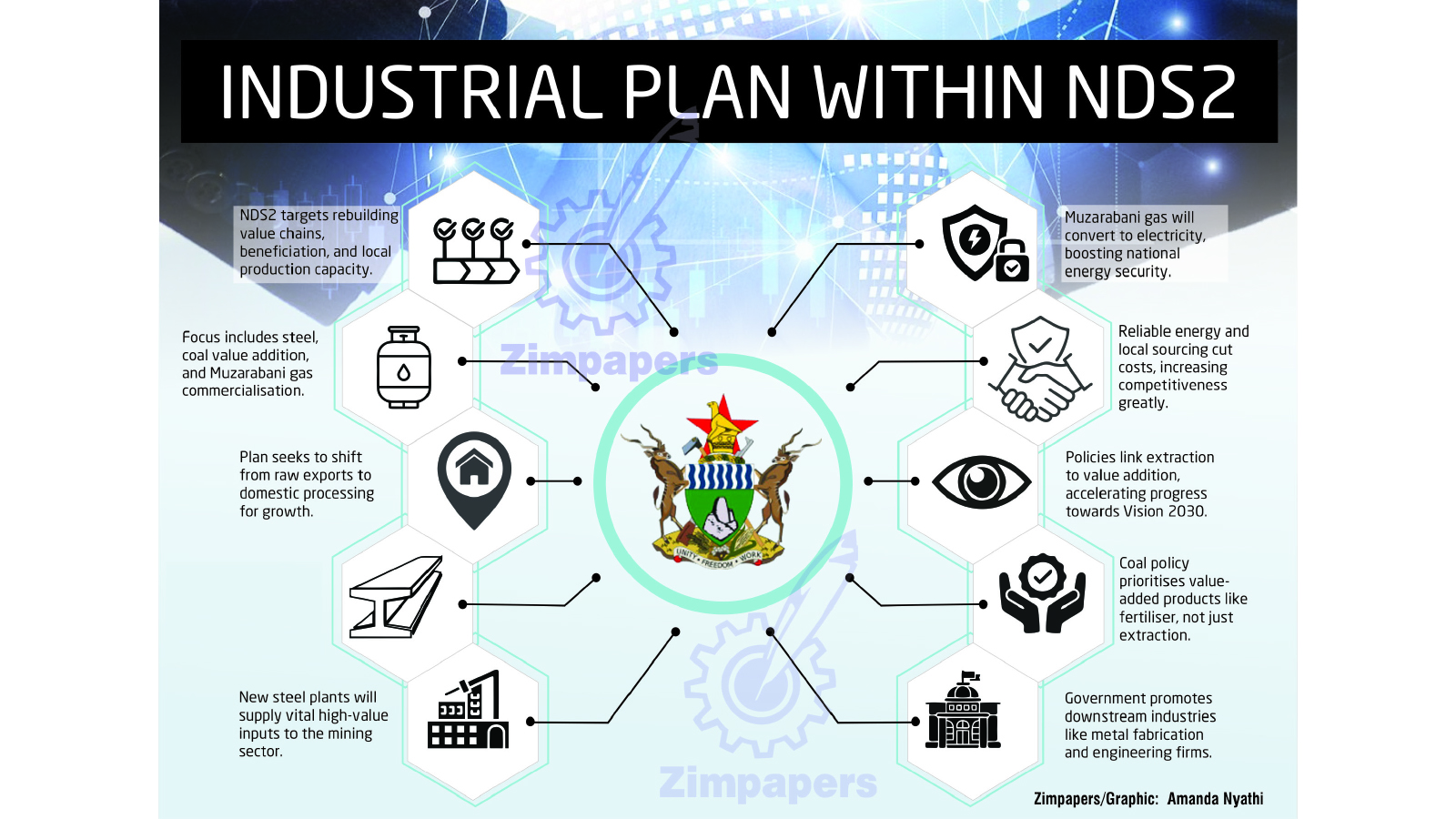
ZIMBABWE’S industrial landscape is set for significant transformation as the National Development Strategy 2 (NDS2) places strong emphasis on rebuilding value chains, strengthening beneficiation and deepening domestic production capacity.
The latest section of the strategy outlines achievable targets covering steel production, coal value addition and the long-awaited commercialisation of the Muzarabani oil and gas prospects.
Analysts say the measures show the Government’s intent to anchor economic growth in productive sectors, while ensuring that local industries reclaim their role as the centre of national development.
Industrialist Dr Nxaba Ndiweni described the outlined interventions as a timely and strategic reset that positions Zimbabwe to capture more value from its minerals while building competitiveness across value chains.
“The clarity provided in NDS2 demonstrates a Government keen to move beyond raw mineral exports towards domestic processing, a stance that benefits industry, jobs and export earnings,” he said.
Rebuilding the iron and steel sector
A central pillar of the strategy is the bold plan to rebuild a vertically integrated iron and steel industry, with efforts centred on developing synergies between Dinson Iron and Steel Company and domestic ferrochrome producers to manufacture high-value steel products, including stainless steel and steel bolts.
Economist Mr Tinevimbo Shava said: “Such products are vital inputs for Zimbabwe’s rapidly expanding mining sector. Localising their production is expected to cut import costs, shorten supply chains and improve national self-sufficiency.”
The Government plans to promote downstream industries such as iron and steel processors, metal fabricators, casting businesses, engineering firms and tool-making enterprises. This is meant to stimulate diversified manufacturing, increase employment and expand Zimbabwe’s industrial base.
Economic governance expert Mr Tawanda Mukusha said the steel value chain presents one of Zimbabwe’s strongest opportunities for rapid reindustrialisation.
“The re-emergence of a robust steel industry will revive many associated sectors. Toolmakers, assemblers, foundries and engineering firms stand to benefit directly,” he said.
“This multiplier effect is exactly what a modern industrial policy aims for.” He said mandatory local procurement for public infrastructure projects will give local producers guaranteed markets essential for sustainable growth.
Beneficiation of coal resources
During NDS2, the Government intends to formulate a comprehensive coal mining policy that emphasises beneficiation, not just extraction. The focus is on value-added products such as fertiliser and the efficient utilisation of by-products like tar, gas and benzene.
Zimbabwe’s coal resources hold substantial potential to support agriculture, chemical manufacturing and construction industries, among others. The Government’s stance on maximising value aligns with the broader push in the NDS2 to convert raw resources into finished or semi-finished goods.
Dr Ndiweni said the coal strategy demonstrates a deepening understanding of the interconnectedness of value chains.
“When coal is processed domestically, it supports fertiliser production, farmers and reduces import dependence,” he said. “This is how national competitiveness is built, ensuring every resource is fully exploited for socio-economic benefit.”
Commercialising oil and gas
Oil and gas prospects in the Muzarabani basin have already been classified as a key focus area over the next five years.
Following significant progress during NDS1, including the granting of national project status, the next phase of the project entails processing the natural gas into electricity to bolster national energy security. The plan speaks directly to industrial competitiveness. More reliable and affordable power will reduce production costs and ensure that manufacturers operate efficiently.
Mr Shava said the integration of oil and gas into the energy mix would mark one of the most important milestones in Zimbabwe’s economic transformation.
“Energy is the lifeblood of industry. The ability to generate power locally from gas will not only stabilise supply, but also position Zimbabwe as a regional energy contributor in the long term,” he remarked.
The Government’s commitment to ensuring that extracted resources are processed domestically ties in with the overall aim of retaining a greater share of value within the national economy. From stabilising the macroeconomic environment to anchoring industrial expansion of steel, coal and gas value chains, NDS2 provides a strong road map for structural transformation.
Mr Mukusha concluded that the outlined policies reflect a Government that has analysed past shortcomings and is now deliberately addressing the gaps.
“Linking extraction to value addition, and value addition to industrial capacity, shows maturity in policy design. If implementation matches planning, Zimbabwe will significantly accelerate progress towards Vision 2030,” he said.
Dr Ndiweni echoed the sentiment, adding that the industrial measures carry strong potential for job creation, improved export performance and national self-reliance.
Overall, the NDS2 projects a confident, forward-looking industrial agenda.
It signals that Zimbabwe is ready to move from potential to realisation, driven by carefully structured strategies that prioritise local value creation, beneficiation and sustainable economic growth.