

 admin
admin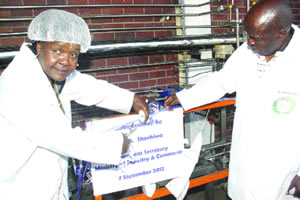
more than doubled its production and exports to Zambia, Malawi, the DRC and Mozambique.
“Nestle has so far invested close to US$12 million in the refurbishment and upgrading of the cereals plant and equipment to increase production capacity, efficiency and introduce new products,” he said.
“This is a business growing at double-digit numbers. A lot of that is coming from our farmers, bankers and the Government,” he said.
The company had significantly reduced exports to the region about two years ago due to overwhelming local demand.
The plant upgrade would also enable Nestle to continue introducing new products, such as Nestle MOM launched last month.
In recent years the firm has introduced new products under the Maggi brand and new beverages such as Nestea and Ricoffy 3 in 1.
The expansion in Nestle’s production capacity would obviously lead to an increase in demand for the firm’s milk- based products.
And the firm has thus started preparing for the increase under a US$14 million dairy development and empowerment programme.
The company intends to import more than 4 000 dairy heifers from South Africa over the next seven years.
At fruition, the investment programme is expected to increase Nestle’s annual milk intake from 3,5 million litres to 28 million litres.
The company initiated a similar dairy development and empowerment programme in India, set to transform the lives of impoverished families, especially women.
Officially commissioning the plant, Secretary for Industry and Commerce Ms Abigail Shonhiwa commended Nestle for the investment, despite the challenges facing the industry.
“I am glad to say that such efforts are in line with initiatives of our Industrial Development Policy where we seek, among other objectives, to re-equip and replace obsolete equipment,” she said.
Ms Shonhiwa also commended Nestle for the investment that was expected to result in 40 additional jobs, mostly on the production lines.
To demonstrate its commitment to Zimbabwe, Nestle would embrace its parent firm’s thrust of localising raw material procurement, which in Zimbabwe would include small grains.
“One of the things that Nestle is doing, is an international programme, especially in Africa, to look at sourcing of local raw materials. One of the items is small grains — mhunga and mapfunde.”
Mr Katsande said agriculture did not start with farmers, but with consumers who provide guarantees for agricultural produce.
He said it was the role of firms such as Nestle to provide the market, as agriculture started with consumers who provided the market.
“It is the role of companies like Nestle to provide the market for farmers,’ said Mr Katsande. He said Nestle remained committed to maintaining its investment in Zimbabwe.



 Online Reporter