

 admin
admin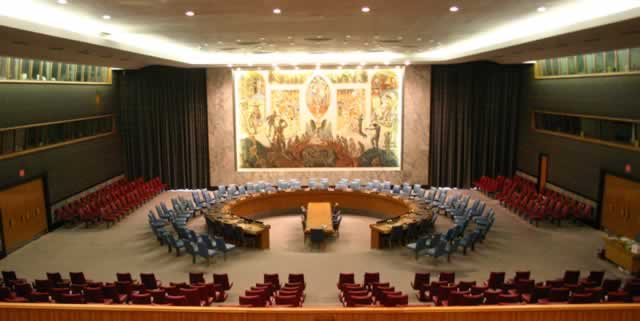
Alexander Mezyaev Correspondent
On October 16 the United Nations General Assembly elected a new United Nations Security Council (UNSC). According to UN Charter, there are fifteen Council members — five permanent with 10 others elected. Half of non-permanent members are re-elected every year. Non-permanent members have no veto right but still possess considerable clout, especially when they join together. First, the United Nations Security Council is the main UN organ responsible for peace and international security. It can approve the use of force. Recently there were cases when non-permanent members hindered the passing of draft resolutions submitted by permanent UNSC members.
The UN Security Council is to be based on equitable geographical distribution which envisions that five seats in 2015 are to be taken by the states representing three regions — Africa, Asia-Pacific and Latin America. There was no competition; each region was represented by one candidate, correspondingly Angola, Malaysia and Venezuela.
The Western European and Others Group has two representatives and there were three hopefuls — New Zealand, Spain and Turkey. New Zealand won in the first round with 145 votes. Spain won against Turkey in the third round (132 vs 60). All non-permanent members have some, no matter unequal, experience of being a UNSC member (Spain and Venezuela have been elected four times, this is the second time in case of Angola).
The United Nations history knows the examples of holding three-four rounds to elect a non-permanent member. In 2011 a non-permanent member was elected after 17 rounds. In 2006 Panama was elected after 48 rounds with the count 164:11.
Sometimes problems emerge after seemingly successfully won elections.
For instance, in October 2013 Saudi Arabia had a triumphant success being elected a non-permanent UNSC member (176 vs1 that went to Lebanon). After winning the election it refused to take the seat till the order and mechanisms of functioning were changed.
Saudi Arabia said the United Nations Security Council practiced double standards preventing the maintenance of peace and security. No matter the affirmation is rather substantiated, Saudi Arabia did not mean the United States and other Western nations but Russia which has many times blocked the decisions taken on Syria. It has vetoed a number of draft resolutions on the use of force against Syria and the attempts to refer the case of Syria to the International Criminal Court.
The fact that Venezuela was elected a non-permanent member attracts attention. First it received full support of its group — nobody in Latin America opposed the choice. Second, it got 181 votes out of 193. Only one state was against (ten countries abstained and one vote was invalid). It speaks of wide support given to Venezuela by the international community.
The support of Venezuela mirrors the support of its position made public by President Nicolas Maduro during the session of United Nations General Assembly in late September. Talking about the UN Charter, Maduro said it was an example of great poetry that has ever existed in the world.
He added that the document is not taken into consideration, ignored and breached from point of view of the goals it sets. Maduro put forward a programme of democratic changes of the UN Security Council. In particular the President of Venezuela emphasized the role of Secretary General and the need to reconsider the functions of the United Nations General Assembly.
Venezuela believes that a new United Nations organisation should be built along the pattern of international organisations created by Venezuela or established with its active participation.
Spain is an advocate of multiple financial systems and democracy. Spain has also taken very active part in UN peacekeeping operations (8).
New Zealand is a reliable member of the Western European and Others Group.
It’s a UNSC member with an aggressive stance on Russia. Speaking at the United Nations General Assembly’s September session, New Zealand’s Minister of Foreign Affairs made no bones about it saying that the inability of the United Nations Security Council to take the needed decisions resulted in the deaths of hundreds of thousands or, perhaps, even a million of civilians.
He brazenly distorted the gist of Ukraine’s problem saying Russia encroached on the Ukraine’s territorial integrity. He even went as far as to put the blame for the Malaysian Boeing crash in Ukraine on Russia.
There are two specific features about Malaysia. First, the investigation of Malaysian MH17 Boeing crash continues. — Strategic Culture Foundation/nsnbc



 Online Reporter