Online Reporter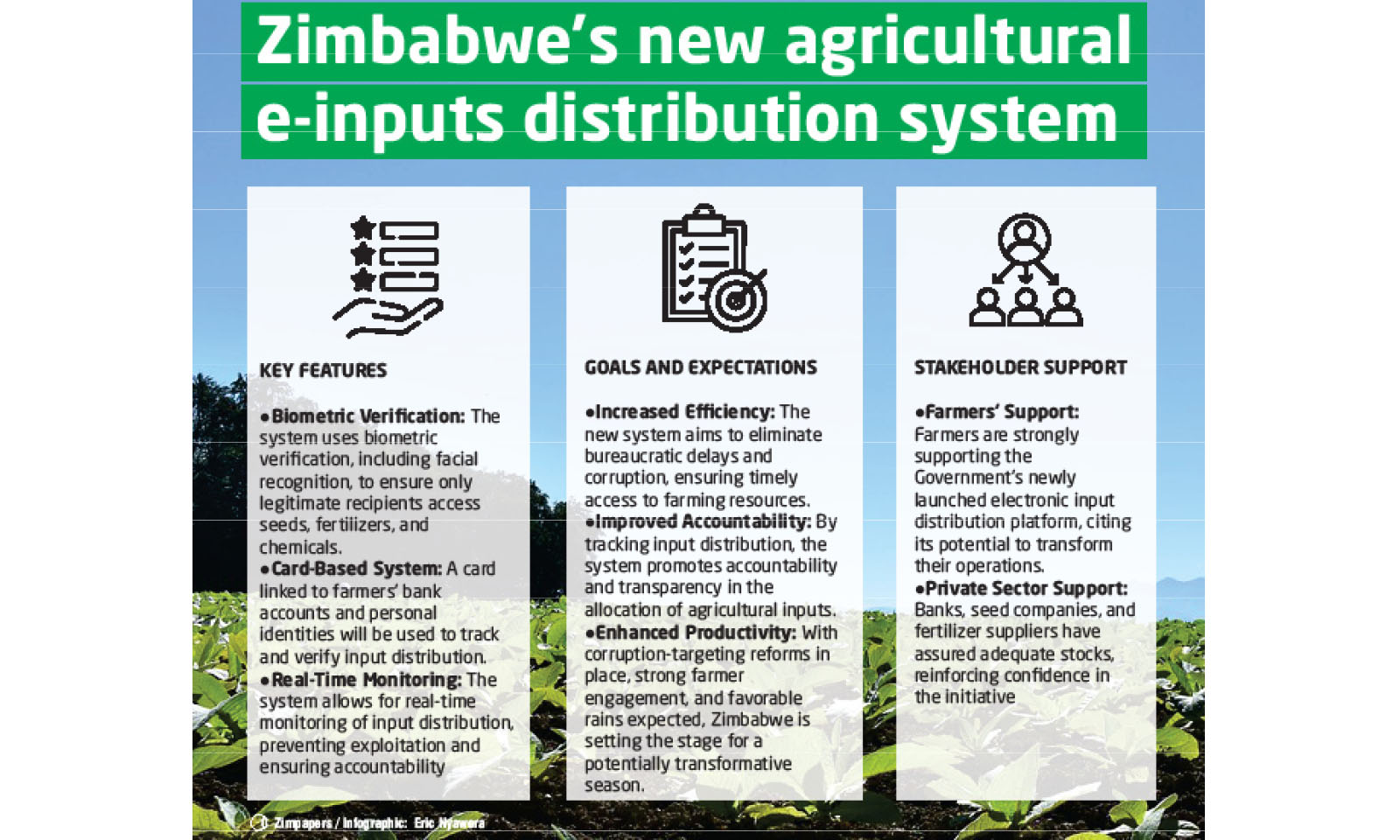
Mukudzei Chingwere and Precious Manomano
THE Government intends to introduce biometric verification through a card linked to farmers’ bank accounts, personal identities and facial recognition to eliminate corruption in the distribution of agricultural inputs.
Lands, Agriculture, Fisheries, Water and Rural Development Minister Dr Anxious Masuka said the technology, which is also being used in Kenya, will ensure that only legitimate recipients access seeds, fertilisers and chemicals under State support programmes.
“We are very prepared and we will be able to provide periodic updates on the distribution, and we don’t foresee any problems. Over and above the traditional ward-based system, we are going to overlay that with a card, being developed by AFC, which has shown distribution prowess in Kenya,” said Dr Masuka.
“This will enable us to give bona fide recipients of inputs and eliminate corruption within that system.”
The new measures come as the country mobilises inputs for the 2025/2026 farming season.
The Government is targeting 3,1 million hectares for summer crops, with one million hectares under the Pfumvudza/Intwasa programme, largely focused on maize, sorghum and millet.
The authorities expect to produce more than 3,2 million tonnes of cereals from 2,5 million hectares.
The Presidential Input Support Programme is central to these preparations, with the Government already distributing seeds and fertilisers to Grain Marketing Board (GMB) depots and enrolling new fertiliser suppliers.
Meteorological forecasts point to normal to above-normal rainfall for the 2025/2026 summer cropping season.
Commercial Farmers Union (CFU) president Dr Shadreck Makombe stressed the importance of coordination.
“This season requires a united front among all stakeholders to secure a brighter agricultural future for Zimbabwe.”
Permanent Secretary in the Ministry of Lands, Agriculture, Fisheries, Water and Rural Development Professor Obert Jiri encouraged farmers to be proactive.
“Farmers need to prepare accordingly because the season will likely be good. Agro-matched input acquisition and land preparation must be on point to embrace the predicted rains,” he said.
Support from the private sector has boosted confidence.
Banks, seed companies and fertiliser suppliers have assured adequate stocks.
Agricultural and Rural Development Authority board chairperson Mr Ivan Craig urged farmers to conduct soil tests to optimise yields.
“Soil testing is essential. The health and fitness of farmers are also important for increasing production,” said Mr Craig.
Farmers are also being encouraged to stock dipping chemicals and strengthen animal health systems against diseases likely to spread in moist conditions.
Agriculture remains the backbone of Zimbabwe’s economy, providing employment and income for 70 percent of the population, supplying 65 percent of raw materials to local industries and accounting for 40 percent of total export earnings.
It is also the country’s second-largest foreign currency earner after mining.