Online Reporter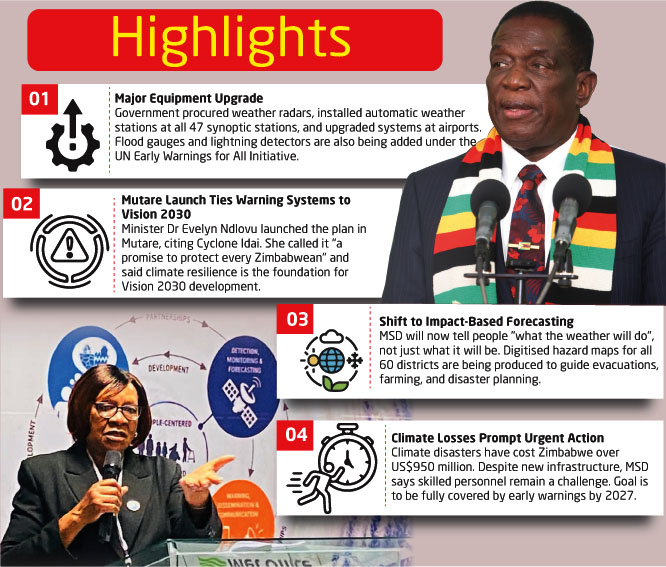
Ray Bande
Senior Reporter
THE Government has significantly strengthened disaster preparedness capacity through the procurement of radars, automatic weather observation systems and other modern forecasting equipment as part of a nationwide push to protect communities from climate-induced disasters.
The investments by the Second Republic under President Mnangagwa form part of the Early Warnings for All (EW4ALL) Initiative, a United Nations-backed programme aimed at ensuring that every person on earth is covered by life-saving early warning systems by 2027.
Speaking at the official launch of Zimbabwe’s EW4ALL Initiative in Mutare yesterday (Thursday), Environment, Climate and Wildlife Minister, Dr Evelyn Ndlovu, said the country has embraced the global programme as a national commitment to build resilience and safeguard lives against increasingly severe climate shocks.
“Zimbabwe has translated this initiative into a national obligation that will see us more resilient beyond 2027.
“It is a promise we make to ensure that we protect every Zimbabwean, in every village, in every corner of our beloved country with systems that translate early warning into effective people-centred transformative early action,” she said.
Minister Ndlovu said the decision to launch the initiative in Manicaland carried special significance, given the province’s experience with devastating disasters such as Cyclone Idai, which exposed vulnerabilities while also demonstrating the importance of preparedness and resilience.
“The Early Warning for All initiative goes hand-in-glove with the national development strategy of leaving no place and no one behind as we move towards Vision 2030.
“Climate resilience is not separate from development; it is the foundation upon which sustainable development is built.”
Minister Ndlovu stressed that the country must move beyond merely responding to emergencies.
“We must break the cycle of loss and recovery, and instead build communities that are prepared, informed and able to act before hazards become disasters,” she said.
Meteorological Services Department Director and Zimbabwe’s Permanent Representative to the World Meteorological Organisation, Mrs Rebecca Manzou, revealed that the Government has already made substantial investments in modern forecasting and monitoring infrastructure.
Among the key developments are the procurement of weather radars strategically positioned to provide extensive national coverage, the installation of automatic weather stations at all 47 synoptic stations and the upgrading of weather observation systems at several airports.
“We are grateful that the Government has invested heavily in the early warning system where we saw radars being procured for the whole country.
“All the 47 synoptic stations now have automatic weather stations, while three airports have already been equipped with new automatic observation systems. Work is ongoing to cover the remaining airports,” she said.
She said the Meteorological Services Department is also installing flood level gauges and lightning detection systems, while upgrading numerical weather prediction models to improve forecasting accuracy.
Despite these gains, Mrs Manzou noted that human resource capacity remains a major challenge.
“Our capacity is stretched, particularly in terms of skilled personnel. While infrastructure is improving, human capacitation remains critical,” she said.
As part of the initiative, authorities are producing digitised hazard maps for all of Zimbabwe’s 60 districts, identifying flood-prone areas, drought zones, cyclone pathways and landslide hotspots.
The data will feed into a new National Disaster Risk Information Management System, designed to provide evidence-based information for disaster planning and response.
“We cannot protect against what we do not know or understand,” said Mrs Manzou.
The initiative is built around four pillars, including risk knowledge, observation and forecasting, warning dissemination and community preparedness.
A key shift will be the introduction of impact-based forecasting, which focuses, not only on predicting weather conditions, but also on communicating their likely consequences.
“We will no longer just tell people what the weather will be. We will tell them what the weather will do. To a farmer that means planting drought-tolerant crops.
To a community that means evacuating before floodwaters arrive. This is where warnings save lives,” she said.
The launch comes against a backdrop of worsening climate-related disasters that continue to exact a heavy human and
▶ To Page 6
From Page 1
economic toll on Zimbabwe.
According to disaster data presented at the event, the country’s disaster profile over the past five decades has been dominated by droughts, floods, storms and disease outbreaks, with droughts causing the greatest humanitarian impact.
The 2007-2008 drought affected more than six million people, while the 2024 El Niño-induced drought triggered widespread food insecurity across large parts of the country. Mrs Manzou said economic losses from climate-related disasters have exceeded US$950 million, undermining economic growth and development.
“The pattern is clear. Climate change is making droughts longer and floods heavier, while floods often trigger disease outbreaks, creating a cycle of food insecurity, loss of life and infrastructure setbacks,” she said.
“These are not just statistics. They represent families disrupted, livelihoods destroyed and dreams deferred.”
Launching the national action plan, Minister Ndlovu said the Government is committed to ensure that early warning systems benefit every citizen, particularly vulnerable communities exposed to climate risks.
“We are launching the Early Warning for All Action Plan not as a document, but as a promise.
“A promise to the people of Zimbabwe that we will do everything in our power to protect them from the impacts of climate variability and climate change.
“Early warnings save lives. Early warnings protect livelihoods. Early warnings build resilience. Early warnings work, and they must work for everyone,” she said.
She said the action plan will serve as the foundation for building a safer, stronger and more climate-resilient Zimbabwe as the nation advances towards Vision 2030.