


 Online Reporter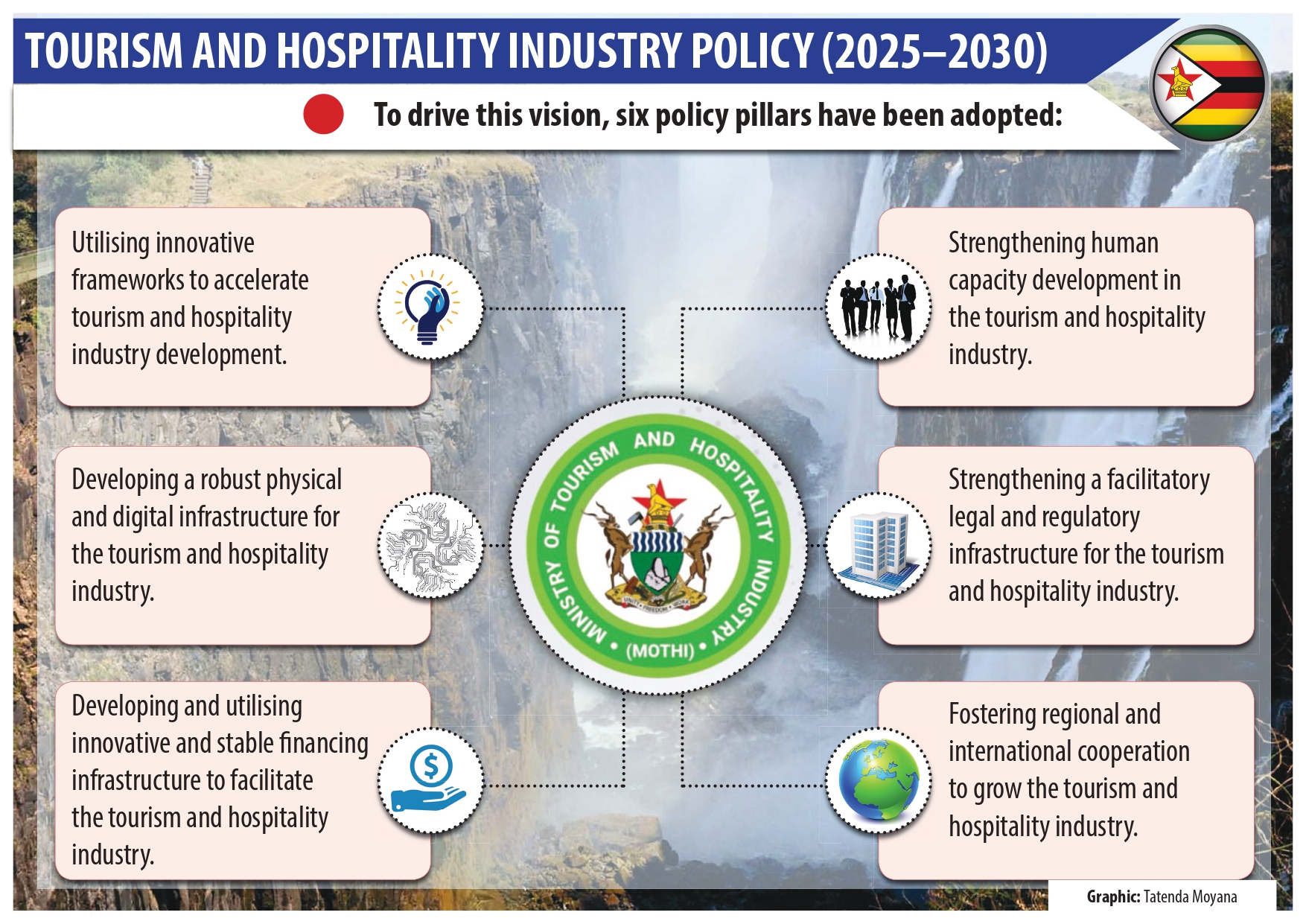
Nqobile Bhebhe
Zimpapers Business Hub
IN a decisive step towards transforming Zimbabwe’s tourism and hospitality sector into a globally competitive and inclusive economic driver, the Government last week unveiled the Tourism and Hospitality Industry Policy (2025-2030).
Launched by President Mnangagwa, the landmark blueprint lays out a transformative road map focusing on inclusive sectoral growth, infrastructure development, digital transformation and devolution, all anchored in the national vision of becoming an upper middle-income economy by 2030.
The policy’s launch coincides with the industry’s remarkable achievement of surpassing its US$5 billion revenue target, originally set for 2025, demonstrating how visionary leadership ensures tangible results.
Backed by extensive consultations across all the 10 provinces, the comprehensive policy is rooted in Section 13 of the Constitution on national development, and aligns with the Tourism Act (Chapter 14:20).
Its general framework aims to promote and develop the tourism and hospitality industry in Zimbabwe.
Recognising tourism’s critical role in economic revival, President Mnangagwa directed the policy’s formulation to steer industrialisation in line with the national ethos “Nyika inovakwa nevene vayo/Ilizwe lakhiwa ngabanikazi balo”, a call to citizens to develop their own country and ensure “no one and no place is left behind”.
“Realising the importance of tourism as one of the largest contributors to the national gross domestic product (GDP), His Excellency . . . directed the development of a robust tourism and hospitality industry policy,” reads the policy document.
The policy seeks to bring about balanced tourism and hospitality-related development across Zimbabwe, ensuring that local communities benefit from resources in their areas.
Stakeholder consultations, interviews and a detailed gap analysis informed the policy formulation, ensuring it is both practical and reflective of local realities.
A key directive is to “Promote a heritage-based approach to tourism development so as to take advantage of Zimbabwe’s unique heritage in growing the industry”.
In doing so, the Government aims to ensure Zimbabwe’s story is told by its own people through its ancient monuments, vibrant cultures, cuisine, wildlife, music and hospitality.
The strategy also adopts a cluster-based approach to grow niche tourism segments such as sports, as well as cultural and medical tourism, each with its own tailored promotion strategies.
Crucially, the policy introduces a devolved tourism model, putting the spotlight on rural areas and marginalised communities, shifting from decades of concentration on traditional hotspots like Victoria Falls and the Eastern Highlands.
This promotes “an inclusive approach in tourism development and promotion by making tourism facilities accessible to marginalised groups and persons, including those with disabilities, rural women and the youths, thereby leaving no one behind”.
Tourism players have widely welcomed the policy.
A lecturer at Lupane State University, Dr Ngoni Shereni, noted that the policy is imperative given recent changes in the business environment and socioeconomic dynamics.
He emphasised, “A devolved approach is going to be critical to the success of this policy”, requiring grassroots awareness and adequate funding for implementation.
He called for practical multi-stakeholder collaboration involving the academia, industry and local authorities.
A tourism player in Bulawayo, Mr Tinashe Mudawari, described the new policy as a “game-changer”, highlighting its foresight and practicality.
“It is not a policy of lofty ambitions. It is grounded in action,” he said.
“The emphasis on decentralisation, digital infrastructure, financing and skills development shows Government’s seriousness in elevating tourism as a true economic pillar.”
Travel and leisure operator Mr Tafadzwa Mandiwanzira added that a clear national tourism policy was critical for long-term planning and investor confidence.
The policy makes a bold statement on education and skills development, requiring tourism and hospitality students to spend at least 40 percent of their training on practical learning under the Heritage-Based Education 5.0 model.
Furthermore, the legal framework governing tourism will be modernised to align with the Constitution’s development mandate and bolster regulation, standards, gender equity and governance.
The financing component is among the most transformative, providing for a resilient and sustainable model to fund sector development.
The policy document notes that the “financing infrastructure for the tourism and hospitality industry shall provide for the establishment of a resilient and sustainable model and system of financing the development of the sector”.
This pillar aims to attract both domestic and foreign investment, enhance accountability and mobilise financial resources for infrastructure development, service delivery enhancement and sustainability.
As part of this financing drive, the Zimbabwe Tourism Fund (ZTF) has been reconfigured into a critical vehicle for financing priority infrastructure, and promoting service quality and standards within the sector.
The Government has gazetted the Tourism Amendment Bill, which seeks to create a stand-alone tourism fund.
This new fund, which is made up of levies from players and other appropriated monies, is expected to improve good governance, transparency and accountability. It will be used to promote local tourism offerings and support players struggling for capital.
The policy outlines Zimbabwe’s ambition to integrate more deeply with regional and international tourism ecosystems, promote transfrontier conservation and attract global hospitality brands.
To operationalise the blueprint, 23 actionable policy areas have been mapped across six pillars, each with clear timelines, roles and performance indicators, ensuring constant monitoring and evaluation.
With this new blueprint in hand, Zimbabwe is positioning itself not just to attract more visitors, but to build a thriving, inclusive tourism economy that benefits all its citizens.



 Online Reporter