Online Reporter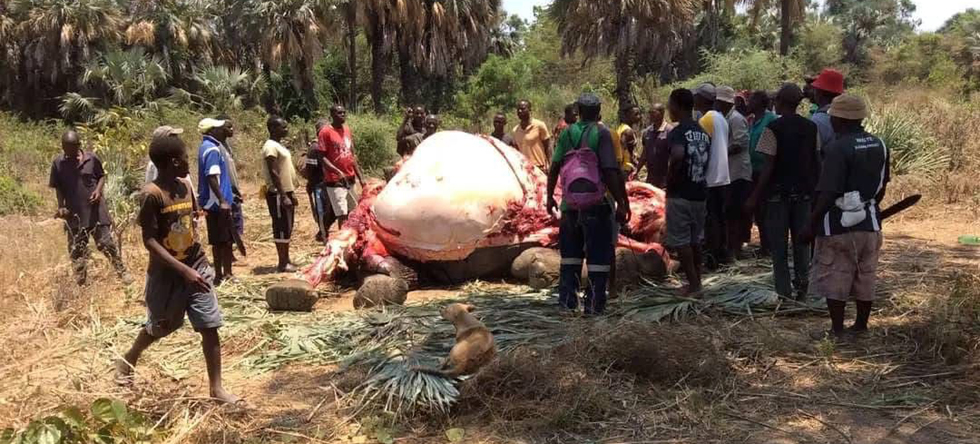
Lovemore Kadzura
Post Reporter
VILLAGERS in the south-eastern parts of Manicaland continue to bear the brunt of wild animals straying from a nearby conservancy, destroying their crops and killing their domestic animals, as the human-wildlife conflict continues to afflict the communities.
Parts of Chipinge, Mutare and Buhera districts are paying the price of being close to the Save Conservancy, where wild animals are now freely escaping to roam in communities due to lack of fencing.
The animals are destroying irrigation scheme infrastructure, crops and feasting on domestic animals.
Early this year, Zimbabwe Parks and Wildlife Authority (ZimParks) had to gun down five problematic elephants that were ravaging the Chibuwe area of Chipinge. Recently, ZimParks killed another elephant following distress calls by the same community.
The same night, a herd of elephants visited the community in search of green pastures in farmers’ fields.
Besides the elephants, buffaloes and lions have been regularly straying into communities around Save River, leading to the constant outbreaks of diseases such as foot-and-mouth (cattle), which is spread from the buffaloes as they share pastures with domestic animals.
Although communities benefit from the meat from the killed elephants and buffaloes, which they are given for free by ZimParks, they feel that was not enough to compensate for the damage which the stray wild animals cause to their economic activities.
Councillor Edmore Mabika, of Ward 20 under Chipinge Rural District Council called for the rehabilitation of the double fencing of Save Conservancy to minimise the number of stray wild animals in their communities.
“In Ward 20, we have a challenge of wild animals, especially elephants and buffaloes, which are causing havoc in our communities. Last Sunday, one elephant was gunned down by ZimParks rangers following distress calls by communities.
The following night, another herd of elephants strayed into the community.
These animals are vandalising irrigation infrastructure in the Mutema/Musikavanhu Irrigation Scheme in search of food in the fields.
“These animals are straying from Save Valley Conservancy, crossing into Chibuwe Village. They will be searching for green vegetation, which is readily available in our irrigation schemes. Currently, the vegetation in the conservancy is dry. The conservancy is also no longer properly secured, as most of the fence is down, allowing easy passage of the animals.
“Farmers are accruing huge losses as irrigation infrastructure is being damaged, while their crops, which are their source of livelihood, are being grazed by the wild animals. At the moment, we are urging community members to co-exist with the wild animals. Whenever they spot them, they should immediately inform ZimParks and other relevant stakeholders for a solution. We are calling for the double fencing of some parts of Save River so that these animals do not cross into villages after drinking water. Villagers are also encouraged to secure irrigation schemes tightly and guard their fields during the night and scare animals away,” said Councillor Mabika.
Village Head Simione Dambamuromo said, besides the spread of diseases to their livestock by stray buffaloes, lions regularly visit their area to attack their domestic animals.
“We need a solution to wild animals from the game reserve. Lions are also straying into the villages to attack people’s livestock, such as cattle, goats and sheep. Buffaloes are also mixing with our livestock, spreading foot-and-mouth disease.
“Our people are being urged to dip their cattle regularly to protect them from disease while we wait for the fencing of the conservancy. We have raised the issue of straying animals for a long time, and we hope a solution is on its way,” he said.
While efforts to get a comment from ZimParks Director-General Professor Edison Gandiwa were fruitless, as he was not reachable, ZimParks is on record encouraging the co-existence of humans and wildlife, and usually reacts fast to distress calls by communities besieged by straying animals.
Zimbabwe has the second-largest elephant population in the world after Botswana, which stands at over 100 000.
Save Conservancy is one of the largest privately owned game reserves in Africa, which is home to a variety of animals..