Online Reporter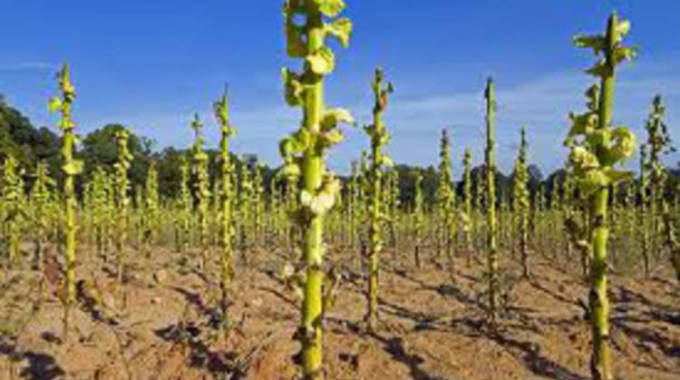
Elita Chikwati
Agriculture News Editor
TOBACCO growers who fail to destroy stalks will be flagged in the national grower database, a move that will directly affect their regulatory clearance, marketing privileges and contractor support for the 2026/2027 season, the Plant Quarantine Services Institute has revealed.
The national regulatory authority, mandated through the Plant Pests and Diseases Act [Chapter 19:08] to safeguard Zimbabwe’s agricultural biosecurity and protect its international trade status, has launched intensive nationwide enforcement audits following the expiry of the statutory May 15 deadline for the uprooting and destruction of tobacco crop residues.
PQSI is working closely with the Tobacco Industry and Marketing Board (TIMB) and the Agricultural and Rural Development Advisory Services (ARDAS).
According to the head of PQSI, Dr Loiusa Makumbe, the institute’s plant health inspectors from the internal quarantine enforcement stations that include Mazowe, Bindura, Chinhoyi, Karoi and Mutare were conducting random and targeted physical field audits to manage compliance gaps and enforce adherence to the legislative calendar.
The institute is targeting areas identified as non-compliance hotspots.
“The deliberate or negligent failure by some growers to remove these residues is a high-risk phytosanitary violation that cannot be tolerated.
“In terms of the Plant Pests and Diseases Act, inspectors are issuing immediate penalties.
“First-time offenders face a statutory fine of up to US$100 per hectare (or local currency equivalent) and/or up to one year of imprisonment. Repeat offenders face up to US$200 per hectare and/or up to two years of imprisonment,” she said.
The law enforces an absolute host-free period between 1st of January and June 1 (the earliest legal date for sowing seedbeds) and 15th May to September 1 to create a “dead period” for tobacco transplanting into the field.
“In the absence of live green tissue to feed on, overwintering pest populations naturally collapse. Standing stalks and root re-growths act as living reservoirs for devastating, economically important viruses, most notably Potato Virus Y (PVY) and Tobacco Bushy Top Virus.
“These viruses are efficiently transmitted over long distances by vectors such as the tobacco aphid (Myzus persicae),” she said.
Dr Makumbe said if tobacco fields are not cleared, there is transmission of viruses from old stalks straight into new seedbeds, risking an industry-wide pandemic.
“Merely cutting or slashing the crop above ground is completely ineffective. Undestroyed roots and stumps continue to host Root-Knot Nematodes (Meloidogyne spp.) and hardy fungal pathogens like Black Shank, Phytophthora nicotianae,” she said.
Since the opening of the tobacco marketing season in March, the inspectorate has conducted awareness campaigns at tobacco auction floors in Harare, Bindura, Rusape, Mvurwi, Marondera and Karoi to strengthen farmer compliance.
“The awareness campaigns involved direct farmer engagement (presentations, question and answer) and distribution of printed materials.
“Although we acknowledge that delayed seasons, such as those caused by the recent El Niño patterns that could shift reaping schedules, could occur, growers who faced genuine agronomic delays are legally required to apply for official extension permits from the PQSI head office before the deadline.
“Anyone found with standing stalks without an approved PQSI extension certificate is facing immediate penalisation,” she said.
Dr Makumbe said crop protection was a collective responsibility.
“A single non-compliant farm puts an entire area at risk of air/insect borne viral infestation. We urge all growers to immediately uproot their stalks, render them entirely incapable of regrowth, and practice sound crop rotation to disrupt pest lifecycles and preserve soil integrity,” she said.
Some tobacco farmers have attributed their failure to remove the tobacco stalks to a lack of funds, as they got low prices this season.
The farmers said they did not have cash to pay for labour; hence, they could not destroy the plant residues within the stipulated period.
Zimbabwe Tobacco Growers Association (ZTGA) president, Mr George Seremwe, confirmed that some farmers had not destroyed the stalks on time.
“Of course, farmers are angry, but we are encouraging our members to be patient and understand that this season was not good in terms of the prices.
“We fully understand the anger, but at the same time, let’s not allow it to destroy our future. Transmission of the viruses will also affect crops like potatoes and tomatoes.
“The season has been an unfortunate one in terms of prices, but let us not lose hope. Let us destroy stalks and curb the spread of diseases,” he said.