admin
admin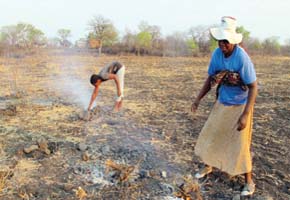
Land preparation is in various forms, the most common of which is tilling the fields which may be done immediately after harvesting is finished or, at the latest, this month before the hot September-October tropical sun dries up the ground.
Another way of land preparation involves cutting down bushes and trees and the removal of stumps. Farmers may wish to extend their fields, an activity that involves felling trees and using their branches to build hedges something done by those who cannot afford to buy and erect barbed wire fences.
The most important agricultural activity, however, for every serious farmer this month is to till the fields. That is what used to be called winter-ploughing because it is done more or less in winter.
Its major advantages are three: it helps to reduce weeds, especially couch grass (hanje, tsangadzi, uqethu) whose long creeping roots are exposed to the sun by tilling, thus reducing its incidence in the field; it destroys pests such as maize stalk borers in their pupal stage by exposing them to the sun, it loosens the soil, making it more porous so that rain water can percolate instead of flowing away superficially without being accessible to the roots of crops or plants.
A porous soil is much better for crops in that it allows air and such gases as nitrogen to reach roots of leguminous plants that fix it into the soil and are used for healthy growth of the relevant crops.
Winter ploughing buries weeds and other vegetable matter under the soil where they decay and enrich the field as manure. Weeds that cannot be covered by the plough can be harrowed away and turned into compost manure.
The primitive practice of burning weeds and then ploughing the burnt area is certainly not recommended as fire destroys chemical and mineral substances that contribute to the healthy germination, growth and maturation of crops and plants.
Research has proved in the past 100 or so years that soil frequently or regularly subjected to the “slash and burn” (known as the chitemene system in Zambia’s Bemba region) agricultural system becomes utterly unproductive sooner than later.
It has also been concluded that ashes (vegetable) are a good tonic for growth but not for productivity. They are only good if the soil with such ashes receives plentiful rain or irrigation water. It would appear that the only crop that does well in such soil in both growth and productivity is tobacco, but again as long as there is very much rain or water.
Farmers who practise dry planting are well advised to winter-plough. Should they feel that the fields need more tilling before planting is done, they can certainly plough again on the onset of the first rains.
That would reduce the incidence of pests and weeds much more than winter ploughing and also increase the germination rate of their seeds, all other factors being equal.
A winter-ploughed field is much easier to cultivate since most of the weeds would have been destroyed by the sun as stated earlier.
Because of that and the other factors such as relatively high soil fertility caused by the decayed and decaying weeds buried by the winter-ploughing yields in such fields are much higher than in other fields.
Farmers who have not done winter-ploughing before would be pleasantly surprised if they tried this on a part of their field, even if it is on only an acre or two this coming rainy season.
The tilling can be done manually if scarcity of resources makes it impossible to use mechanised or animal-drawn ploughs or discs.
Urban farmers can increase their yields by tilling their little pieces of land now and in the process bury the dry leaves that abound in the peri-urban localities where they have their mini-plots.
It is the opinion of this article’s author that there will be much rain this coming season if most past leap year rainy seasons are anything to go by.
In 1936, rains started in December in most parts of Matabeleland and were so heavy that most farmers got bumper harvests. In 1940 the rain was well above average. In 1944 and 1948, Matabeleland received a drenching downpour, as in 1952.
The years 1956, 1960 and 1964 were also quite good, giving this writer a very debatable opinion that heavy rains fall in this region at the end of every four-year cycle.
The affected regions are Matabeleland, Midlands, parts of Manicaland as well as Botswana, western Mozambique and the extreme northern-South African region bordering Zimbabwe, Mozambique and Botswana.
With that observation in mind, it would be advisable for Zimbabwean farmers to prepare themselves for favourable agricultural season at the end of this leap year.


 Online Reporter