daniel chigunwe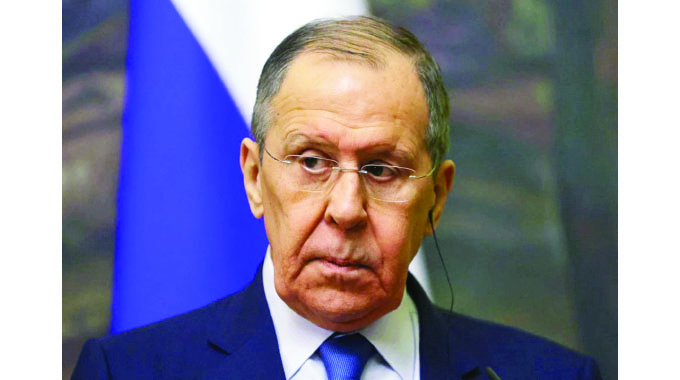
MOSCOW. – Russia said yesterday that some parts of a possible peace deal with Ukraine were close to being agreed after Kyiv agreed to discuss neutrality, raising hopes of an end to the biggest war in Europe since World War Two.
“Neutral status is now being seriously discussed along, of course, with security guarantees,” Foreign Minister Sergei Lavrov said told RBC news.
“Now this very thing is being discussed in negotiations – there are absolutely specific formulations which in my view are close to agreement,” Lavrov said.
He said that President Vladimir Putin had spoken about neutrality, along with security guarantees for Ukraine without NATO enlargement, as one possible variant in February.
The euro extended gains after Lavrov’s comments and was up 0.4% to $ 1.1005.
Lavrov cautioned that the negotiations were not easy but that there was “some hope of reaching a compromise”.
Ukraine has also made cautious positive statements on peace talks. It says it is willing to negotiate to the end the war, but will not surrender or accept Russian ultimatums.
Lavrov said key issues included the security of people in eastern Ukraine, the demilitarisation of Ukraine and the rights of Russian-speaking people in Ukraine.
New talk of compromise lifted hope for a potential breakthrough after three weeks of war.
Ukraine’s President Volodymyr Zelenskiy said negotiations were becoming “more realistic”.
Russian President Vladimir Putin, who ordered his troops into Ukraine on Feb. 24, said Moscow was ready to discuss neutral status for its neighbour.
But Putin also said Russia would achieve its goals in Ukraine and would not submit to what he called a Western attempt to achieve global dominance and dismember Russia. The military operation was “going to plan,” he said in a televised address.
In a speech to government ministers broadcast yesterday, Putin went further than before in acknowledging the pain that Western sanctions were inflicting on the economy, but insisted that Russia could withstand the blow.
There was no sign of any softening in his bitter invective against the West and Ukraine.
Meanwhile, Russia and the US have exchanged and escalated sanctions with Russia announcing on Tuesday tit-to-tat sanctions on US President Joe Biden and 12 top officials including Secretary of State Antony Blinken and Defence Secretary Lloyd Austin.
Analysts said Russia’s new move is a reciprocal countermeasure against US provocations and sanctions, and the escalation of sanctions between the two world powers cast a shadow on dialogue and that it showed a diplomatic solution to the ongoing Ukraine crisis is not yet in sight.
The sanctions, which also apply to National Security Advisor Jake Sullivan and CIA director William Burns, came after US sanctions on President Putin, Lavrov and Defence Minister Sergei Shoigu in February.
Russian media said the people on Kremlin’s black list will be denied entry to Russia.
Russia’s sanctions against the Biden administration are reciprocal countermeasures in response to US sanctions, Zhang Hong, an Eastern European studies expert from the Chinese Academy of Social Sciences, told the Global Times.
Zhang said that sanctions in terms of international affairs generally avoid those against heads of state to leave a door open for dialogue. “After the US and Russia successively upgraded sanctions on heads of state, they closed the door for dialogue in the short term.”
Some analysts added that the “closed-door” situation does not mean there are zero possibilities for communication, nor does it prevent them from reaching a compromise on Ukraine.
Kremlin spokesman Dmitry Peskov said on Tuesday that Russia has never ruled out normalizing relations with the US, “if Washington takes a constructive position,” Tass reported.
Sanctions against Biden and top US officials reflected Russia’s determination to continue its own way to deal with the Ukraine crisis and its dissatisfaction toward US’ involvement in the Ukraine crisis, said Zhu Feng, a professor of international relations at Nanjing University.
“It also shows that the time for a diplomatic solution to the Ukraine crisis is still not ripe,” Zhu said.
After banning certain Russian financial institutions from SWIFT, many Western companies and financial institutions suspended their operations in Russia. And the sanctions, according to Chinese analysts, are likely far from over.
The EU on Monday launched a new barrage of sanctions against Russia including bans on energy sector investment, imports of steel products and luxury goods exports, Reuters reported. EU is also considering suspending Russia’s IMF membership. – Reuters/GlobalTimes



 Online Reporter