Chronicle Editor
Raymond Jaravaza in Kezi, [email protected]
MATOBO District, located in a semi-arid region characterised by low rainfall, has emerged as an ideal environment for commercial goat farming due to the abundant acacia and mopane trees.
The trees provide a nutritious food source for goats, making it particularly lucrative for breeding Boer, Savanna, and Kalahari goat breeds. These breeds are in high demand both locally and internationally for their quality meat and genetic value.
Health consciousness, leather and milk value chain, and religious festivities are among the major factors pushing demand for goat meat in Zimbabwe with goat meat producers struggling to keep up with demand.
Government is already running a Goat Pass-On Scheme, which is expected to uplift rural communities across the country where three million households are expected to benefit.
Yesterday, over 300 villagers from Tshelanyemba and surrounding areas attended a day-long workshop at Tshelanyemba High School, focusing on goat pedigree breeding. The workshop was designed to empower local farmers with the knowledge and skills needed to excel in this field.
The initiative was led by experienced goat breeders from Gweru, Bubi, and South Africa who included Mr Nqobile Madlela, Mr Reuben Manhondo, and Mr Daniel Chiwota. Together, these breeders have over 30 years of experience in the goat pedigree breeding industry.
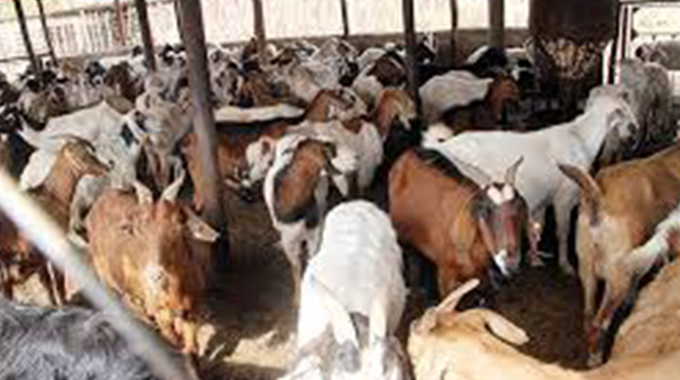
Mr Manhondo, who manages a herd of over 500 Kalahari and Boer goats on a five-hectare piece of land, shared insights on the intensive nature of goat breeding.
He emphasised that successful goat farming does not require large tracts of land, as he manages his herd on the same size of land typically available to villagers in Kezi.
He also highlighted the need to shift perceptions about goats, urging villagers to view goat farming as a profitable business that can be passed down through generations.
He further encouraged the villagers to capitalise on the available pastures, noting that goats are well-suited to the harsh conditions of the area due to their ability to graze and browse on minimal pastures.
Mr Manhondo advised farmers to store green grass during the rainy season as stock-feed for the dry season and emphasised the importance of providing supplementary feeding during critical times like pregnancy and weaning.
“Boer and Kalahari goat breeding is a scientific and intensive form of farming that does not necessarily need huge pieces of land. Zimbabweans have for a very long time been orientated to believe that goats are for local consumption at a household level, but we must now change that perception and look at goat rearing as a profitable business that can be passed from generation to generation,” he said.
During the workshop, Mr Manhondo guided the farmers through the critical process of maintaining clean goat pens. He emphasized the importance of cleanliness in preventing diseases and controlling ticks, which are common challenges in goat farming.
“By ensuring that goat pens are well-maintained and hygienic, farmers can significantly reduce the risk of health issues among their herds, thereby improving the overall productivity and profitability of their goat breeding efforts,” he said.
Mr Chiwota, who runs DC Boer Goats, shared his personal journey of transitioning from commercial cattle rearing to goat breeding. His venture currently boasts 150 Boer goats. He recounted how he made the switch after facing difficulties selling his cattle, with abattoirs offering just R3 500 per beast, a price he found unsustainable.
This experience led him to explore goat breeding, which he found to be more lucrative and better suited to the local environment. His story resonated with many farmers, highlighting the potential benefits of goat farming in areas such as Matobo.
“I wanted to pay school fees for my children and abattoirs were offering R3 500 for one cow, an offer that I found unjustifiable considering that it took me three years to feed those cattle. I immediately switched to Boer goats after doing some research,” said Mr Chiwota.
“I recently sold a buck for US$1 200 to a Midlands farmer and that proves how good goat breeding pays.”
Mr Madlela, who runs a successful goat breeding enterprise in South Africa, explained the process of cross-breeding local Matabele goats with Boer or Kalahari goats to produce first-generation (F1) goats, which can fetch as much as US$90.
He said over time, these F1 goats can be improved into pure breeds, further increasing their market value. Mr Madlela also encouraged farmers to harness technology to market their products effectively.
To support the local community, the breeders donated a buck to help improve the genetic quality of the goats in Tshelanyemba.
Local farmers were inspired by the workshop, with Mrs Aglet Ncube (68) expressing her gratitude for the knowledge gained, which she believes will help her better manage her herd.
“My herd of 25 goats could have easily doubled in one year, but I lost so many kids to an unknown disease. So, today, I learnt about the importance of taking goat breeding seriously,” she said.
Ms Nobuhle Mlilo (25) also looked forward to applying what she learned to enhance her goat breeding efforts.
In addition, six young farmers from the area formed the Yandisa Isibaya Cooperative, with plans to purchase a Boer goat to improve the genetics of their herd and offer better breeding options to other farmers in Kezi.



 Online Reporter