Chronicle Editor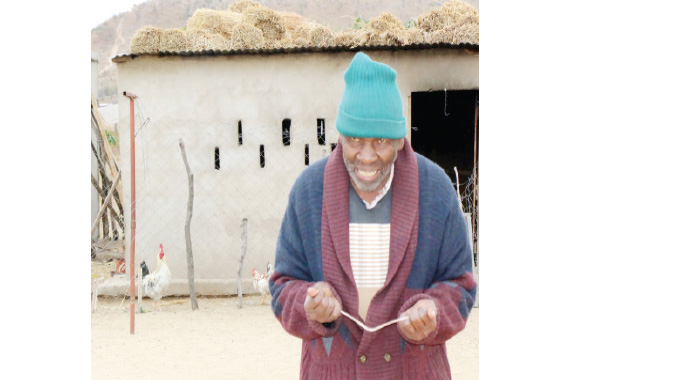
Nqobile Tshili, Chronicle Reporter
AT the age of 75, Mr Micah Mathe from Montgomery Plots on the outskirts of Bulawayo is not an ordinary pensioner.
He said while he was born in 1946, there was a mistake at registry and as such his ID suggests that he is 67 years old when infact he is 75.
He could be among the most popular people in the Montgomery area in Umguza district because of his line of work.
Mr Mathe is a water surveyor and uses traditional methods where he employs just a copper wire and sometimes a wet small tree branch to locate underground water.
He is not a sophisticated man and can even be mistaken for any other struggling pensioner who has become a dependent due to his old age.
But his is a different tale as he shows Chronicle news crew photographs of his 2015 wedding with his wife Mrs Ntombiyesisa Mathe.
When a Chronicle news crew visited his home on Thursday, he couldn’t immediately recognise the crews despite having spoken to them prior.
When the news crew introduced itself to him again, his face lit up and smilingly, he welcomed the team to his 2,5 hectare plot.
At the plot there is a recently completed five-roomed house and another older structure where his family lives.
He has a modest fowl run with chickens.
Turning to his work, Mr Mathe brags that he has never got it wrong in his long career that spans up to nearly 40 years.
“I started this in 1984 but before that, I worked as a gardener at several homes but that job was not paying because you would wait for a salary only once per month. But water surveying pays handsomely. Whatever you see in this home, was bought using proceeds from water surveying.

“Tomorrow I have a client who wants me to survey water for him and on Saturday I have eight customers that have contracted my services,” said Mr Mathe, who is not shy to show how lucrative his job is.
The newly constructed five-roomed house has been tiled and he explained that what is left is for him to build a septic tank and connect water before his family moves in.
“I bought this 2,5 hectare land in 2015 and I have managed to develop so far through the money I get from surveying jobs,” he said.
Mr Mathe has erected a banner about 50 metres from his home to direct clients.
He said he can no longer remember the number of jobs he has done as he is overwhelmed by clients.
“And these clients are individuals and institutions such as schools and clinics. I have done a lot of work for public institutions in Bulawayo,
Matabeleland North and Matabeleland South,” he said, adding that his reputation is what has kept him in the game for so long.
Mr Mathe said business was very good during years when areas such as Bulawayo were facing water challenges as many people were drilling boreholes.
He mocked the surveyors using latest technologies saying he was being hired to survey for water where they would have failed.
Mr Mathe uses either a V-bended copper wire or wet small tree branch to survey for water.
He invited the news crew outdoor where he illustrated the process of identifying a water point.
The news crew observed him as he moved from point to point and upon reaching a water point he marks the ground.
Quizzed if anyone could use his copper wire or the wet tree to locate underground, he said yes, before asking his nephew Mr Nesbert Mangamiso to do the same.
Mr Mangamiso, confidently took the copper wire but in less than a minute he had broken it, probably proving that the not so complicated task, is not so easy to do as well.
“Mzukulu, you have broken my wire. Do you know how much it costs? But I have another one,” said Mr Mathe, leaving the site where he was making illustrations.
He returned just a few moments later with a small tree branch which he used to demonstrate how he locates the underground water.
The father of five however said that none of his children have decided to follow his footsteps.
He however points out that he has mentored a man from Pumula South suburb, who had to leave being a taxi driver to take up this better paying job.
“I used to hire his taxi to ferry me to Mzilikazi and over time, we became close. One day, he asked me what job I was doing. I believe, this was after he realised that it’s not really cheap to call a cab to take you from here to Mzilikazi. I opened up to him and he requested for my mentorship. I agreed, I would take him along to some of the jobs that I was doing. Now he is working alone and when he started to operate alone, after doing some jobs, he would come to give me tokens to say thank you. He is now driving a big car from the earnings he is getting from this job,” he said.
Mr Mathe said he has even earned trust from some borehole drilling companies because of his accuracy.
“The owner of the one of the companies even drilled a borehole for me in my yard. So as we speak, I have two boreholes and the man promised to equip the second borehole with solar pumps just as an appreciation for the work we have done together because I have also brought clients to him,” said Mr Mathe.
His wife said her husband’s job ensured that there is food on the table.
“This is really helping us as a family. He has assisted a lot of people who come here seeking his service.
“He has even empowered a man who came here showing some humility and requested to be taught how this is done. Now that man is operating independently. But sadly, none of his children have taken this. We hope that God my preserve him so that he could maybe teach one of these little ones who seem interested in his job,” said Mrs Mathe.
An engineering lecturer with National University of Science and Technology (Nust) Engineer Alvin Mkandla said the traditional methods have proved accurate where there are no minerals underground.
Eng Mkandla said handling of modern equipment also plays a role in the successes and failures of modern professional surveyors.
He said he has also heard of incidents where professional surveyors using latest technologies fail to locate water.
“On the comparisons of those, I think there is a guy who has done that I believe what he was saying is that these traditional methods are more accurate where there is no mineral concentration.
“The traditional method cannot tell whether what you found is mineral or water so that is the disadvantage of the traditional method. The modern equipment will tell you that there is so much depth of water or there is mineral underground,” said Eng Mkandla. — @nqotshili


 Online Reporter