admin
admin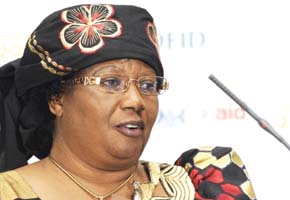
The three letter creature is none other than Aid, defined by the Collins dictionary as (money, equipment, or services that are provided for people, countries, or organisations who need them but cannot provide them for themselves).
You (yes you) guessed correctly from the foregoing that aid is not as innocuous as it sounds.
Today, for instance, weaker Eurozone countries are squealing under austerity measures that stronger European Union (EU) partners insist must accompany bail-outs that the countries with ailing economies are asking as lifelines for their own survival within the European community.
This situation in point goes to show that conditionalities attached to aid — any aid for that matter — can really be dizzifying for the taker who has to decide to swallow the bait, hook and sinker or opt to trudge alone along the rugged road hoping that, by the grace of God, a good Samaritan will stop by and throw in a rescue package with no noose attached to it.
For the uninitiated, the impact of foreign aid particularly on developing nations has the potential to undermine national soverenity by subordinating a recipient country to the donor to the extent of influencing, nay directing, a country’s foreign policy.
Let us enter memory lane back to the time when as President of South Africa Cde Thabo Mbeki mediated in the political impasse in Zimbabwe, culminating in the Global Political Agreement and the inclusive government of Zanu-Pf and the two MDC formations in September 2008.
As the South African leader weighed into the fray Western countries frothing at the mouth over land reform and drooling after the Zanu-Pf government’s liver, might have fallen over each other trying to shove keys to their banks in Mbeki’s hands for any amount of loan South Africa needed if Cde Mbeki could only deliver President Mugabe and his party to the wolves for the kill on their behalf.
But a discerning Mbeki stuck to his quiet diplomacy and delivered what Zimbabwe needed the most at that trying time — political unity which those using foreign aid as cat’s paws would certainly have had none of since a united people stand as a fortress against imperialists machinations.
Going back decades ago to the time of Africa’s decolonisation, former colonial powers angry at their ouster, used aid to distabilise newly independent states in West Africa.
The erstwhile rulers gave aid by way of training black officer cadets at their elite military academics in Britain and France, countries that had previously been imperial powers in Africa.
The blacks were indoctrinated with the garbage that African military culture was “primitive” compared with “civilised Western military culture”.
Encoded in their lessons was a silent message that the blacks should not allow themselves to work under civilian governments — and the result was a string military coups that have continued to dog some West African countries to the present time.
The leaders who were overthrown, but survived with their lives must have killed themselves in anger at their failure to discern secret agendas underpinned by maneouvres of the imperialists.
For the same obvious inability to see the hidden objective behind the aid being lumped on her country by the donor community, Malawi’s new President, Joyce Banda, might sooner or later come to grief should she be seen by her benefactors as trying to turn her back on them and therefore be perceived as “biting the hand that feeds her” and her people.
By breaking with the African Union’s common stand opposing the arrest and handover of Sudan’s President Omar al-Bashir to the International Criminal Court at the Hague — in order to please the Americans and the British for lavishing her country with the aid they had withdrawn during the rule of her predecessor President Bingu wa Mutharika — Joyce Banda has left many African leaders seething with anger over her defiance of the AU.
Malawi had been due to host an AU summit on 6 July, but the venue has been moved to Addis Ababa after the Malawian leader said al-Bashir would be arrested if he came to Malawi for the summit and be handed over to the ICC which wants to try him for alleged crimes against humanity stemming from the civil war that resulted in the succession of South Sudan.
Her pledge to the West to repeal the anti-gay legislation by her predecessor and to blacken wa-Mutharika’s political legacy, is the lone star kind of behaviour that the imperialist West has always sought to divide and weaken Africa and then embark on an orgy of exploitation of the continent’s rich raw materials.
Her country’s own Voice newspaper described President Banda’s decision not to host the AU summit as a “good donor-pleasing decision, poor leadership decision, counter productive African decision, and a wrong business decision”.
In Ghana, Kofi Ali Abdul Yekin, chairman and co-ordinator of think-tank Action Group of Africa, called President Banda a latter-day Judas Iscariot.
l To Page 6
He wrote in Modern Ghana in reference to a Biblical story in which Judas sold Jesus for financial gain.
Coincidentally, history seems to repeat itself for Malawi. For it was under the Presidency of Joice Banda’s namesake, Dr Hastings Kamuzu Banda, that Malawi first went maverick by establishing diplomatic ties with apartheid Pretoria before going on solo again to recognise the “’independence” be stored upon Transkei Bantustan by Pretoria.
President Joice Banda’s unilateral stand over Bashir — an act of thumbing her nose on the AU position — raises the question whether African organisation needs a loud and eloquent ethical code that instills the fear of God in any member who breaches the code of conduct like a yoke of oxen that wander off the furrow to nibble at succulent tufts of grass on the sides, infuriating the ploughman in the process.
It is no exaggeration that the Malawi’s leader’s blind consort with the West is good news for male chauvinists who oppose the empowerment of women right up to the highest political post in the land, and is bad news for aspiring women presidency elsewhere in Africa.
Obviously, had the new leader in Lilongwe extensively studied the impacts of foreign aid on Africa, closer to home she might had discovered that resisting harsh conditionalities that sometimes accompany donor aid do not kill after all.
Next door to Malawi, here in Zimbabwe, donor institutions said they were willing to give the Zanu-Pf Government aid to implement a Economic Structural Adjustment Programme (ESAP) then asked the country to draw water in perforated cans. Zimbabwe said no ways.
The country soldiers on today even after Western imposed sanctions over land reform blocked much needed financial aid to try to bring about regime change in this country.
No doubt Zimbabweans understand the pressures that the donor community brings to bear on a country holding out begging bowls, hence they have not come out in the streets to demonstrate for foreign aid, as Malawians have done for lack of knowledge of possible consequences for over-dependency on foreign aid.
A population that mistakes foreign aid as charity might one day even demonstrate against its government for not accepting visibility aid, which means exactly that — the desire of a foreign country to be seen to be present as a friend in another country.
In any case, foreign aid is not given for nothing. It is business, an investment on which interest accrues over time so both the donor and the recipient reap mutual benefit.
Meanwhile, President Banda’s decision to boycott the AU summit in Addis Ababa no doubt aware that her presence there after the Bashir debacle would be an embarrassment both to herself and to other heads of state — is no doubt being celebrated with funfare in the West.
In addition to the millions of dollars being funnelled to Malawi as aid, the Western donor community, in a bid to ease unemployment there, might go further and offload its own rejects on to Malawi as “experts” under a technical assistance programme for that impoverished African country.
Included among the expatriate personnel might well be hoardes of gay workers with Malawi under Joyce Banda now presenting itself as haven for those people of inverted sex.
Finally, when all has been said and Africans have raved and raved to burn out their anger at President Joyce Banda’s contact because they hold her and her country dear to the hearts — it should be realised that Malawi is not an island by itself, for lack of a better figure of speech, but part and parcel of the African political landmass.
As such, Joyce Banda should be rehabilitated into the rehab of unified African political thinking by persuasion or some such effective means.
If left to her own designs for good, other potential Joiyce Bandas elsewhere might come to the conclusion that the AU is a toothless bulldog and then make a beeline along the trail the Malawi President has blazed and into the lap of imperialism.
Should that happen the consequences for African unity and solidarity might be too gustly to contemplate.


 Online Reporter