Chronicle Editor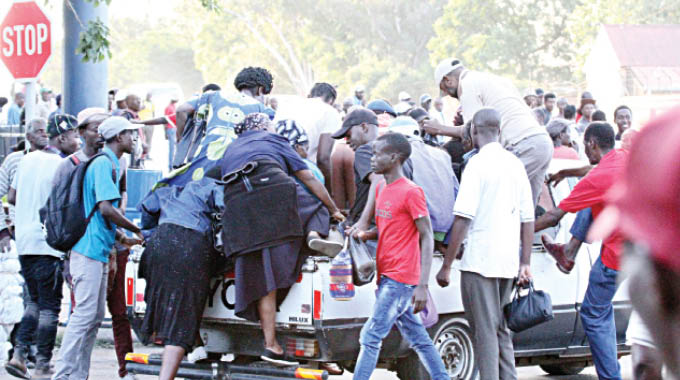
Andile Tshuma, Chronicle Reporter
Imagine Stella, a front desk officer of a reputable establishment clad in a crisp white shirt and a grey pencil skirt taking off stiletto heels, adjusting her skirt and pulling it up to allow her to stretch her leg enough to climb at the back of a pick-up truck, which is the only means to get home.
She got changed into her work clothes at work as her mode of transport for the past two months does not allow her to get dressed at home. All this happens in a matter of seconds.
The tout at the makeshift rank tells her to hurry as “this is not an office”.
She unfolds a sarong, wraps it around her lower body and ties it around her waist. She finds a convenient spot at the corner of the loading box and sits facing the opposite direction, leaning against the rear screen. There isn’t enough room to sit with less stretching, so she folds her legs, with her knees up, slightly parted so that another passenger can fit in between, and it happens to be a man, but nobody cares.
“I make sure to arrive early and change into my work clothes. I walk into the office looking like a homeless woman,” Stella jokingly says as she exchanges a lighter moment after finally settling down.
The bakkie must fit at least 20 people. It is a Mazda B1800 and it is destined for Nketa 6 suburb and will go via Sizinda and Tshabalala suburbs, joining Nketa Drive at the robots by the Service station.
Cramped with 20 or more other passengers, total strangers packed like sardines, the journey will last about 15 minutes.
However, the journey temporarily halts about half a kilometre away when the truck pulls over along Plumtree Road just before Belmont and the driver starts collecting the $2 fares from the commuters. If he doesn’t do this, the passengers would go away without paying, finding a convenient time to jump off the vehicle while in motion, or when it stops to give way to traffic.
This is the reality of many Zimbabweans nowadays as the cost of commuting has soared. Stella is one of the many women who find themselves in such situations, exchanging their dignity for a trip home.
Women are the hardest hit.

Just last week, a video circulated on Twitter and it was of a baby that fell off a mother’s back at the Ross Camp makeshift rank as she tried to board a two-tonne truck. There was a stampede and as people were jostling to make it to the vehicle, the knot on her baby’s wrapper undid itself and the toddler came down. The helpless woman had one foot in and the other still on the tow bar.
Luckily, there was a very alert man who extended his foot and the baby landed on his leg. The child giggled. Some woman shouted in the background saying the actions of the man showed that he is a very alert father with experience on raising toddlers, always on edge.
Fuel is expensive, the kombi operators say, and they charge an average of $8 per trip, an amount that the average worker cannot afford. Many Bulawayo residents are resorting to boarding pick-up trucks as a mode of transport as the cost of commuting continues to increase in the city.
Enterprising touts along Herbert Chitepo and Fort streets in the city who spoke to Chronicle yesterday said they have established makeshift ranks that operate during peak hours.
Some women who spoke to this publication said they now resort to carrying their work clothes in bags and changing into them only when they get to work as the clothes that they would have commuted in would be soiled.
“I carry an extra set of clothes, a sarong to sit on and I am always clad in trousers so that I am not exposed when boarding or getting off the truck.
Most of the trucks charge about $2 for a trip to town while kombis charge an average of $8.
Zupco buses charge $1 for a trip while Zupco kombis charge $2 for a trip. Residents, however, said it was difficult to get Zupco buses or kombis in suburbs such as Pumula South and Nkulumane 10, with inspectors telling them that there was either no fuel or that the buses were overwhelmed.
“I cannot afford $14 a day for myself and $42 daily if including my school going children whom I cannot transfer to township schools as I am a tenant and move around the city a lot. So if we board pick-up trucks, we save up to $24 a day for transport and $90 a week on transport, which goes a long way for us,” said Mr Maxwell Dube.
A tout identified as Tongai who operates at the makeshift John Love rank, getting clients for private cars, mainly trucks, yesterday said he works during peak hours only, but is able to fend for is family from the money he makes.
“I make way less than touts at kombi ranks who go home with hundreds of dollars. But I take home around $80 daily and it is enough to sustain my wife and child. I open my rank at 3PM and close it at 7PM. It’s better than what some people go to formal work for,” he said.
Bulawayo United Residents’ Association chairman, Winos Dube described the latest commuting patterns in the city as a sign of desperation.
“The unfolding situation shows that the transport issue in the city is at crisis stage. Yes, we have the Zupcos and they’re honestly affordable, but they’re just so few, getting a ride is real luck.
“Now that is why you’ll find people trooping to trucks. It’s saddening because you’ll find women leading the rush to the pickup trucks where they will go through uncomfortable stretches in order to ride at the back with men. But they’ll do it because they have no choice.
“Can you imagine young professionals going to work in offices, but opting for that kind of transport. We hope that our government is observing what is happening and that when we cry out as we are doing now, our leadership will hear us,” said Dube.
“The money that is charged by kombis, $7 is not even enough to sustain the kombis and to keep them fit and well maintained for the safety of the passengers, but that $7 is too expensive for the majority of people who cannot part with $14 a day for transport. So these truck people who provide the $2 rides are not even in it for money because you’ll need 10 people to buy just a litre of petrol for diesel.”
The residents’ leader urged motorists to ensure that whenever they offer commuters transport, all possible safety precautions are taken and that passengers do not sit on the edge or panels of load boxes.
“People have a habit of sitting of the edges of trucks. It is unsafe. People must stay safe all the time and must sit inside on the floor of the loading box. It is not ideal, but we all need to arrive alive,” Dube said.
Zupco acting CEO, Eversito Madangwa in a recent interview said his company is sometimes overwhelmed by the high number of people needing their services, likely explaining why more and more are opting for the trucks.
“We’re trying hard to provide service across the county. We do get overwhelmed by the high numbers many times, and sometimes we face fuel challenges, reducing the numbers of our fleet on the roads,” Madangwa explained. – @andile_tshuma.



 Online Reporter